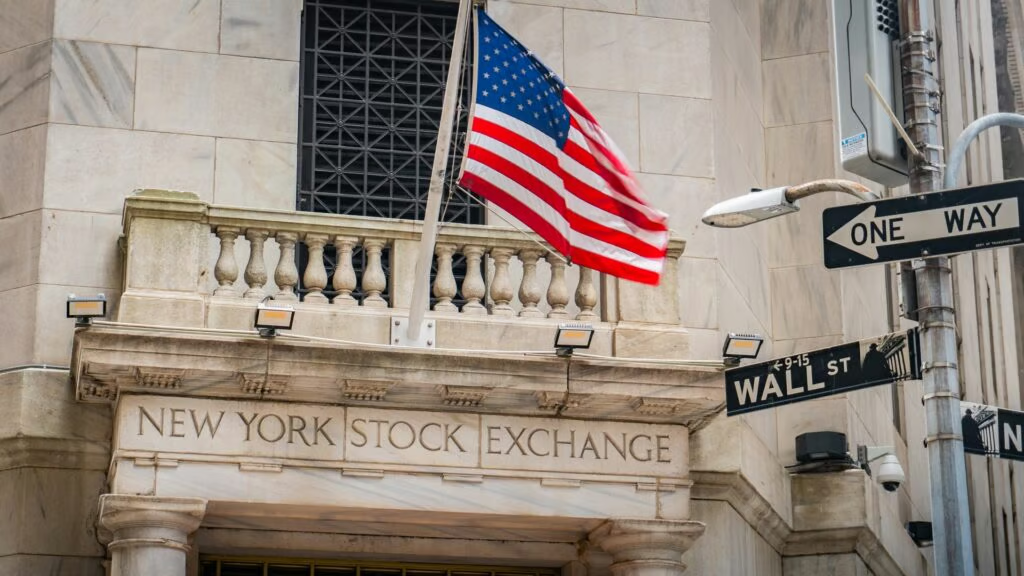
So, Goldman Sachs Group Inc. (GS) had a pretty good quarter—revenue up, earnings beating expectations, clients still eager for their services. But the stock? Down almost 4% on Monday. Because in finance, sometimes it’s not just about the numbers you post, but the warnings you issue while doing it.
Net revenue rose 14% year over year to $17.23 billion, topping the $16.97 billion consensus estimate. That was fueled by strength in Global Banking & Markets, where revenue jumped 19% to $12.74 billion. Investment banking fees soared 48%, and equity revenue hit a record $5.33 billion, up 27%. Net interest income climbed to $3.56 billion from $2.90 billion a year earlier. Earnings per share came in at $17.55, up from $14.12 and beating the $16.30 estimate. Not too shabby.
But operating expenses also rose 14% to $10.43 billion, thanks to higher transaction costs and compensation. And fixed income, currencies, and commodities revenue? Down 10% to $4.01 billion, dragged by weaker interest rate trading and mortgages. So, mixed bag on the segment front.
CEO David Solomon said the firm delivered strong results despite rising market volatility, highlighting “continued client demand” for execution and advisory work. He added that disciplined risk management is critical amid ongoing geopolitical uncertainty. Which brings us to the inflation warning.
During the earnings call, Solomon noted that investment banking activity remains “incredibly robust,” especially in M&A, but IPO activity slowed in March amid heightened geopolitical uncertainty tied to the Middle East conflict. He said prolonged tensions could add pressure to inflation in the second and third quarters, while CEOs are closely watching the impact of commodity prices on the broader economy. Market volatility has weighed on sentiment, he added, prompting clients to actively reposition portfolios. While IPO and sponsor activity were tempered, he expects dealmaking to rebound once conditions stabilize.
On the capital side, provision for credit losses totaled $315 million, up from $287 million a year earlier. The firm’s efficiency ratio improved slightly to 60.5% from 60.6%. The standardized CET1 capital ratio stood at 12.5%, while the advanced CET1 ratio was 13.4%. Assets under supervision reached a record $3.65 trillion.
Goldman returned $6.38 billion to shareholders during the quarter, including $5.00 billion in share repurchases and $1.38 billion in dividends. On April 10, the board declared a quarterly dividend of $4.50 per share, payable June 29 to shareholders of record as of June 1.
Strategy-wise, Solomon remains optimistic about private credit, highlighting lender-friendly spreads and a significant runway to scale the business toward its $300 billion target. He also said regulatory reforms are moving in a positive direction for the banking system. Separately, Goldman is increasing investments in cybersecurity and infrastructure resilience, including collaboration with Anthropic and other vendors.
CFO Denis Coleman said the bank is accelerating spending on cloud migration and data capabilities, while continuing to balance client-focused capital deployment with shareholder returns.
In the end, Goldman’s quarter shows a firm executing well in a tricky environment—but Solomon’s inflation caution and the stock drop remind us that on Wall Street, the future often speaks louder than the past.