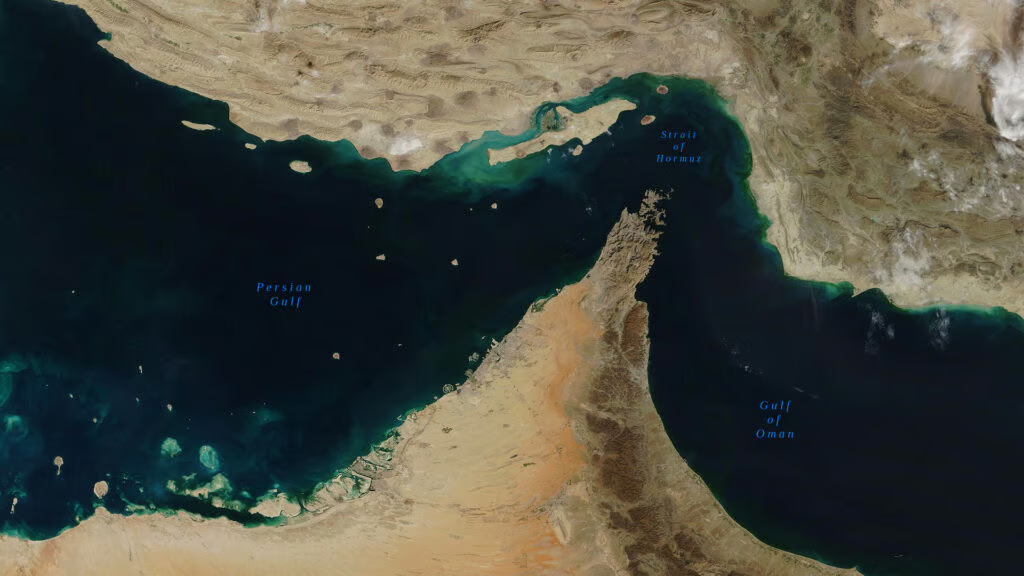
So here's what happens when you try to solve one of the world's most delicate diplomatic puzzles in a single marathon session: sometimes you just run out of time, and sometimes you run out of common ground. U.S.-Iran nuclear negotiations ended without an agreement in Islamabad on Sunday after 21 hours of talks, which is basically the diplomatic equivalent of an all-nighter. The result? More uncertainty over a fragile ceasefire and rising tensions in the Strait of Hormuz, which is a pretty important shipping lane for, you know, global oil.
Vice President JD Vance said American negotiators were packing up and leaving Pakistan after failing to secure a deal, making it clear that Washington wasn't going to budge on what it considers non-negotiable. "The bad news is that we have not reached an agreement, and I think that's bad news for Iran much more than it's bad news for the United States of America," Vance told reporters shortly before his departure, according to Reuters. "So we go back to the United States having not come to an agreement. We've made very clear what our red lines are."
What are those red lines? Vance spelled it out: the U.S. requires "an affirmative commitment that they will not seek a nuclear weapon," and that Iran must not pursue "the tools that would enable them to quickly achieve a nuclear weapon." He added, "That is the core goal of the president of the United States, and that's what we've tried to achieve through these negotiations." In other words, the U.S. came to the table with a very specific shopping list, and it left with an empty cart.
On the other side, Iran pointed the finger at what it called "excessive" demands from the U.S., according to a report by the country's semi-official Tasnim news agency. The agency said the Iranian delegation, which included senior officials like Parliament Speaker Mohammad Baqer Qalibaf and Foreign Minister Seyed Abbas Araqchi, defended national rights during the negotiations. It reported that Iran rejected U.S. efforts to advance demands related to the Strait of Hormuz and nuclear materials, and despite Iranian proposals for a common framework, the U.S. position stayed firm, leading to a dead end.
Meanwhile, President Donald Trump had already set the tone before the talks even wrapped up. On Saturday, he said negotiations with Iran were ongoing but insisted the outcome didn't change the U.S. position. "We've totally defeated that country… let's see what happens, we win… Maybe they make a deal, maybe they don't. Doesn't matter." He doubled down, claiming, "We win regardless. We've defeated them militarily… Their navy is gone," and added, "whether we make a deal or not makes no difference to me." So, from the U.S. perspective, this might feel like a high-stakes poker game where one player is already counting their chips before the cards are even dealt.
What does all this mean? Well, when talks collapse after a 21-hour sprint, it's usually a sign that the gaps were too wide to bridge, at least for now. The U.S. is sticking to its guns—literally and figuratively—on nuclear non-proliferation, while Iran sees the demands as overreach. And with Trump's comments framing the U.S. as militarily dominant regardless of diplomacy, the whole episode feels less like a negotiation and more like an ultimatum that didn't land. For investors and markets, this kind of geopolitical friction around key oil chokepoints like the Strait of Hormuz is the kind of thing that keeps energy traders up at night, wondering if the next headline will be about tankers or treaties.