Here's a funny thing about investing in geopolitical risk: sometimes the most direct play isn't a defense contractor or a cybersecurity firm. It's a tanker. Specifically, a tanker ETF that's up around 615% this year because global freight rates have tripled and the world's shipping lanes are looking more like a geopolitical obstacle course.
The star of this show is the Breakwave Tanker Shipping ETF (BWET), which tracks freight futures, not stocks. It's basically a bet on what it costs to move oil across oceans. And right now, that cost is going through the roof. According to reports, global freight rates are three times higher than they were at the start of the year. On the key U.S. Gulf to China route, the rate per barrel has skyrocketed from about $4.60 to $15. Oh, and if you want to insure your ship against war risks these days? That'll be 3% of the vessel's total value, please.
So what's going on? It's the classic supply and demand story, but with a heavy dose of geopolitics. Disruption across major maritime chokepoints is tightening global supply. When routes get longer (because you have to avoid certain areas), cargo availability shrinks, and risk premiums surge, freight rates spike. And BWET moves almost in lockstep with those rates.
Freight Markets in Overdrive
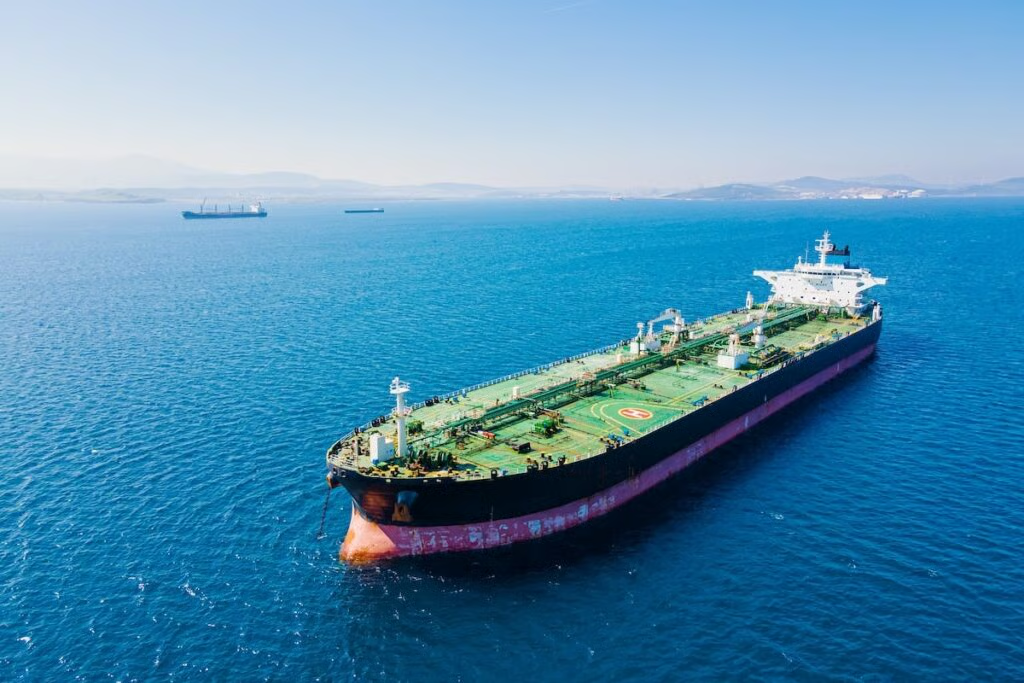
Let's talk about the numbers, because they're kind of absurd. Earnings for tankers are at historic highs. Very Large Crude Carriers (VLCCs) are pulling in around $135,700 per day. Some specific fixtures are even hitting $700,000. Suezmax and Aframax tankers are also fetching over $120,000 daily. This isn't just a good market; it's a market screaming that global trade is getting more expensive, more complicated, and a lot riskier.
Shipping Companies Catch a Wave
It's not just the freight futures that are benefiting. The actual shipping companies are seeing their margins expand, though not as explosively as the spot rates might suggest. The SonicShares Global Shipping ETF (BOAT), which holds stocks of shipping firms, is up about 30% year-to-date. Its holdings, like Frontline Plc (FRO) and Mitsui OSK Lines Ltd (MSLOY), are enjoying improved pricing power. When voyages are longer and supply chains are less predictable, the people who own the boats get to charge more.
The Big Picture: Friction is the New Normal
This isn't just a temporary spike. The broader context is a fundamental change in global shipping. Crude flows from the Middle East are affected. Shipping cargo across oil, LNG, and LPG markets is constrained. The old idea of cheap, efficient, and predictable global shipping is breaking down. Shipping is no longer just a simple function of economic demand; it's increasingly dictated by geopolitical risk.
From an investment standpoint, that's a major shift. ETFs like BWET have become real-time gauges of global friction. Equity-focused ETFs like BOAT offer a different kind of exposure—less direct than freight futures, but a play on sustained pricing power for the companies.
If these trends hold—and there's little reason to think the world is getting less complicated—shipping ETFs might graduate from being niche, cyclical plays to becoming core tools for anyone trying to navigate a more fragmented and volatile global economy. After all, when the cost of moving stuff triples, it's probably telling you something important.






.jpeg)