Wall Street took a breather on Monday, stepping back from last week's record-breaking rally. The S&P 500 and Nasdaq 100 each slid around half a percent, a modest pullback that felt a lot like the market catching its breath after a sprint. The reason for the pause? A turbulent weekend that saw U.S.-Iran tensions flare up again, sending oil prices surging more than 6% and reminding everyone just how fragile the recent Middle East ceasefire really is.
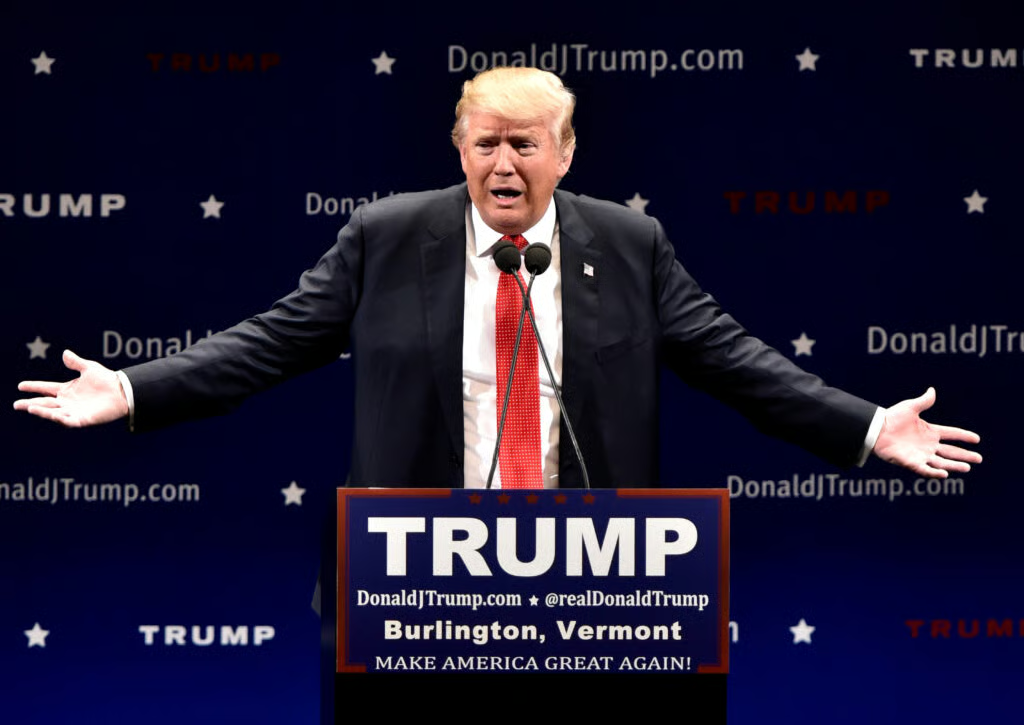
Over the weekend, the U.S. Navy seized the Iranian cargo ship TOUSKA in the Gulf of Oman. That move was followed by President Donald Trump signaling that it's "highly unlikely" he'll extend the ceasefire with Iran, which is set to expire on Tuesday. So, just like that, the geopolitical risk premium is back in the oil market.
West Texas Intermediate crude rallied 6% to $88.91 per barrel. That's a sharp rebound from Friday's 12.8% slump, which had been driven by hopes for a lasting peace. It turns out those hopes might have been a bit premature.
By midday Monday, the market's losses were concentrated in the megacap tech names, while small caps actually managed to buck the trend. The S&P 500 fell 0.4% to 7,096, the Dow Jones Industrial Average slipped 0.2% (about 114 points) to 49,333, and the Nasdaq 100 dropped 0.6% to 26,507. Within the so-called Magnificent Seven, Meta Platforms Inc. (META) slid 2.3% and Tesla Inc. (TSLA) fell 2% ahead of its earnings report later this week. Meanwhile, the Russell 2000 extended its recent outperformance, rising 0.3% to 2,786.
Interestingly, Treasury markets were pretty quiet despite the geopolitical flare-up. The 10-year Treasury yield hovered around 4.25%, little changed and still close to one-month lows. It seems bond traders weren't as spooked by the headlines as equity investors were.
Monday's Performance In Major U.S. Indices
| Index | Last | % Change |
|---|
| S&P 500 | 7,096 | -0.4% |
| Dow Jones | 49,333 | -0.2% |
| Nasdaq 100 | 26,507 | -0.6% |
| Russell 2000 | 2,786 | +0.3% |
Updated by 12:30 a.m. ET
Looking at the major ETFs that track these indices: the Vanguard S&P 500 ETF (VOO) fell 0.4%, the SPDR Dow Jones Industrial Average ETF Trust (DIA) slid 0.2%, the Invesco QQQ Trust (QQQ) dropped 0.6%, and the iShares Russell 2000 ETF (IWM) rose 0.3%.
Homebuilders and Oil Drillers Lead As Tech and Airlines Slide
At the sector level, it was a classic "risk-on, risk-off" kind of day, except the risks were all about oil prices and geopolitics. The Materials Select Sector SPDR Fund (XLB) led the tape with a 0.8% gain, followed closely by the Energy Select Sector SPDR Fund (XLE), which rose 0.7% on crude's rebound. When oil jumps, energy stocks tend to follow.
On the losing side, the Consumer Discretionary Select Sector SPDR Fund (XLY) was the worst performer, down 0.9%. It was weighed down by Tesla and Amazon.com Inc. (AMZN). The Utilities Select Sector SPDR Fund (XLU) dropped 0.054%, and the Health Care Select Sector SPDR Fund (XLV) slipped 0.5%.
Drilling down to specific industries (pun intended), the iShares U.S. Home Construction ETF (ITB) jumped 1.4% — making it the day's top mover — followed by the SPDR S&P Oil & Gas Exploration & Production ETF (XOP), which added 0.9%, buoyed by the oil rally.
On the losing side, the VanEck Gold Miners ETF (GDX) slid 1.6% alongside weaker bullion prices, the U.S. Global Jets ETF (JETS) fell 1.5% as higher jet fuel prices pressured airline carriers, and the VanEck Semiconductor ETF (SMH) dropped 0.5%.
Airlines and cruise operators — which had strongly rallied just last Friday on peace hopes — got hit hard by the oil spike. American Airlines Group Inc. (AAL) fell 4.7%, while Norwegian Cruise Line Holdings Ltd. (NCLH) slid 4.6% and Royal Caribbean Cruises Ltd. (RCL) traded lower. When fuel costs go up, transportation stocks tend to go down. It's a pretty straightforward relationship.
Chip names were mixed: Intel Corp. (INTC) dropped 3.7% ahead of its earnings report this week, and Micron Technology Inc. (MU) shed 2.8%. Netflix Inc. (NFLX) slipped 3.6%, deepening the sell-off after last week's negative performance following its earnings report.
In notable corporate movers, TopBuild Corp. (BLD) was the top Russell 1000 gainer, surging more than 17% after QXO Inc. (QXO) announced late Sunday it will acquire the insulation and building products installer in a $17 billion cash-and-stock deal. The offer values TopBuild at $505 per share — a 23% premium to Friday's close. On the flip side, the acquirer took a hit: QXO slid roughly 6% on concerns about dilution and integration risk, landing as one of the session's biggest Russell 1000 losers. That's the M&A trade in a nutshell — the target pops, the acquirer often drops.
Elsewhere, Avis Budget Group Inc. (CAR) added 7.2%, extending a blistering rally that has pushed the stock up roughly fourfold in recent weeks. The driver behind this move? Ongoing TSA staffing disruptions at U.S. airports continue to funnel travelers into rental cars. When air travel gets messy, car rental companies clean up.
Monday's Russell 1000 Top Gainers
| Name | % change |
|---|
| TopBuild Corp. | +17.40% |
| Avis Budget Group, Inc. | +7.16% |
| GLOBALFOUNDRIES Inc. (GFS) | +7.12% |
| WillScot Holdings Corporation (WSC) | +6.81% |
| Sirius XM Holdings Inc. (SIRI) | +5.88% |
Monday's Russell 1000 Top Losers
| Name | % change |
|---|
| Fermi Inc. (FRMI) | -21.45% |
| AST SpaceMobile, Inc. (ASTS) | -7.65% |
| QXO, Inc. | -6.05% |
| Lucid Group, Inc. (LCID) | -5.99% |
| NRG Energy, Inc. (NRG) | -5.05% |
So there you have it. A day where geopolitics reminded everyone they're still in the driver's seat, oil prices jumped on supply concerns, and the stock market took a modest step back. The big question now is what happens when that Iran ceasefire officially expires tomorrow. Will the tensions escalate further, or will cooler heads prevail? For now, traders are watching the headlines and the price of crude.