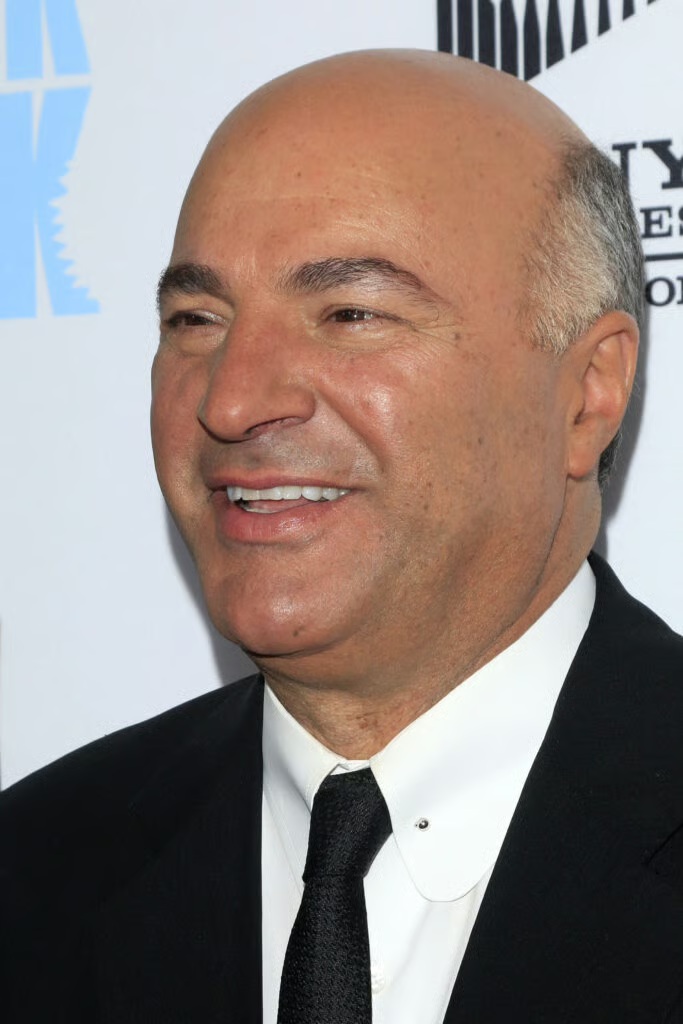
Here's a simple way to think about it: if your business is still treating artificial intelligence like a fancy new gadget you might get around to trying someday, you're already losing. That's the blunt message from investor Kevin O'Leary, who says the jump from weeklong execution cycles to near-instant output is being driven by AI. Companies that haven't made the shift are watching their rivals pull ahead.
O'Leary's comments, shared in a post on X, echo a broader theme he's been hitting: every company he's involved with is now using AI for content, advertising, and customer acquisition. The reason is straightforward—it lowers spending while cranking up creative output. He says he's applying AI tools across core workstreams, including finance and marketing, and even in his personal photography. The shift is a step-change in speed; tasks that used to drag on can now be wrapped up in seconds.
AI Adoption: Not a Project, a Necessity
That urgency matches how O'Leary describes AI inside the companies he backs. The tools are used to compress timelines and slash the overhead tied to producing marketing assets. AI is deployed directly in ad creation and customer acquisition, turning work that once required bigger teams and longer lead times into faster, tighter cycles.
He points to a practical playbook: use AI to draft and generate the raw material, then have people step in to refine the final output so it fits the tight constraints of, say, a short-form ad. The advantage isn't just speed; it's lower production and creative costs paired with sharper copy.
He describes startups in his orbit as licensing multiple AI "stacks" available on the market and leaning on them for social media execution—writing and producing commercials and video content. The goal, as he tells it, is measurable performance in customer acquisition, not experimentation for its own sake.
Opting Out Means Handing the Advantage to Rivals
In his post, O'Leary drew a hard line. He warned that opting out of AI adoption effectively hands the advantage to competitors. He also positioned AI as something that belongs in day-to-day operations, not as a siloed tech project that the IT department handles.
Beyond marketing, he says AI is showing up in customer management workflows and is spreading across industries, including real estate. That broader rollout fits his claim that AI is now embedded across business functions, not limited to creative tasks.
O'Leary also ties the shift to new career economics. He argues AI is expanding what young creatives and entrepreneurs can do without traditional, engineering-heavy builds. He cites the rise of social media storytellers who can use AI-driven production to attract customers and, in some cases, earn as much as $500,000 a year based on results.
The Cash-Over-Equity Philosophy
This focus on operational efficiency and immediate results lines up neatly with another of O'Leary's recent assertions: that true wealth should be measured in cash rather than home equity. He emphasizes liquidity's role in entrepreneurial success. In a post on X, he stated that founders should consider taking buyouts when opportunities arise, viewing the individual behind the company as more valuable than the business itself—a perspective he believes fosters quicker decision-making and execution.
O'Leary's emphasis on cash, specifically targeting a liquidity benchmark of $5 million, illustrates his belief that having cash on hand provides the flexibility to pursue new ventures without being tied down by illiquid assets. This strategic approach complements his broader message about integrating AI into daily operations. Both strategies aim to enhance operational performance and decision-making speed.
Transforming Marketing and Closing the Implementation Gap
He notes that the marketing budget line items where companies spend heavily—ads and customer acquisition—are exactly where AI can change the math. In his telling, entry-level creators who can prove performance on platforms like TikTok, Instagram, and LinkedIn can be paid far beyond standard salary bands.
O'Leary has urged would-be founders to focus on the implementation gap. He argues many small businesses want AI but don't have the know-how to deploy it effectively. He's also flagged data center development as another area he considers attractive as AI usage grows.
So, the takeaway from O'Leary is pretty clear. AI isn't a future trend to watch; it's a present-day tool that's reshaping how work gets done, how money is made, and what it means to be competitive. Treating it as anything less than essential, he suggests, is a fast track to getting left behind.