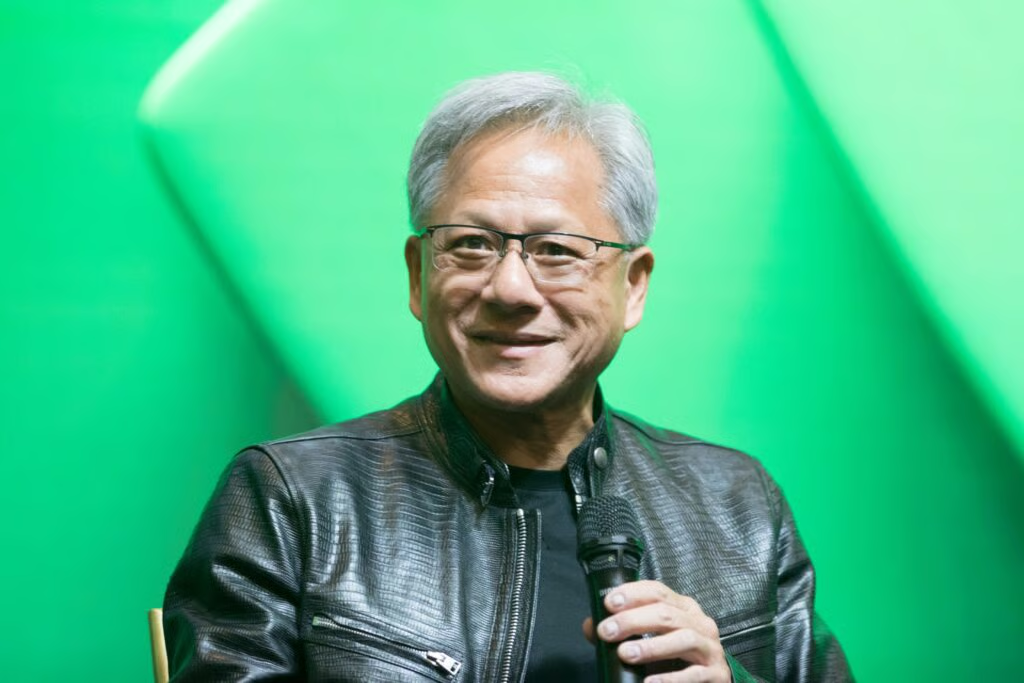
So, you think Nvidia's AI hardware is becoming a commodity? Jensen Huang would like a word. In a podcast posted Wednesday with Dwarkesh Patel, the CEO of Nvidia Corp (NVDA) dismissed that entire notion. He described the company's core mission as an "incredible journey" of transforming electrons into valuable digital tokens.
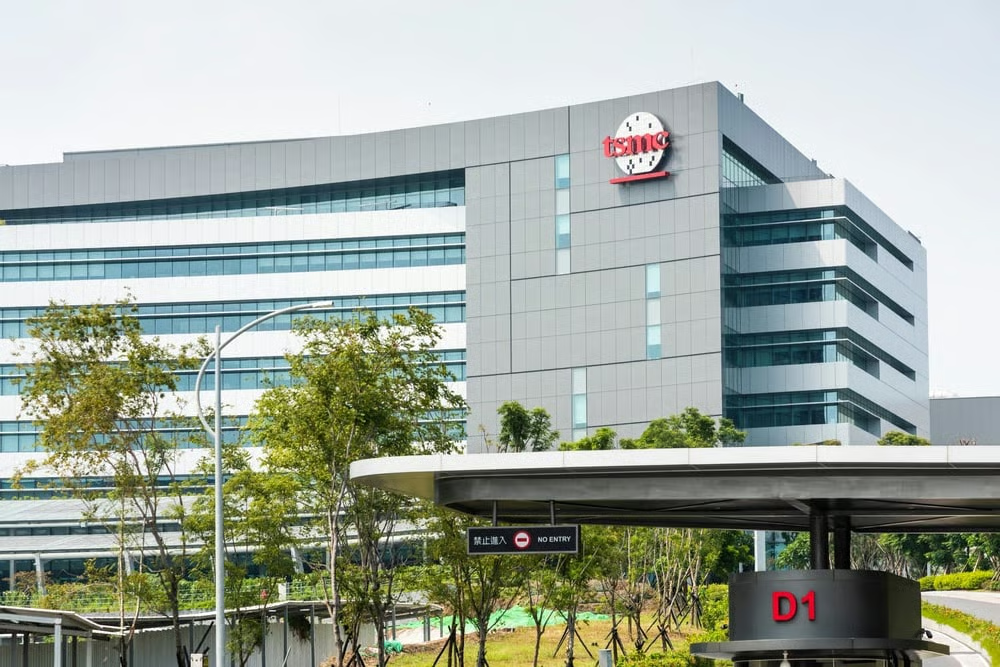
"The amount of artistry, engineering, science, and invention that goes into making that token valuable… is far from deeply understood," Huang stated. He also pushed back against the simpler idea that Nvidia is just a software company using Taiwan Semiconductor Manufacturing Co (TSM) as a middleman. It's more complicated than that.
The ‘Insanely Hard' Five-Layer Cake
Huang framed the challenge with a tasty metaphor: AI is a "five-layer cake," and Nvidia operates across every single level. Sure, the company partners with upstream suppliers like Micron Technology Inc (MU) and SK Hynix for things like High Bandwidth Memory. But Huang insists the parts Nvidia itself handles are, in his words, "insanely hard."
The TPU Challenge and the ‘Winner' Mindset
The conversation naturally turned to competition, specifically the threat from custom Application-Specific Integrated Circuits (ASICs) and Alphabet Inc's (GOOGL) Tensor Processing Units (TPUs). Huang argued that Nvidia's versatility and its efficiency in "tokens per watt" keep it firmly in the lead. He rejected the premise that Nvidia might lose its grip on major markets or developers.
His rebuttal was characteristically direct. "You're not talking to somebody who woke up a loser. That loser attitude, that loser premise makes no sense to me. We're not a car. We are not a car," Huang told Patel. He explained that, unlike cars—which you can easily swap for another model—entire computing ecosystems are "hard to replace."
Supply Chain Reach and TCO Advantage
Nvidia's competitive moat isn't just technical; it's also logistical. Patel cited reports that Nvidia has nearly $100 billion in purchase commitments with foundries and packaging partners. Huang confirmed that these massive investments allow the company to "build for a future" at a trillion-dollar scale.
Finally, Huang made a bold claim about cost. He stated that Nvidia's Total Cost of Ownership (TCO) remains unbeaten. "Nobody can demonstrate to me that any single platform in the world today has a better performance-TCO ratio. Not one company," he said, openly challenging competitors to prove their cost advantages on public benchmarks.
In early trading Thursday, Nvidia shares were down 0.50% at $197.87.