So here's the thing about sounding the alarm about "world war" – people tend to think you mean actual shooting. Ray Dalio, the founder of Bridgewater Associates (BRG), wants to make sure you know that's not what he meant.
On Wednesday, Dalio clarified that his recent warnings about a "world war" were not a prediction of imminent, direct combat between the United States and China. Instead, he was describing a much broader, messier struggle that spans economics, technology, cyber conflict, and geopolitics. Think of it as a cold war that's gotten a lot hotter in every arena except the literal battlefield.
Dalio Reframes the 'World War' Warning
In a post on X, Dalio wrote, "To be clear, I didn't mean to convey that I expect a shooting war between the U.S. and China (or any of the great powers) anytime soon." He added that the world is in a specific phase of his "Big Cycle" theory, where major-power conflicts are increasingly interconnected. Today's various wars and tensions, in his view, are all part of one larger global confrontation.
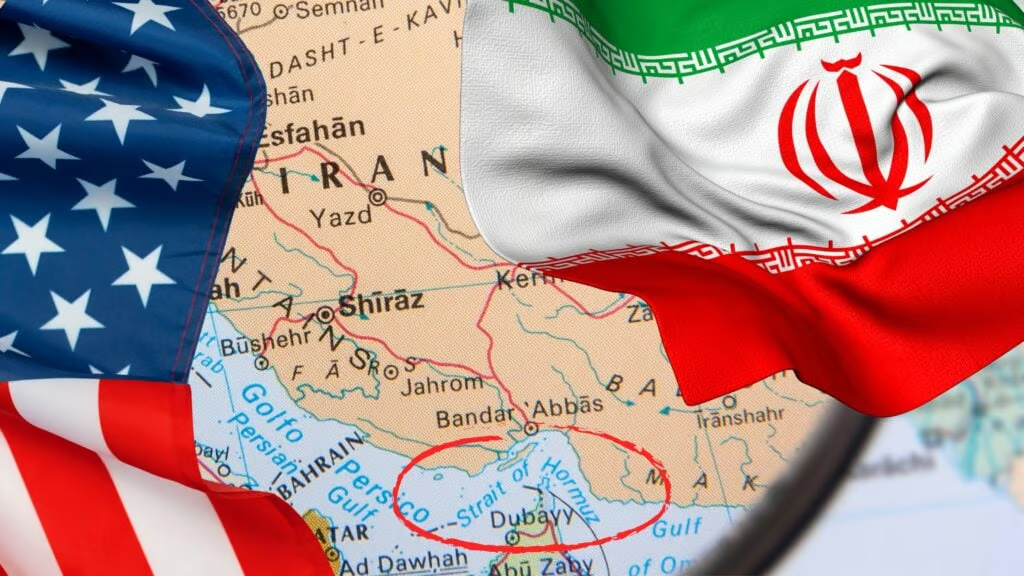
He gave an example to explain the domino effect he sees. If Washington fails to secure free shipping through the Strait of Hormuz and protect its Gulf allies, countries in Asia and elsewhere might start to doubt U.S. strength. That could push them to lean more toward China, both economically and strategically. But a direct U.S.-China war? Dalio argues that's unlikely in the near term because both sides know it would be ruinous, difficult to win decisively, and they both have plenty of pressing domestic problems to deal with.
Brinkmanship Replaces Direct Great Power Combat
So if not a shooting war, then what? Dalio warns of intensifying "brinkmanship." Both powers are pressing each other through every other means available: trade wars, capital controls, technology battles, cyber operations, and influence campaigns. He sees the old rules-based multilateral order breaking down and being replaced by a more raw, power-driven system where everyone is testing limits.
This clarification came after some blowback to an April 7 note he published titled, "We Are In A World War That Isn't Going To End Anytime Soon." In that note, Dalio argued that the U.S.-Israel-Iran conflict was just one front in a wider struggle involving blocs led by Washington on one side and countries like China, Russia, and Iran on the other. He pointed to historical patterns where world wars emerge not from a single spark, but from a series of smaller conflicts that become increasingly linked over time.
New Remarks Land Amid Broader Tensions
Dalio's comments didn't happen in a vacuum. They landed on a day when other world leaders were also making waves. President Donald Trump told Fox Business anchor Maria Bartiromo that the U.S.-Iran war was "very close to being over," even though negotiations haven't resumed and maritime tensions remain dangerously high around the blocked Strait of Hormuz – the very chokepoint Dalio used in his example.
Meanwhile, on the other side of the geopolitical chessboard, Chinese President Xi Jinping told Spanish Prime Minister Pedro Sanchez that the international order was "crumbling into disarray." Beijing has also condemned the U.S. blockade of Iranian ports as "dangerous and irresponsible."
So, to sum up Dalio's view: Don't look for tanks rolling across borders. Look for the pressure to build everywhere else. The war is already on; it's just being fought with different weapons. The goal isn't necessarily to destroy the other side's army, but to undermine its economy, outpace its technology, and convince the rest of the world to pick your team. It's a high-stakes game of chicken where the collision might be economic rather than military, but the consequences could be just as world-altering.