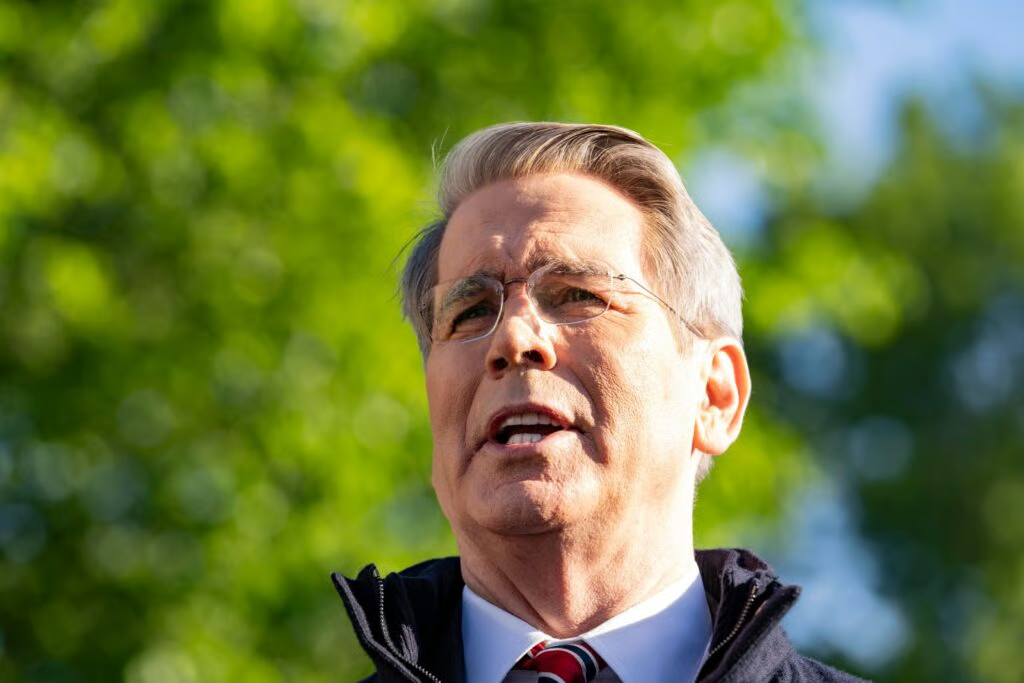
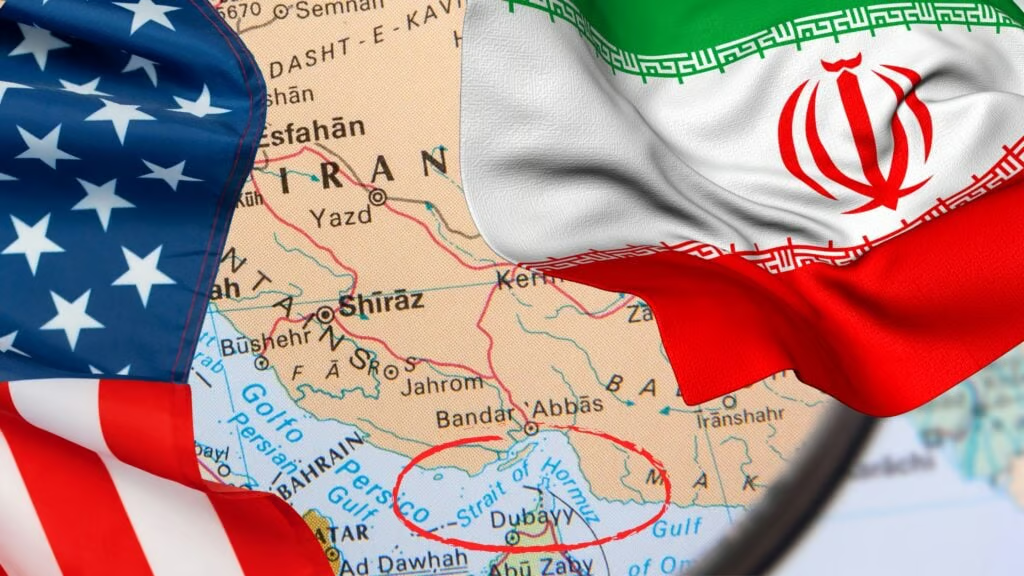
Here's a thing about going to war: it's probably easier to do when your economy is humming along nicely. At least that's what Treasury Secretary Scott Bessent suggested Wednesday when he defended the U.S. decision to go to war with Iran.
Speaking to CNBC's Sara Eisen, Bessent said the economy was in "such good shape" before the conflict, and that strong economic indicators were part of what influenced President Donald Trump's move. It's the financial version of "strike while the iron is hot"—or perhaps, "engage in military conflict while the GDP is growing."
But here's the catch: Bessent also warned that economic growth this quarter might "be slower than it was" because of the war. He didn't put a number on it, though. When asked about a GDP prediction, he said it would be "path dependent" and contingent on how long the fighting lasts. "I don't know whether it's three days or three weeks," he said. Which, in treasury secretary speak, translates to: "Your guess is as good as mine, but probably don't expect a boom quarter."
Bessent's approach to reading the economy is interesting. He said he leans on "micro data points" from companies and banks to build a broader perspective, rather than trying to forecast GDP with precision. He pointed to JPMorgan Chase (JPM) CEO Jamie Dimon's recent comments about consumer credit and cited corporate earnings as signs that consumers and businesses are still holding up. It's a bottom-up view: check the pieces, and maybe the whole picture will make sense.
This isn't the first time he's addressed the economic trade-offs of the war. On Tuesday, Bessent told the BBC that a "small bit of economic pain" is worthwhile for long-term global security. He also said he was "less concerned" about short-term forecasts. In other words: some quarterly GDP slippage might be the price of doing... geopolitical business.
The Great Economic Debate: War Spending vs. Consumer Weakness
While Bessent frames the pre-war economy as a strength, analysts are now debating what the war economy actually looks like. Tom Lee, head of research at Fundstrat, has a pretty straightforward theory: the war itself is propping things up. He argues that increased defense spending—potentially reaching $60 billion a month—is helping to offset the impact of rising oil prices, which are adding about $12 billion a month to household expenses. That spending, he says, is a key reason for the economy's resilience and the continued rise of stocks. It's the old military-industrial complex as economic stimulus playbook.
Not everyone is buying that narrative. Earlier this month, economist Mark Zandi warned that the U.S. economy was becoming fragile due to weakening consumer spending and rising geopolitical tensions. He noted that real consumer spending growth has been running at "barely 1% annualized" in recent months, while the personal saving rate has fallen to around 4%, a historically low level. That suggests households might be running on fumes, war spending or not.
Jamie Dimon, for his part, struck a more cautiously optimistic note. He said the economy remains resilient due to fiscal stimulus, deregulation, AI-driven investment, and Fed support. Still, he warned that rising geopolitical, energy, trade, fiscal, and valuation risks are making the outlook more uncertain. Which is a polite way of saying: "We've got some strengths, but also a lot of things that could go wrong."
So where does that leave us? Bessent says we went into this from a position of economic strength. The current quarter might be slower. Some analysts think war spending is a temporary cushion; others worry the consumer foundation is cracking. And the treasury secretary is mostly watching the micro data and hoping the conflict doesn't drag on too long. It's not the clearest economic picture, but then again, war rarely makes for simple math.