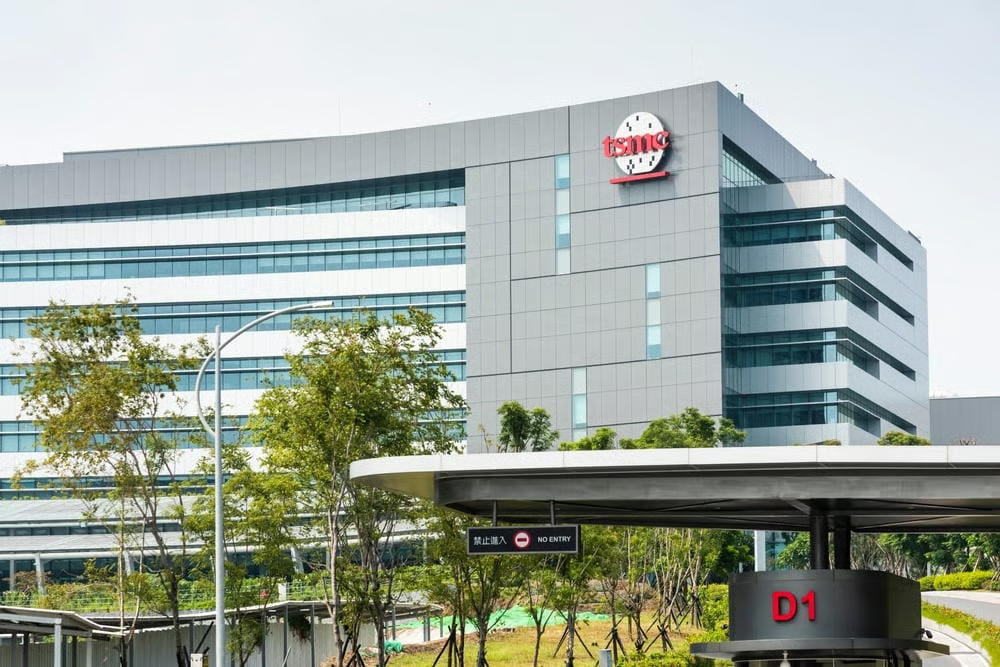
So here’s how you know the AI chip boom is real: when the company that makes the chips for everyone else is crushing it. On Thursday, Taiwan Semiconductor Manufacturing Co. (TSM)—the contract chipmaker that supplies NVIDIA Corp. (NVDA) with GPUs and Apple Inc. (AAPL) with processors—posted first-quarter results that beat forecasts and then raised its outlook for the next quarter. Because why not?
Revenue came in at $35.898 billion (or 1.13 trillion New Taiwan dollars, if you prefer), up 35.1% from a year ago and topping the analyst consensus estimate of $35.500 billion. In dollar terms, that’s a 40.6% year-over-year jump. Net income was 572.48 billion New Taiwan dollars, with earnings per share of 22.08 New Taiwan dollars ($3.49), beating the $3.31 consensus. The company also generated $22.1 million in operating cash flow and is sitting on $105.5 billion in cash and equivalents. Not too shabby.
But the real story is in the tech mix. Advanced 3-nm chips accounted for 25% of total revenue, 5-nm for 36%, and 7-nm for 13%. Put another way, 7-nm and more advanced technologies made up 74% of total wafer revenue. That’s the kind of product mix that lets you print money—or, in TSMC’s case, expand gross margins by 740 basis points to 66.2% and operating margins by 960 basis points to 58.1%.
And the company isn’t slowing down. It now expects capital expenditure to land at the higher end of its $52 billion to $56 billion range, reflecting what it calls "continued confidence in long-term AI demand." That spending aligns with an upgraded outlook of more than 30% annual revenue growth. Basically, TSMC is betting that demand will outpace supply for a while, and it’s putting its money where its mouth is.
On the earnings call, CEO C.C. Wei didn’t mince words. He said demand remains robust and customer feedback points to a "very positive outlook," reinforcing the company’s conviction in a "multi-year AI growth cycle." AI adoption, he noted, is driving higher computational needs, which boosts demand for leading-edge chips. Management emphasized that capacity will likely remain tight through 2027, which should support pricing and margins.
Of course, it’s not all smooth sailing. Executives flagged rising input costs, softer demand in price-sensitive consumer segments, and macro uncertainties tied to geopolitics. But none of that is expected to disrupt near-term operations. CFO Wendell Huang addressed supply concerns, saying Taiwan has secured sufficient liquefied natural gas supplies through at least May and that TSMC is sourcing specialty gases like helium and hydrogen from multiple regions, with no material impact expected on output.
Then came the competitive talk. Wei noted that customers like Intel Corp. (INTC) and Tesla, Inc. (TSLA) can also be rivals, but he emphasized that success in the foundry business depends on technology leadership, manufacturing excellence, and customer trust. "There are no shortcuts," he said, adding that building and ramping advanced fabs takes years. It was a subtle reminder that while everyone wants a piece of the AI pie, not everyone has TSMC’s decades of experience and scale.
Looking ahead, TSMC guided for second-quarter revenue of $39.00 billion to $40.20 billion, versus the $39.52 billion consensus estimate. It expects gross margins of 65.5% to 67.5% and operating profit margins of 56.5% to 58.5%. The board also approved a cash dividend of 6.00 New Taiwan dollars for the fourth quarter of 2025.
As for the stock, Taiwan Semiconductor shares were down 2.37% at $366.20 in premarket trading on Thursday, though they’re still approaching their 52-week high of $390.20. Sometimes even great news gets a muted reaction—but when you’re forecasting billions in revenue growth and talking about multi-year cycles, a little volatility probably doesn’t keep you up at night.