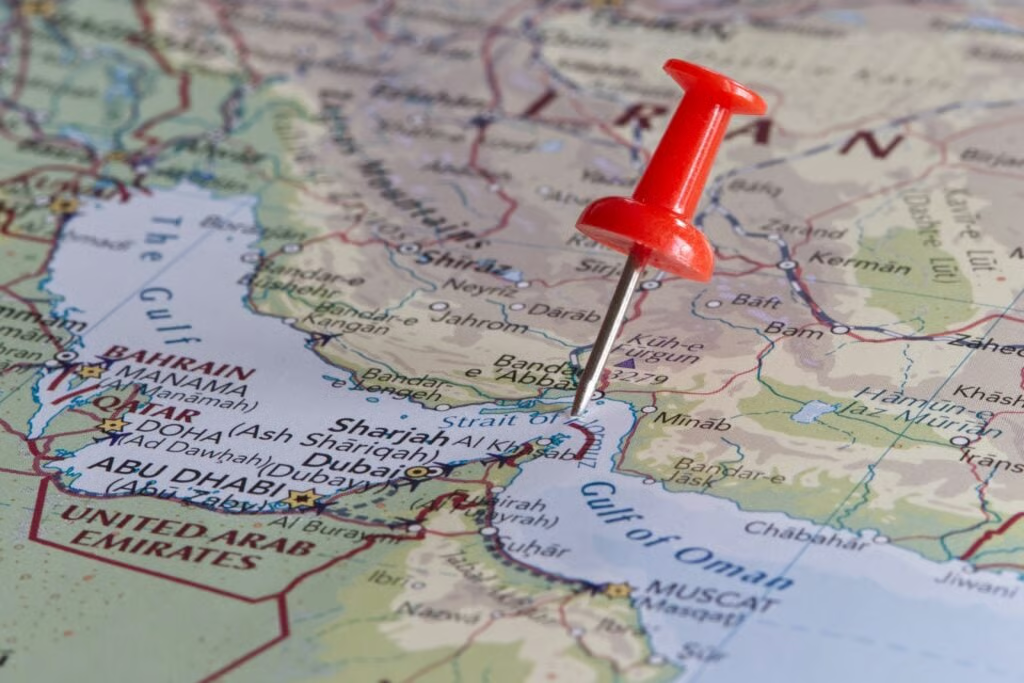
So, the Strait of Hormuz is open again. The sea mines are coming out. And according to President Donald Trump, Iran has agreed it will never close that critical waterway again. If you’re wondering what that means for your portfolio, well, the markets are already telling you: oil is down, stocks are up, and the Nasdaq is doing something it’s only done four other times in the last four decades.
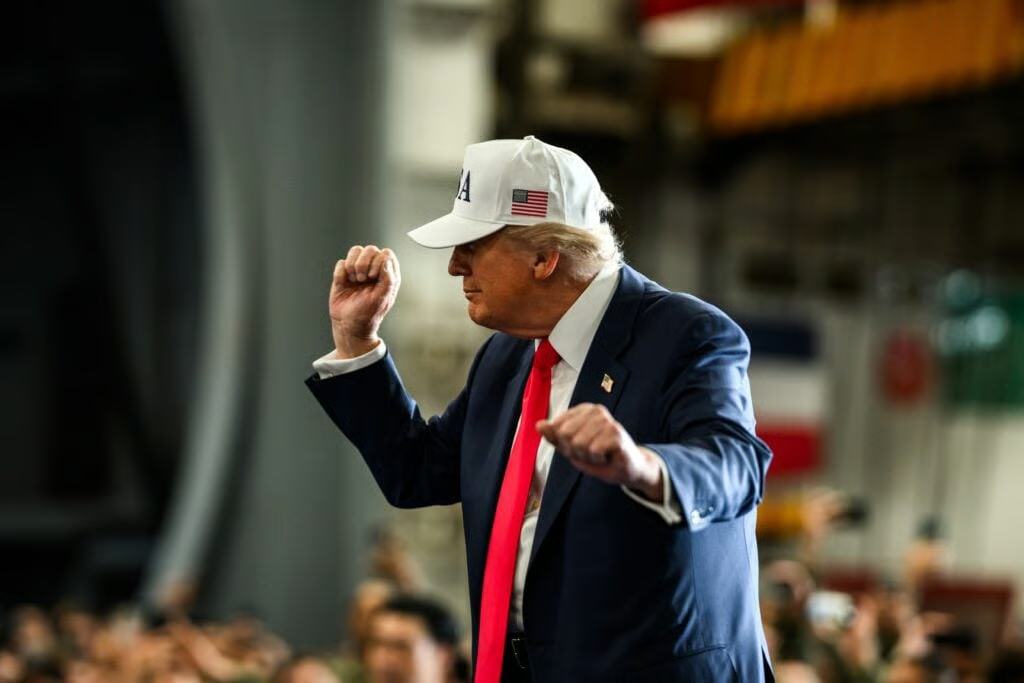
Trump delivered the news in a flurry of Truth Social posts Friday morning, just minutes after Iranian Foreign Minister Abbas Araghchi posted on X that all commercial vessels were free to transit the chokepoint for the duration of a ceasefire. Trump claimed credit for the opening, confirmed Iran was actively removing sea mines with U.S. assistance, and wrapped it up with what might be the most consequential line of the day: the strait would no longer be "used as a weapon against the world."
"A great and brilliant day for the world," Trump said. You can almost hear the market sighing in relief.
How This All Unfolded in 24 Hours
Here’s the quick backstory. On Thursday, Trump announced a 10-day ceasefire between Israel and Lebanon, brokered in Washington with Lebanese President Joseph Aoun and Israeli Prime Minister Benjamin Netanyahu. Trump highlighted that the two leaders had met for the first time in 34 years and added that this was his "10th war" solved. Less than a day later, the Hormuz front moved.
At 9:06 AM ET Friday, Trump wrote that Iran had announced the Strait is fully open. Araghchi had posted the same on X minutes earlier. Then things got even more interesting. Trump stated the U.S. would receive all nuclear material—the "dust" created by B2 bombers—and that no money would change hands. At 10:13 AM, he mentioned NATO, writing that after the Strait situation was resolved, he got a call from the alliance asking if help was needed. His response? Told them to stay away. "They were useless when needed, a Paper Tiger," he wrote.
Trump credited Saudi Arabia, UAE, Qatar, and Pakistan by name as essential partners and repeatedly insisted the Iran deal was independent of Lebanon. "Iran has agreed to never close the Strait of Hormuz again. It will no longer be used as a weapon against the world!," Trump stated. The final morning post at 10:58 a.m. shifted from diplomacy to media criticism, because some things never change.
How Markets Reacted: Oil Down, Everything Else Up
The sequence of events hit markets like a pressure release valve. Imagine a giant geopolitical knot suddenly coming undone—that’s what trading floors felt like Friday morning.
WTI crude fell 15% to around $80 a barrel as of 11 a.m. in New York. That puts crude more than $35 below its March highs. When a major oil chokepoint reopens, you don’t need a PhD in economics to guess what happens to oil prices.
Meanwhile, Wall Street pushed sharply higher across the board. The S&P 500 – as tracked by the SPDR S&P 500 ETF Trust (SPY) – rose 1.30% to 7,132, setting new record highs. The Dow Jones Industrial Average – as tracked by the SPDR Dow Jones Industrial Average ETF Trust (DIA) – surged 2.05%, adding 998 points to 49,577. The Russell 2000 – as tracked by the iShares Russell 2000 ETF (IWM) – rallied 2.2% to 2,780 points, also reaching new record highs.
But the real story is the Nasdaq 100 – as tracked by the Invesco QQQ Trust (QQQ) – which gained 1.31% to 26,677. That puts it on pace to close its 13th consecutive session of gains. Let that sink in: 13 days in a row. Since 1985, that’s only happened four other times. We’re now in the fifth.
The prior four episodes offer an interesting, if uneven, road map for what might come next. The signal on the one-month horizon is modestly positive—an average gain of 2.23% and a median of 2.61%—but deteriorates sharply at three and six months, with average returns of −4.33% and −4.41% respectively. The 12-month picture, however, recovers strongly, averaging +17.07% with a 100% win rate across all four prior episodes.
| Episodes of 13-Day Straight Gains | Move % | 1M % | 3M % | 6M % | 12M % |
|---|
| May 1990 | 8.74 | 5.14 | −10.19 | −17.84 | 15.80 |
| January 1992 | 15.51 | −1.45 | −8.79 | −13.74 | 5.85 |
| March 2010 | 6.15 | 3.70 | −4.10 | −0.14 | 19.03 |
| July 2013 | 6.40 | 1.52 | 5.75 | 14.09 | 27.62 |
| April 17, 2026 ★ | 11.03 | — | — | — | — |
| — Stats (excl. 2026) — |
| AVG | — | 2.23 | −4.33 | −4.41 | 17.07 |
| MEDIAN | — | 2.61 | −6.45 | −6.94 | 17.41 |
| WIN % | — | 75% | 25% | 25% | 100% |
Within the Nasdaq 100 on Friday, 85 of 102 components advanced. MicroStrategy Inc. (MSTR) led with a 14.55% gain. Shopify Inc. (SHOP) rose 4.66%, DoorDash Inc. (DASH) added 4.47%, and Marriott International Inc. (MAR) gained 4.19%.
On the losing side, Netflix Inc. (NFLX) fell 8.86% on earnings, and Diamondback Energy Inc. (FANG) dropped 8.52% as crude’s collapse hit energy exploration and production names across the index. When oil tanks, energy stocks tend to follow—no surprise there.
So there you have it. A geopolitical breakthrough, a historic market streak, and a whole lot of volatility packed into one morning. Whether this rally has legs or is just a sugar high from the Hormuz news remains to be seen, but for now, the bulls are firmly in charge.