Here's a funny thing about oil markets: sometimes the good news arrives just as everyone decides they don't really need it anymore.
On Sunday, Saudi Arabia announced that its East-West pipeline—the kingdom's crucial crude export artery—has been fully restored to its peak throughput of roughly 7 million barrels per day. This comes after the pipeline and other energy infrastructure took a hit during the ongoing conflict with Iran. The kingdom's energy ministry confirmed that everything is now back to regular functioning, according to a Reuters report.
This is, objectively, a big deal. Last week, the assessment was that the combined damage had knocked out about 600,000 barrels per day of production capacity and about 700,000 bpd of pipeline throughput. Getting that back online is a significant feat of engineering and logistics.
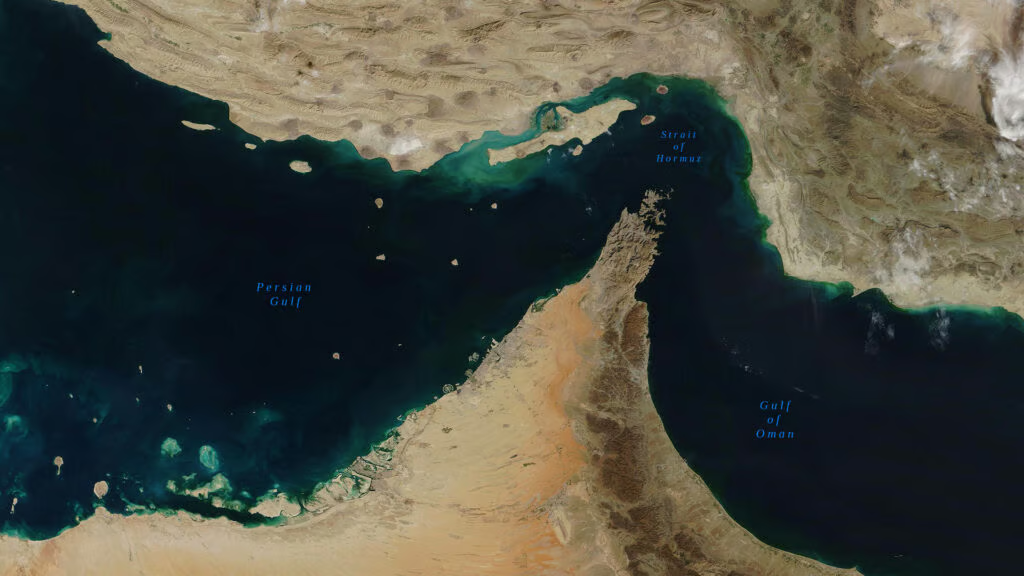
But the timing is everything. This restart lands just as oil is in freefall. Why? Because a U.S.-Iran ceasefire has been reached, and Iran has agreed to reopen the Strait of Hormuz. That single move helped unwind a massive geopolitical risk premium that had built up over five weeks of fighting. The result was a 15.9% one-day tumble in WTI crude and a 13.3% drop in Brent. It was the steepest single-session fall for WTI since April 2020.
So, Saudi Arabia fixed its pipeline just as the market decided the pipeline wasn't the problem anymore. The real problem—a closed Strait of Hormuz—seems to be going away. It's like finally fixing a leaky roof right as the storm clouds break and the sun comes out.
The Pipeline's Wild Week
To understand why this is a bit ironic, let's rewind to last Wednesday. The market mood was swinging between relief over the ceasefire and fresh caution. Why the caution? Because an early report surfaced about an attack on that very same East-West pipeline. It was a test for risk appetite even as peace headlines dominated.
That pipeline had effectively become Saudi Arabia's key crude export lifeline while the Strait of Hormuz was shut. And according to Reuters, it was attacked just hours after the ceasefire deal was reached. Talk about bad timing.
By midday in New York, the sharp drop in crude was pulling other assets along with it. The 10-year Treasury yield fell about three basis points to 4.27%, its lowest in roughly three weeks. Equities, however, reacted as if a giant weight had been lifted. The S&P 500 jumped 2.5% to 6,783. The Dow gained a whopping 1,298 points to 47,882. The Nasdaq 100 climbed 3.1% to 24,951, and the Russell 2000 added 3.1% as the 'risk-on' move spread to smaller companies.
The Saudi ministry also said it restored affected volumes from the Manifa oilfield, where output had been reduced by roughly 300,000 bpd. So, a lot of oil is coming back online, fast.
Who Wins, Who Loses When Oil Crashes?
When oil drops nearly 16% in a day, it creates some very clear winners and losers. Let's start with the losers.
The energy sector got hammered. The Energy Select Sector SPDR Fund (XLE) was down around 4%. Big oil names took it on the chin: Exxon Mobil (XOM) fell 6.1% to $153.92, ConocoPhillips (COP) dropped 6% to $123.92, and Chevron (CVX) slid 5.7% to $189.94. They were absorbing the crude selloff directly.
Now, the winners. First, think of anyone who buys a lot of fuel. Airlines soared. The U.S. Global Jets ETF (JETS) shot up 6.7% as investors repriced lower jet fuel costs. Delta Air Lines (DAL) had a particularly great day, jumping 12% after posting better-than-expected quarterly results—combining good company news with a fantastic sector-wide tailwind.
Tech stocks also led the charge. The VanEck Semiconductor ETF (SMH) rose 5.3%. Large-cap tech had a strong day: Alphabet (GOOGL) and Meta Platforms (META) each gained 3.7%. (Meta also introduced its first AI model from its superintelligence research group, for what that's worth.) NVIDIA (NVDA) gained 2.1% and Microsoft (MSFT) added 1.7%.
Why did tech do so well? Two reasons tied directly to the oil crash. First, lower energy costs ease inflation fears. Second, those easing fears change what people think the Federal Reserve might do. Markets started pricing in about a 35% chance of a rate cut by year-end, versus near-zero odds at the start of the week. When the outlook for interest rates improves, money often flows into growth sectors like tech, industrials, and consumer discretionary stocks. They're the classic beneficiaries when fuel costs and bond yields fall together.
Not Everything Is Fixed (and Tensions Are Still High)
Before we declare the oil crisis over, it's worth noting that Saudi officials said work is still underway to fully bring the Khurais facility back online. Strikes there had lowered its capacity by another 300,000 bpd.
More importantly, the geopolitical backdrop hasn't suddenly become peaceful. This situation unfolds amid seriously escalating tensions. Iran's foreign minister, Abbas Araghchi, recently urged Saudi Arabia to expel U.S. forces, claiming it was "high time" to remove what he called "enemy aggressors." This followed an Iranian strike on a major American air base in Saudi Arabia last week that injured 12 U.S. service members.
So, just as Saudi Arabia gets its pipeline running again, the regional instability that threatened it is still very much present. The U.S.-Saudi security partnership is facing new, loud challenges from Iran. This underlines the complex game surrounding oil supply stability. The market might be breathing a sigh of relief today, but the underlying tensions that can spike prices haven't gone away. They've just been paused.
The full pipeline restoration adds to the supply-side signals that helped cool inflation fears during last Wednesday's wild cross-asset swing. But in the energy sector, traders are now facing a new kind of volatility: the volatility of peace, repair, and the uneasy calm that follows a storm.