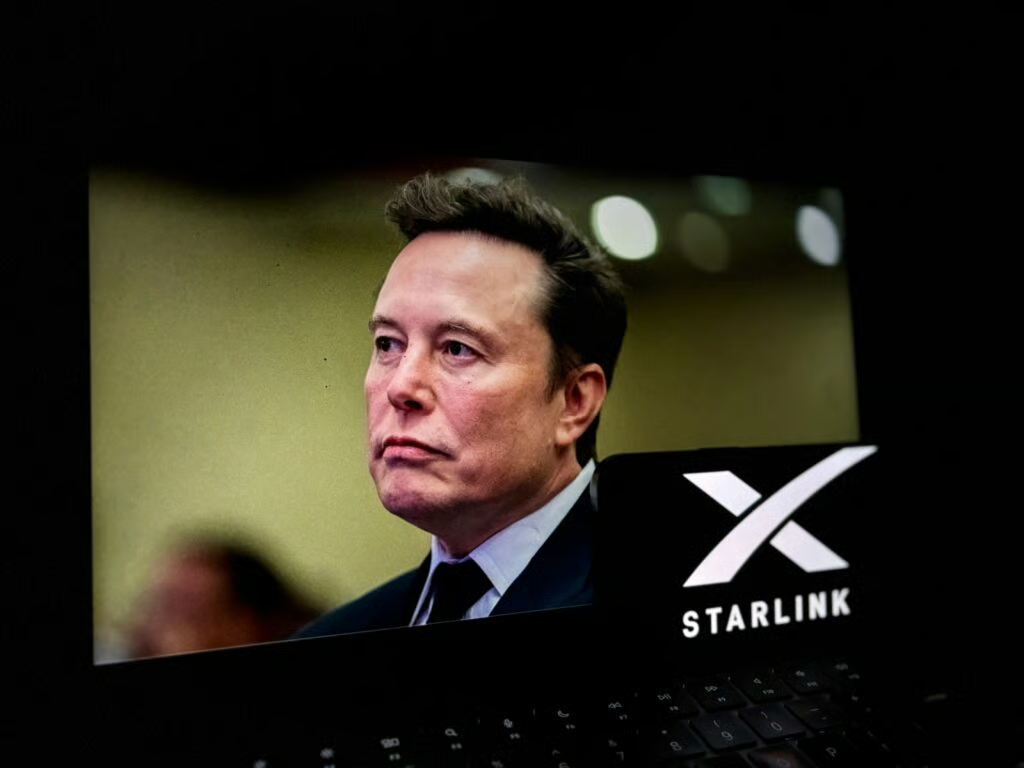
Here's a story about satellite internet, racial politics, and why some things that look impossible sometimes aren't. Elon Musk says South Africa won't give Starlink a license because he's not Black. This is awkward because, as Musk points out, he was born there. In a post on X, he wrote that South Africa "won't allow Starlink to be licensed" and tied the refusal to race. He also said he was repeatedly offered a path to approval that involved misrepresenting who controls a local Starlink entity, which he rejected.
Musk framed it as a matter of principle, arguing that discrimination shouldn't be incentivized no matter who it targets. He also went after South African politicians, telling people to ostracize officials he called racists. It's a sharp accusation, especially since Starlink has become a go-to connectivity option in many markets. Musk's suggestion is that South Africa is an exception for political reasons, not technical or demand ones—and that contrast is sharper because of his personal ties to the country.
Meanwhile, venture capitalist Marc Andreessen has been making the case that Starlink's rise is a big deal that people aren't fully appreciating. He says it's a technological win that actually worked where satellite internet kept failing before. Think back to Motorola's Iridium or the Teledesic venture linked to Bill Gates and Craig McCaw—ambitious projects that never quite delivered a sustainable model. Starlink, in Andreessen's view, is different.
On David Senra's podcast last month, Andreessen explained that Starlink's edge came from SpaceX already having reusable rockets, which made frequent launches and rapid iteration possible. Instead of waiting for outside customers to justify building satellites, SpaceX built them for its own network. Andreessen said reports show Starlink has scaled to millions of subscribers worldwide, and Senra mentioned he uses the service himself. The result, according to Andreessen, is an engineering-and-scale combo that started as a side project and turned into a major piece of global infrastructure.
Competition is heating up, too. SpaceX is pushing Starlink mobile upgrades for higher speeds and more capacity. At the same time, Amazon.com Inc. (AMZN) has expanded Project Kuiper through telecom deals that focus on strengthening existing mobile networks in hard-to-serve areas—a different approach than SpaceX's direct-to-user model. Starlink's momentum has even reached aviation, with reports that American Airlines Group Inc. (AAL) explored bringing the service onboard and possibly bringing back seatback screens on narrow-body jets. The carrier was also in talks about Amazon's Kuiper as it weighed multiple satellite providers for in-flight connectivity upgrades.
All this aligns with Musk's recent comments about Starlink's push for affordability. He says the company is cutting prices and offering free hardware to reach a broader customer base, especially in developing countries. Musk emphasized, "This has nothing to do with Kuiper, we're just trying to make Starlink more affordable." The strategy has big implications, as Starlink expands offerings like a recent agreement for direct-to-cell connectivity in the European Union, showing its commitment to global connectivity amid rising competition.
Andreessen's comments come at an interesting time. SpaceX has confidentially filed for an initial public offering, with a reported target valuation of $1.75 trillion. Starlink's growth story is key to that number, given its expanding subscriber base and role as a commercial pillar alongside SpaceX's launch business. Musk has also noted Starlink's price cuts and free hardware moves are about scaling access broadly. So you've got a racial dispute in one country, a satellite service quietly becoming a global utility, and a potential IPO that could reshape the space industry—all in one messy, fascinating package.