So here's a diplomatic puzzle for you: when you need to negotiate peace with a country that hasn't talked directly to the United States since 1979, who do you send? If you're the Trump administration, apparently the answer is two real estate developers.
That's what has Senator Mark Kelly (D-Ariz.) shaking his head. Over the weekend, Kelly blasted the Trump administration's diplomatic team, questioning the credentials of special envoys Steve Witkoff and Jared Kushner as they lead high-stakes negotiations with Iran. "You can't send the two real estate developers to negotiate a peace with another region," Kelly said at the National Action Network Convention in New York City.
Let's meet the developers in question. Kushner, as you probably know, is President Donald Trump's son-in-law and husband of Ivanka Trump. He built his wealth over several years as a real estate investor through the family-run Kushner Companies in New York City. Witkoff, founder of the Witkoff Group, has been a friend of Trump for four decades. He also leads World Liberty Financial (CRYPTO: WLFI), the president's crypto finance venture, making him one of the more unconventional diplomatic envoys in recent memory.
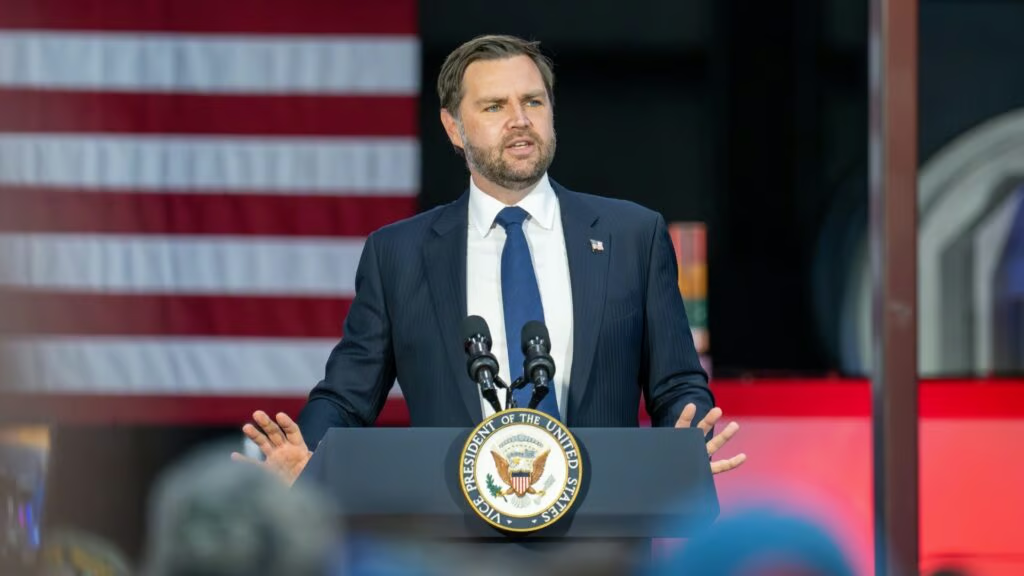
Now, here's why this matters right now: Witkoff and Kushner are part of a U.S. delegation led by Vice President JD Vance that's holding direct talks with Iranian officials on Saturday in Islamabad. This isn't just another diplomatic meeting—it's the first such face-to-face meeting between the U.S. and Iran since the Islamic Revolution in 1979. That's 47 years of no direct talks, and now we're sending real estate guys to break the ice.
These two have become something of a diplomatic tag team in Trump's second term, covering everything from the Russia-Ukraine war to Iran's nuclear program to the Gaza ceasefire. But Kelly isn't just questioning their qualifications—he's criticizing the entire approach.
Speaking at the National Action Network Convention, Kelly criticized Trump for his handling of the conflict, stating that Trump went into it "without a plan, without a timeline, without an exit strategy." He also squarely blamed Trump for Iran's blockade of the Strait of Hormuz, a chokepoint handling roughly 20% of the world's oil supply.
In his appearance, the potential Democratic presidential contender for 2028 also criticized Trump for not consulting U.S. allies before launching initial strikes in late February, saying his decisions have "alienated our allies."
The talks in Islamabad come after a six-week conflict with Iran that began following Israeli and U.S. strikes on Iran. The fighting has resulted in that blockade of the Strait of Hormuz, an important shipping route for global oil supplies. Iran has accused the U.S. and Israel of violating the terms of its 10-point peace proposal, while the U.S. has accused Tehran of obstructing the safe passage of ships through the strait.
Trump expressed confidence on Friday, stating that the Strait of Hormuz will reopen "fairly soon," without specifying the steps to be taken. That's the kind of vague optimism that makes diplomats nervous and senators critical.
Kelly, a retired NASA astronaut, also warned that the standoff hands Iran "a strategic asset they can exploit for decades." Think about that for a moment—when you control 20% of the world's oil shipping, you have leverage. And when you've been handed that leverage because of a conflict that started without a clear plan, well, that's the kind of situation that keeps national security experts up at night.
So here we are: historic talks, real estate developers at the negotiating table, a critical shipping lane blocked, and a senator questioning whether we're playing diplomatic chess or just making moves without understanding the board. The question isn't just whether Kushner and Witkoff can negotiate peace—it's whether anyone should be surprised if the process looks more like a property deal than international diplomacy.