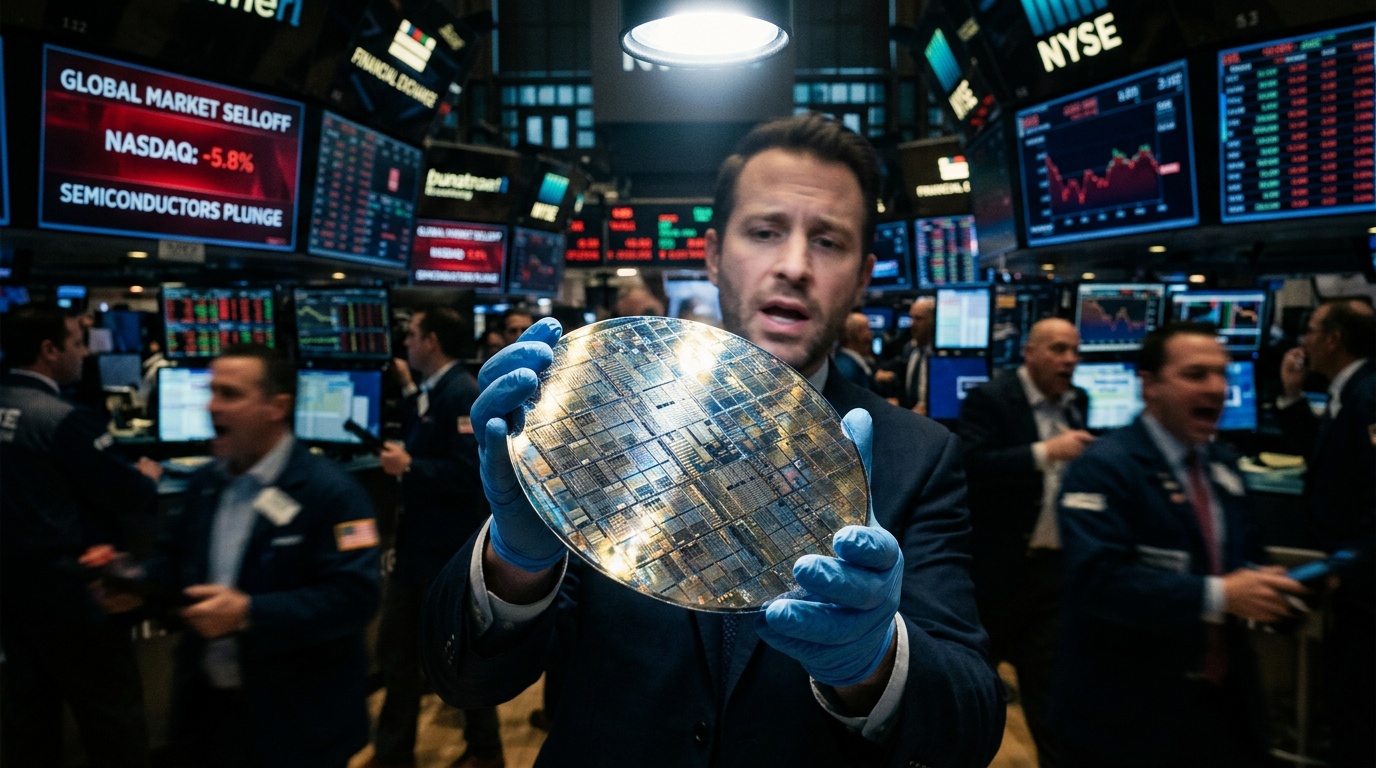
Wall Street split in two on Monday, with money pouring out of the AI hardware complex and straight into security software after frontier-lab chief executives spent the weekend arguing that model development is moving too fast.
The White House is defending the buildout while Anthropic’s Dario Amodei, OpenAI’s Sam Altman and xAI’s Elon Musk all signaled over the weekend that the pace should slow.
President Donald Trump pushed back hard, posting on Truth Social that there is “a sick conspiracy going on against AI and Data Centers.”
That was enough to gut the AI hardware trade while handing the security complex its best session in months.
Energy piled on. West Texas Intermediate crude climbed 2.4% to $102.43 a barrel and Brent added 2.3% to $106.97, extending last week’s surge after Saudi Arabia shut the East-West pipeline – the main workaround for the Strait of Hormuz – following drone damage, and after a planned Iran-Gulf meeting in Salalah was postponed.
Bonds did the rest of the damage. The 10-year Treasury yield briefly topped 5% for the first time since 2023 on an intraday basis and sits at its highest closing level since 2007.
Rate traders now put roughly an 89% probability on a 25-basis-point hike at the Federal Open Market Committee meeting, which would be the Fed’s first increase since 2023, with fresh economic projections due alongside the statement. The dollar index rose for a fourth straight session to 99.6.
Across U.S. equity markets by midday Monday, the losses were shallow, but the dispersion was extreme.
The S&P 500 eased 0.3% to 7,634.54, while the Dow Jones Industrial Average was nearly flat at 52,520.74, down 53 points.
The Nasdaq 100 fell 0.6% to 29,182.52, held down by the semiconductor complex. The damage was concentrated one rung down the stack. Micron Technology Inc. (NASDAQ:MU) slid 5.7%, Advanced Micro Devices Inc. (NASDAQ:AMD) fell 4.6% and Broadcom Inc. (NASDAQ:AVGO) dropped 4.1%.
The Russell 2000 was effectively unchanged at 2,902.94.
Gold – tracked by the SPDR Gold Shares (NYSE:GLD) – offered no shelter. Bullion fell 1.4% to $4,291.65 an ounce and is now down 2.8% month-to-date. Silver slid 1.5% to $63.28 and copper dropped 2.6%.
Monday’s Performance In Major US Indices
According to the market data platform:
- The Vanguard S&P 500 ETF (NYSE:VOO) fell 0.4%.
- The SPDR Dow Jones Industrial Average ETF Trust (NYSE:DIA) slipped 0.1%.
- The Invesco QQQ Trust (NASDAQ:QQQ) slid 0.8%.
- The iShares Russell 2000 ETF (NYSE:IWM) was flat.
Cyber Stocks Rocket. The AI Hardware Trade Sinks
The Communication Services Select Sector SPDR Fund (NYSE:XLC) led the tape with a 1.9% gain, followed by the Consumer Staples Select Sector SPDR Fund (NYSE:XLP) at 1.5% and the Health Care Select Sector SPDR Fund (NYSE:XLV) at 1.5%. The Technology Select Sector SPDR Fund (NYSE:XLK) was the worst performer, down 1.7%, with the Industrials Select Sector SPDR Fund (NYSE:XLI) off 1.5% and the Utilities Select Sector SPDR Fund (NYSE:XLU) down 1.0%.
At the industry level, the iShares Expanded Tech-Software Sector ETF (BATS:IGV) surged 4.6%, while the VanEck Semiconductor ETF (NASDAQ:SMH) sank 4.5%.
Every one of the Russell 1000’s five best performers was a security name, and the catalyst was the same: the weekend AI-safety warnings reframed a more dangerous threat environment as a bigger security budget.
SentinelOne Inc. (NYSE:S) led the index with a 15.8% jump to $22.87 on no company-specific news, moving purely with the endpoint-security group.
Zscaler Inc. (NASDAQ:ZS) climbed 15.3% to $189.75, building on a Citi price-target raise to $205 from $175 on Sept. 8 and Wedbush’s Outperform coverage initiation on Sept. 11.
CrowdStrike Holdings Inc. (NASDAQ:CRWD) rose 15.0% to $237.77 – the cleanest expression of the trade given how directly its platform is sold against AI-driven attack tooling – while Palo Alto Networks Inc. (NASDAQ:PANW) advanced 13.1% to $374.07.
SailPoint Inc. (NASDAQ:SAIL) gained 15.4% to $19.90, moving instead as the identity-security proxy for agent-driven AI risk, alongside Okta Inc. (NASDAQ:OKTA) at 12.0% and Rubrik Inc. (NYSE:RBRK) at 13.4%.
The losers’ table was the mirror image, and only one name had a company-specific catalyst.
Corning Inc. (NYSE:GLW) tumbled 11.9% to $146.64 after disclosing an equity distribution agreement with Goldman Sachs to sell up to $2 billion of common stock through an at-the-market program, a dilution risk landing on a stock that had run roughly 91% higher this year on AI infrastructure demand.
The other four were pure de-rating.
MACOM Technology Solutions Holdings Inc. (NASDAQ:MTSI) fell 11.3% to $243.73 and Coherent Corp. (NYSE:COHR) dropped 10.0% to $274.90.
Both are optical-interconnect suppliers whose multiples are levered directly to the pace of data-center buildout.
Teradyne Inc. (NASDAQ:TER) slid 11.2% to $337.37, giving back part of a year-to-date run that had been among the largest in semiconductor testing.
SiTime Corp. (NASDAQ:SITM) fell 10.6% to $568.39, with the timing-device maker trading as a high-multiple derivative of data-center unit growth.
The read-through extended beyond the top five: Semtech Corp. (NASDAQ:SMTC) lost 10.0%, Astera Labs Inc. (NASDAQ:ALAB) fell 9.8% and power-infrastructure supplier nVent Electric plc (NYSE:NVT) dropped 9.7%.