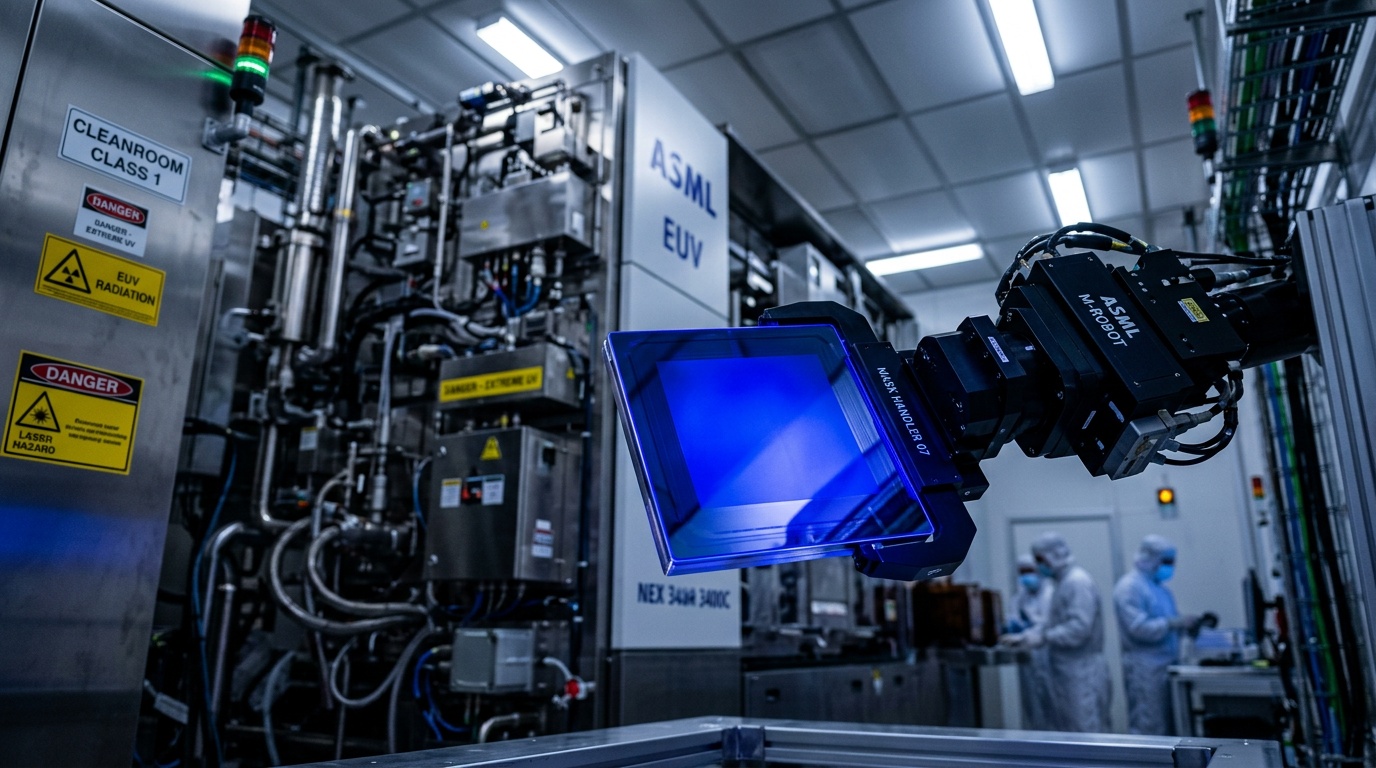
Intel Corp. (INTC) is making a big bet on next-generation chipmaking technology, and it's starting to pay off. The company's foundry business just hit a major milestone: processing more than one million wafers using ASML Holding N.V.'s (ASML) High Numerical Aperture Extreme Ultraviolet (High NA EUV) lithography. That's not just a vanity number. It's a sign that Intel is serious about using this cutting-edge tech in actual production, not just in a lab somewhere.
For those who don't speak chip geek, High NA EUV is like the next step in the photolithography arms race. It lets chipmakers print even tinier features on silicon, which is essential for building the complex, power-hungry processors that power artificial intelligence. Intel and ASML have been working together to get this technology ready for prime time, and this week they're highlighting the progress.
One Million Wafers and Counting
Intel Foundry says it's already using High NA in high-volume manufacturing. The company has processed more than one million wafers across tool certification, testing, R&D, and actual production. That's a lot of silicon, and it suggests Intel isn't just dabbling in High NA; it's integrating it into its core manufacturing flow.
Specifically, Intel is using High NA on select layers of some of its Intel Core Ultra Series 3 processors, which go by the code name Panther Lake. The company says overlay, throughput, and equipment availability are all meeting expectations. In other words, the technology is performing as hoped, which is no small thing for a brand-new manufacturing process.
Even more encouraging, Intel says products made using its Intel 18A process with High NA on selected layers are delivering performance that meets or exceeds comparable layers made with ASML's existing NXE EUV platform. That's a strong vote of confidence for the new tech, and it validates Intel's early adoption.
ASML CEO Christophe Fouquet has taken notice, highlighting Intel's early adoption of the technology. When the CEO of the company that makes the machines is impressed, that's a good sign.
The Mask Question
One of the big debates in the chip world is about masks, the templates used to project patterns onto silicon wafers. Current EUV systems use 6-inch masks, but High NA EUV can handle larger ones. Intel says customers can use High NA today with existing 6-inch masks, either by designing within the mask area or using Intel Foundry's stitching technology and process design kit solutions. That's a nice way of saying, "You can start using this now, and we'll help you figure out the mask stuff."
But Intel is also thinking bigger. For more than three years, the company has been pushing for a transition to larger 6x12-inch masks. That's a bigger change, and it requires the whole industry to get on board. Intel is working with ASML, mask manufacturers, automation suppliers, EDA partners, materials providers, and other chipmakers to develop the standards and infrastructure needed.
Intel Executive Vice President and Intel Foundry Co-General Manager Naga Chandrasekaran put it simply: future AI products require manufacturing technologies that are ready for production and easy for customers to adopt. That's the key. It's not enough to have a cool new machine; you need the whole ecosystem to support it.
Investors See the Upside
This manufacturing progress comes at a time when Intel is also making moves on the financial front. KKM Financial founder Jeff Kilburg recently said Intel created a buying opportunity by raising capital to support AI demand without adding pressure to its balance sheet or credit rating. He called the offering strategic and expects investors to eventually reward the move.
Tech investor Dan Niles echoed that sentiment, saying Intel's expanded $20 billion raise strengthens his view that the company could be approaching major foundry customer wins that require additional capacity. In other words, Intel is raising money to build more chips for big customers, and that could be a huge catalyst.
Stock Performance and Technical Analysis
Intel stock rose more than 3% in Tuesday premarket trading. The stock is trying to rebound after pulling back from its summer highs. For context, Nasdaq futures slipped 0.05%, while S&P 500 futures fell 0.31%, so Intel's move is notable.
Looking at the charts, Intel's long-term trend remains strong, but shorter-term momentum has cooled. The stock trades 33.2% above its 200-day simple moving average of $74.15. That's a big cushion. However, it sits 1.8% below its 50-day SMA of $100.61 and 4.9% below its 100-day SMA of $103.86. So, it's below those shorter-term averages, which suggests some near-term weakness.
The relative strength index (RSI) stands at 50.33, which signals neutral momentum. The stock is neither overbought nor oversold, so there's room to move in either direction.
The 20-day SMA of $93.95 remains below the 50-day SMA, signaling near-term weakness. However, the 50-day SMA remains above the 200-day SMA, which supports the longer-term bullish trend. So, the picture is mixed: short-term soft, long-term solid.
Traders may watch for Intel to reclaim its 50-day and 100-day averages. A move above those levels could strengthen the case for another leg higher. Key resistance sits near $107.50, while support is around $89.50.
Analyst Outlook
Wall Street is cautiously optimistic. Intel carries a consensus Hold rating and an average price forecast of $110.85. That's about 12% above the current price, so there's some upside potential, but analysts aren't pounding the table.
Recent analyst actions show a mix of views. Mizuho maintained a Neutral rating on Sept. 4 and lowered its price forecast to $92. Bank of America Securities maintained a Buy rating on Aug. 12 and lowered its forecast to $145. UBS maintained a Neutral rating that same day and cut its forecast to $112. So, you've got a range of opinions, from cautious to bullish.
Top ETF Exposure
If you're an ETF investor, you might be holding Intel without even knowing it. Intel is a significant component in several tech-focused ETFs:
- iShares Semiconductor ETF (SOXX): 5.53% Weight
- State Street SPDR NYSE Technology ETF (XNTK): 5.86% Weight
- REX FANG & Innovation Equity Premium Income ETF (FEPI): 6.50% Weight
Because INTC carries such a heavy weight in these funds, any significant inflows or outflows for these ETFs will likely force automatic buying or selling of the stock. So, if you're watching Intel, keep an eye on these funds too.
Price Action
As of Tuesday premarket, Intel shares were up 3.29% at $98.95. That's a solid move, and it suggests investors are reacting positively to the High NA news and the broader strategic picture.
So, what's the takeaway? Intel is making real progress on the manufacturing front, and it's positioning itself to be a major player in the AI chip boom. The stock has been volatile, but the long-term trend is up. If Intel can land those big foundry customers and continue to execute on High NA, the current price might look like a bargain in hindsight.