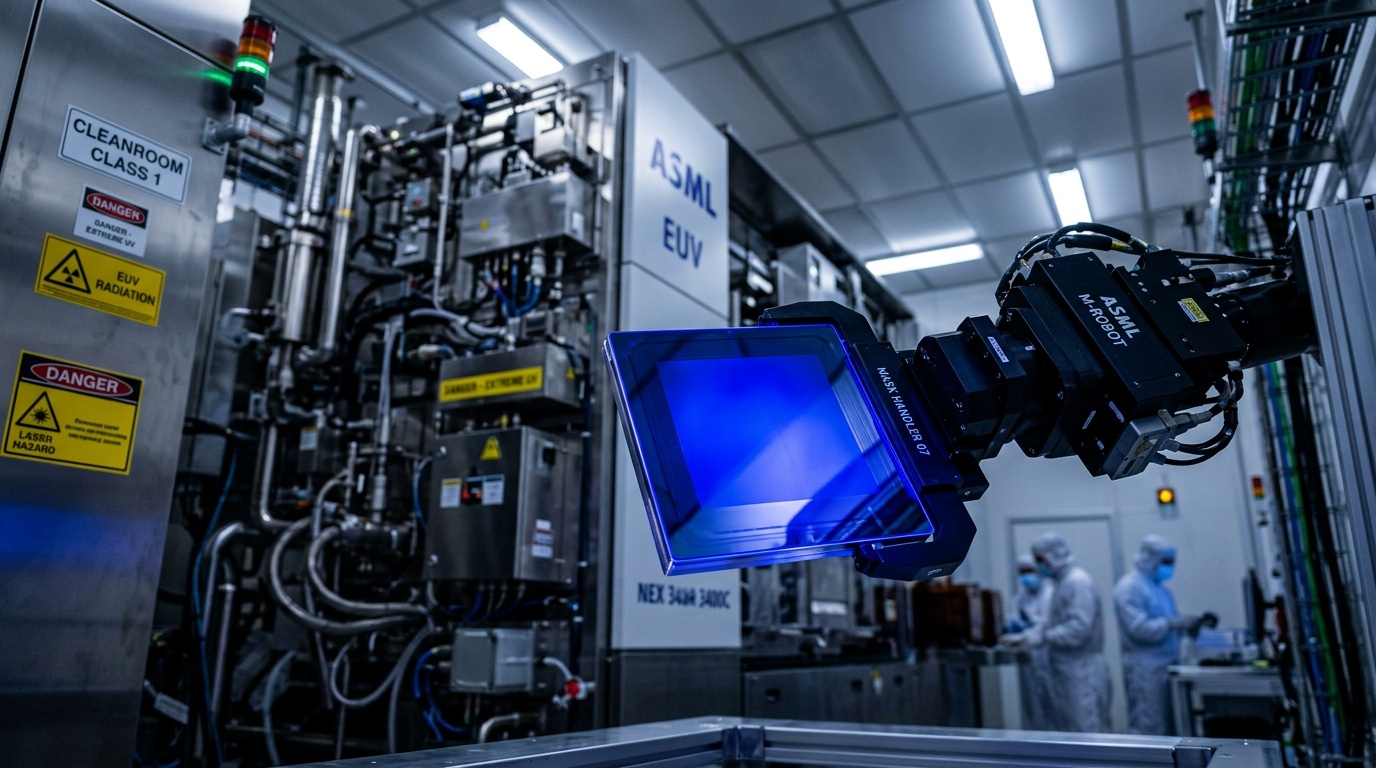
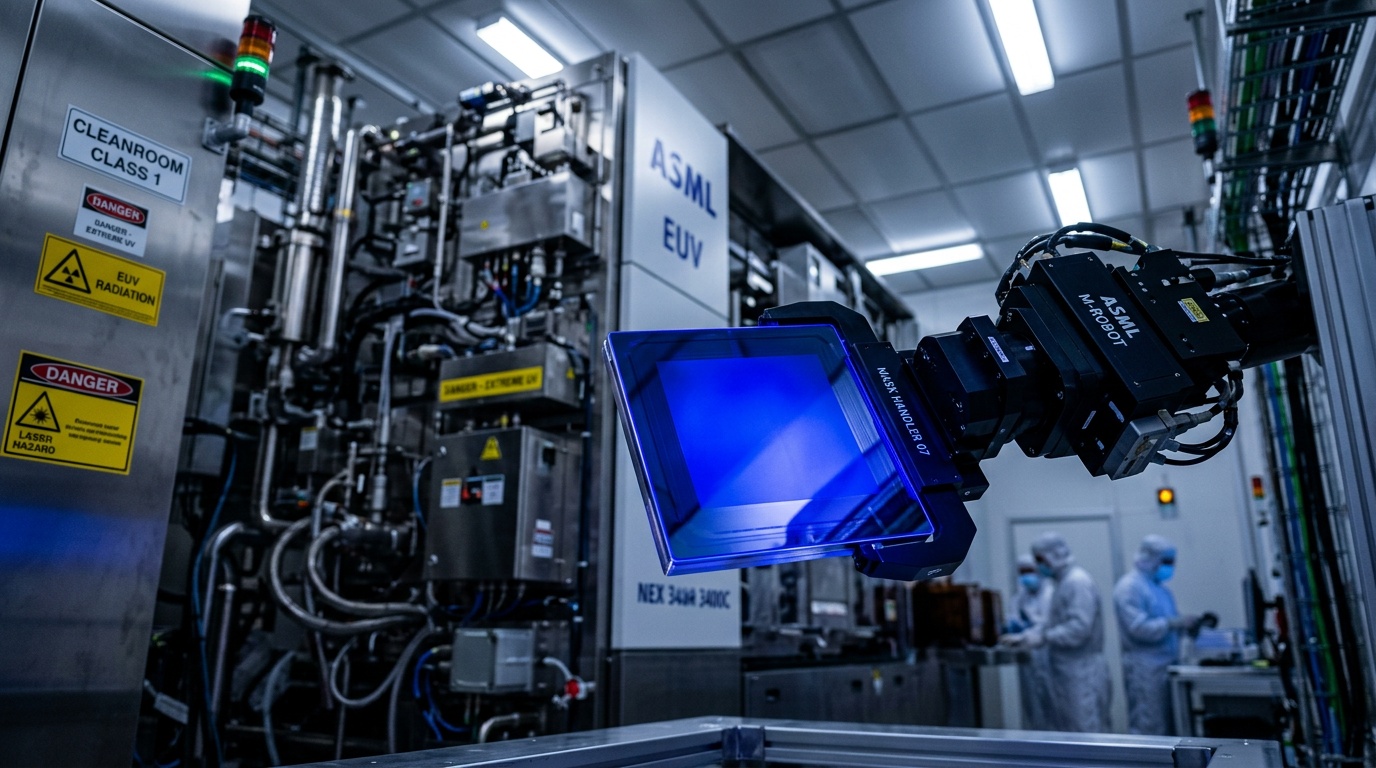
Here's a fun fact about the chip industry: the masks used to print circuits onto silicon wafers are about the size of a dinner plate. But soon, they might need to be the size of a large pizza. That's the gist of a new collaboration between Taiwan Semiconductor Manufacturing Co. (NYSE:TSM) and ASML Holding N.V. (NASDAQ:ASML), two giants teaming up to make advanced chips cheaper and faster to produce.
The contract chipmaker and the Dutch lithography powerhouse are joining forces to develop larger EUV photomasks, specifically moving from the current 6-inch format to 12-inch masks for High NA Extreme Ultraviolet lithography. Why? Because bigger masks mean more chips per wafer, fewer headaches with stitching, and ultimately, lower costs for the cutting-edge semiconductors that power everything from AI models to your smartphone.
Going Big: The 12-Inch Mask Initiative
Taiwan Semiconductor and ASML have launched an industry-wide initiative to transition to 12-inch photomasks. High NA EUV, the next big thing in chipmaking, will initially hit production lines using the existing 6-inch masks. But the companies see a future where 12-inch masks become the standard, offering a significant boost in scanner productivity and eliminating the need to stitch together patterns, which is a current limitation.
The plan is ambitious: establish a 12-inch mask pilot line by 2031, then have 12-inch High NA lithography systems ready for advanced-node production by 2033. That's a long runway, but chipmaking is a marathon, not a sprint. The initiative had its official launch on Sept. 7, and major semiconductor ecosystem partners and suppliers were on hand, expressing interest in backing the transition.
High NA Production on the Horizon
Taiwan Semiconductor is already eyeing 2030 as the year it will deploy ASML's High NA technology in high-volume manufacturing for advanced nodes. The company expects that as technology nodes advance, more layers will require High NA EUV, driven largely by the increasingly complex transistor architectures needed for AI applications. Think of it as the chip equivalent of needing a bigger canvas to paint a more detailed picture.
ASML CEO Christophe Fouquet said the industry will gradually adopt High NA EUV, starting with existing masks and later moving to larger ones. "The industry will progressively adopt High NA EUV, first with existing masks and later with larger masks that can improve scanner productivity and support demand for smaller, faster and more energy-efficient chips," he said.
Taiwan Semiconductor Chairman and CEO C.C. Wei chimed in, highlighting that industry collaboration is critical to lowering the barriers to advanced technology. It's a team effort, after all.
Interestingly, there were earlier reports that Taiwan Semiconductor planned to delay mass-production use of ASML's High-NA EUV systems until at least 2029. Co-Chief Operating Officer Kevin Zhang had cited the tools' high cost, saying the company's A13 node doesn't require them. But now, with this new initiative, the timeline seems to have shifted, and the partnership is moving forward.
Stock Check: TSM's Technical Picture
Investors seem to like what they're hearing. Taiwan Semiconductor stock traded higher in premarket trading on Tuesday, even as U.S. stock futures showed weakness. Nasdaq futures slipped 0.09%, and S&P 500 futures fell 0.32%, but TSM was bucking the trend.
At $431.00, the stock is trading 2.6% above its 20-day simple moving average of $419.94 and 2.5% above its 50-day SMA of $420.41. It's also 15.6% above its 200-day SMA of $372.83, which suggests the longer-term trend remains bullish. However, there's a wrinkle: the 20-day SMA is still below the 50-day SMA, a bearish crossover that hints short-term momentum hasn't fully recovered. But the longer-term picture is stronger, with the 50-day SMA above the 200-day SMA.
The moving average convergence divergence (MACD) indicator is also above its signal line, and the histogram is positive, both pointing to improving momentum. Resistance sits near $436.00, while support is around $405.50.
What Analysts Are Saying
Wall Street is pretty upbeat on Taiwan Semiconductor. The stock carries a consensus Buy rating with an average price forecast of $547.38. Recent moves include Stifel initiating coverage with a Buy rating and a $515 price target on Sept. 2. Bernstein maintained an Outperform rating and raised its price target to $554 on Aug. 11. Needham also maintained a Buy rating and bumped its target to $530 on July 27.
ETF Exposure: A Double-Edged Sword
If you're into ETFs, TSM is a heavyweight in several funds. The VanEck Semiconductor ETF (NASDAQ:SMH) has a 9.28% weight in TSM, the Brown Advisory Flexible Equity ETF (NASDAQ:BAFE) holds a 5.96% weight, and the Harbor International Compounders ETF (NYSE:OSEA) has a 6.77% weight. That's significant because any big inflows or outflows from these funds will likely force automatic buying or selling of TSM shares, which can amplify price moves.
Price Action
As of premarket trading on Tuesday, Taiwan Semiconductor shares were up 0.49% at $431.00, according to market data. The stock's resilience in the face of broader market weakness is a sign of investor confidence in the company's growth prospects, especially with AI demand showing no signs of slowing down.
This collaboration with ASML is a strategic move to ensure Taiwan Semiconductor stays ahead of the curve, producing chips that are not only more powerful but also more cost-effective. And in the high-stakes world of semiconductor manufacturing, that's a winning formula.