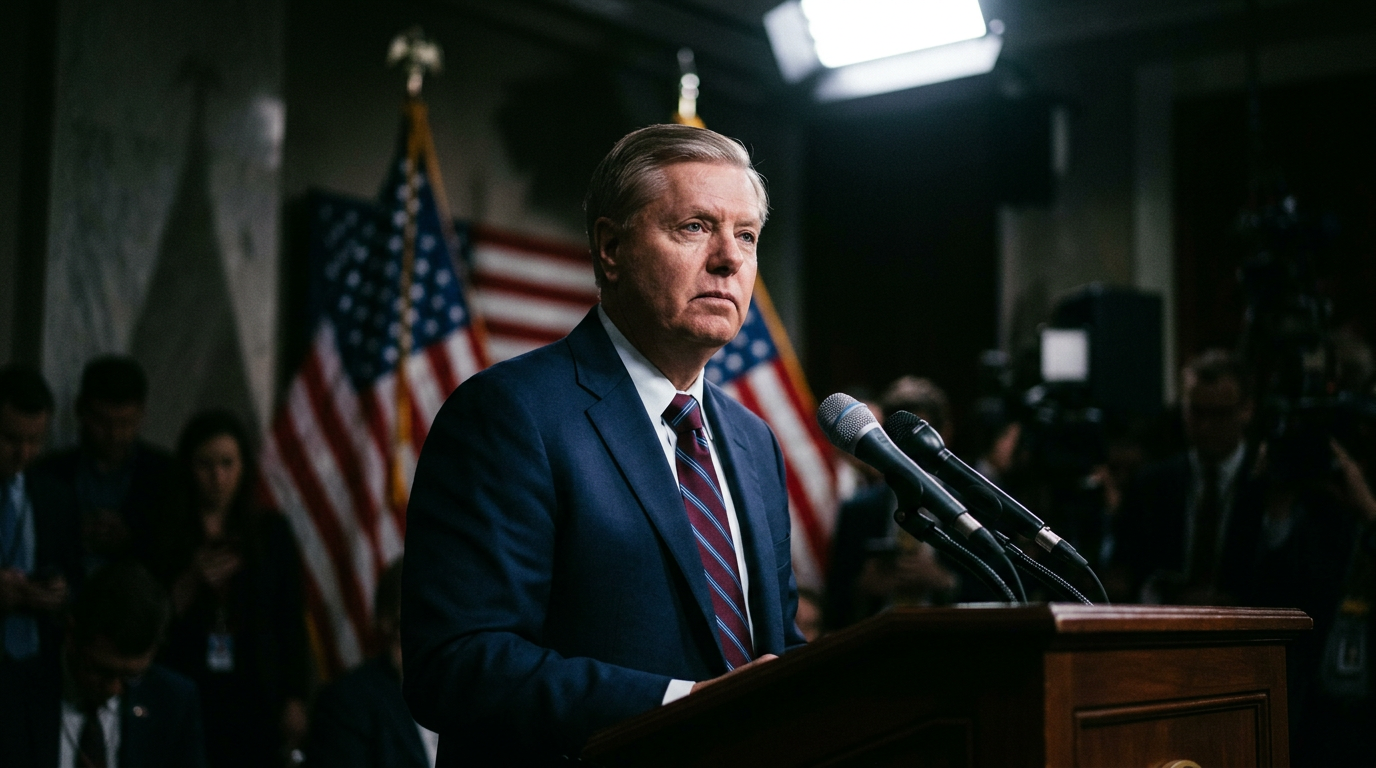
Senator Lindsey Graham (R-S.C.) is not mincing words when it comes to Iran. In a Sunday post on X, alongside a clip from his Face the Nation interview, Graham wrote: "We want diplomacy to succeed. But if Iran tries to test us, we will obliterate them."
That's a pretty direct message. And he didn't stop there. In the interview, Graham laid out a stark scenario: "If this deal fails, President Trump is going to take the Strait of Hormuz over by force. The United States will control the Strait of Hormuz."
The Strait of Hormuz is a critical chokepoint for global oil shipments, and the idea of the U.S. military seizing it is about as aggressive as it gets. Graham also predicted that Saudi Arabia could join the Abraham Accords in 2026, expanding normalization with Israel. And he warned that continued Iranian attacks via proxies like Hezbollah could trigger direct U.S. strikes on Iran. "So to the Iranians, if you're listening… when you use Hezbollah to attack Israel, I think the new policy will be we will attack Iran," he said.
Former national security adviser John Bolton chimed in with his own dose of skepticism. On X, he wrote: "In Iran, we are dealing with a regime that as recently as January, slaughtered tens of thousands of its own civilians in the streets. That's not the kind of regime that honors international agreements." Bolton has long argued that Tehran cannot be trusted, and his comments reinforce the hawkish stance that any deal with Iran is inherently fragile.
But here's where things get interesting: despite all the tough talk, U.S.-Iran negotiations are actually showing some progress. Iran's Foreign Minister Seyed Abbas Araghchi said the U.S. agreed to lift its naval blockade of the Strait of Hormuz following early talks in Switzerland. Both sides reported progress on sanctions relief and regional de-escalation. Restrictions on Iranian oil and petrochemical exports have been eased, and some frozen assets have been released as part of a broader framework that also includes cooperation on Lebanon-related tensions.
U.S. officials, including Energy Secretary Chris Wright, confirmed that oil and gas flows through the strait have returned to normal after earlier disruptions. Energy markets are stabilizing, and prices are expected to soften amid stronger global supply. So, on the ground, things are actually moving in a positive direction.
But the negotiations were briefly shaken after President Donald Trump himself threatened to seize control of the strait and warned of military action over Iran's regional activities. That kind of mixed messaging—diplomacy on one hand, obliteration on the other—creates a lot of uncertainty. For investors, the key takeaway is that the situation remains volatile. Any disruption to the Strait of Hormuz could send oil prices spiking, while progress in talks could ease supply concerns. Keep an eye on energy markets and geopolitical headlines—they're likely to move in tandem.