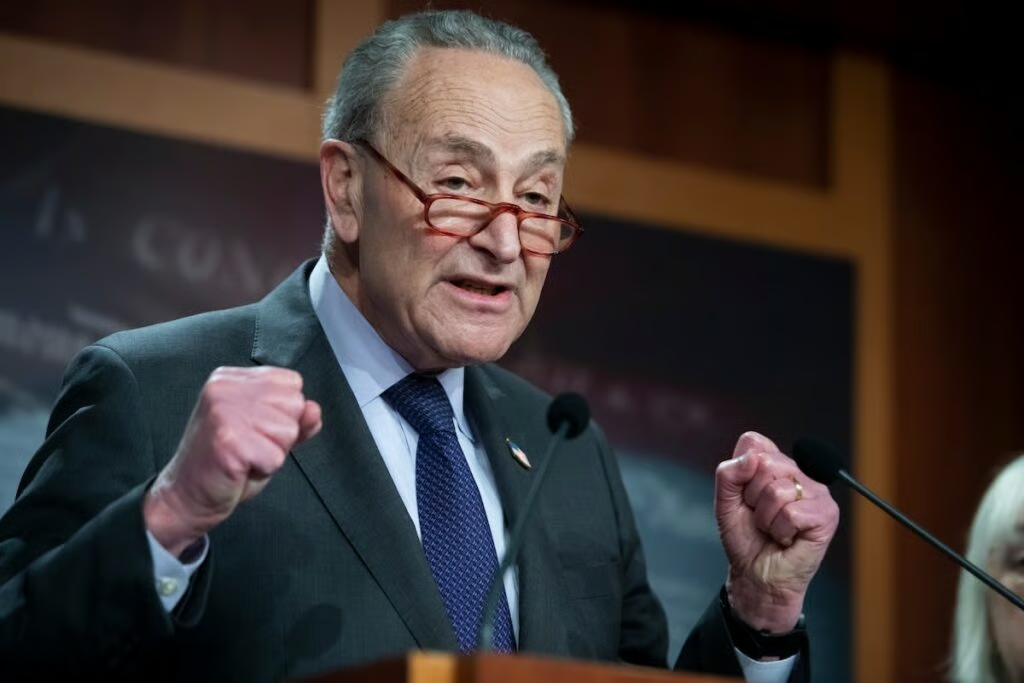
On Monday, Senate Minority Leader Chuck Schumer (D-N.Y.) took a sharp jab at President Donald Trump's recent trip to China, arguing that the president came back with nothing to show for it. In a post on X, Schumer dismissed the meeting with Chinese President Xi Jinping as a "photo op" and listed a litany of unresolved issues.
"Trump returned from China with nothing to show for it besides a photo op with Xi Jinping," Schumer wrote. He went on to tick off the failures: "No action to stop the flow of fentanyl," "No protections for US manufacturers," "Continued CCP ownership of US farmland," "More doubt on our commitment to Taiwan," and "Zero effort to protect our lead in the AI & semiconductor race."
Schumer's criticism comes despite the Trump administration's announcement last week that the two leaders had agreed to create two new economic bodies: the U.S.-China Board of Trade and the U.S.-China Board of Investment. The framework is designed to ease disputes, oversee non-sensitive trade, and allow limited investment flows under security safeguards. Both sides also discussed reducing tariffs and maintaining a fragile trade truce.
The leaders also touched on broader geopolitical issues, including Iran's nuclear program, shipping security in the Strait of Hormuz, and rising tensions over Taiwan. Trump separately said that Xi's comments about a "declining nation" were directed at the Biden administration, adding that America had strengthened under his leadership and expressing hope for improved U.S.-China relations.
But perhaps the most concrete outcome of the visit was the U.S. government's authorization of sales of NVIDIA Corp.'s NVIDIA (NVDA) high-powered H200 AI chips to 10 major Chinese tech companies, including Alibaba Group Holding Ltd. (BABA) and Tencent Holdings ADR (TCEHY). That move is likely to reignite debate over whether the U.S. is giving away its technological edge—exactly the kind of concern Schumer raised in his critique.
So while Trump and Xi posed for cameras and launched new trade boards, Schumer sees a missed opportunity. Whether the new economic bodies will deliver tangible results remains to be seen, but for now, the political battle lines are drawn.
.jpeg)