Seven OPEC+ producers said on Sunday they will dial back part of their extra voluntary cuts by 188,000 barrels per day starting in June 2026, framing the move as a calibrated step aimed at keeping the oil market steady. The decision lands as the United Arab Emirates announced it will withdraw from OPEC and OPEC+ effective May 1, a break with the group's coordinated approach as crude traded above $100 a barrel Tuesday morning.
The shared reader stake is market stability: both the OPEC+ supply plan and the UAE's departure can shift fuel costs and price expectations for consumers and businesses.
Why UAE's Exit Signals A Market Shift
UAE's exit ends nearly 60 years of membership and points to a future where at least one major Gulf producer sets output policy on its own. The UAE state news agency WAM said the country plans to lift production toward 5 million barrels per day by 2027, from about 3.4 million currently.
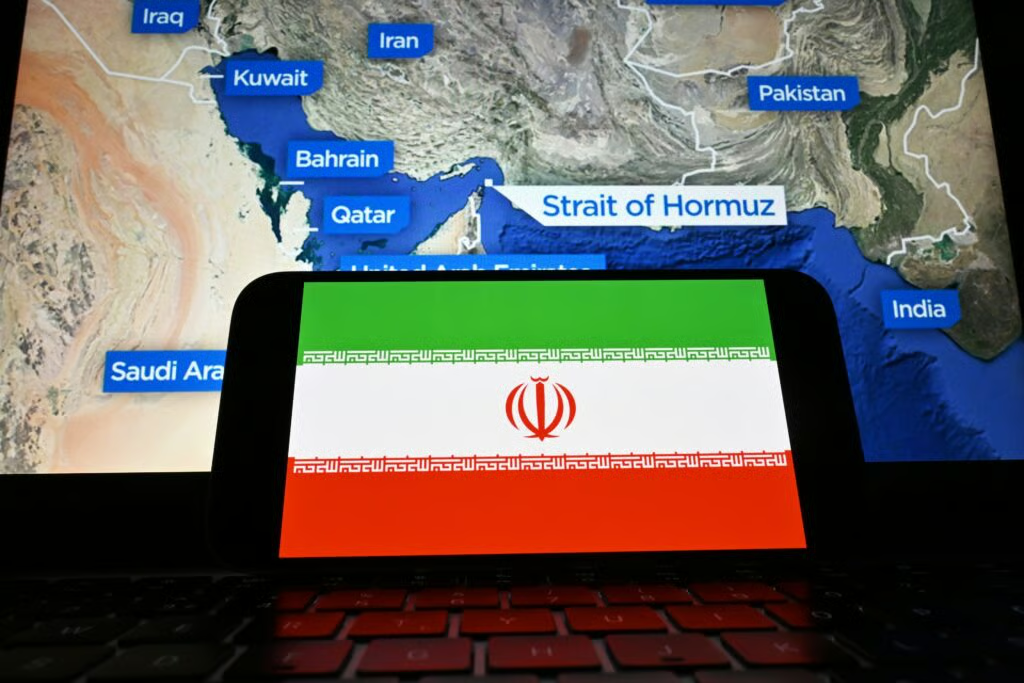
The UAE's energy minister described the move as a sovereign call tied to a long-term strategy, while also arguing the timing was chosen to avoid adding stress to markets constrained by the Strait of Hormuz. The announcement came only hours before OPEC was scheduled to meet in Vienna.
According to OPEC+ statement, Saudi Arabia, Russia, Iraq, Kuwait, Kazakhstan, Algeria and Oman explained that they met virtually Sunday and agreed to a June 2026 production increase of 188,000 barrels per day by unwinding a slice of the extra voluntary cuts first outlined in April 2023.
The group also kept the door open to changing course, saying the voluntary reductions could be brought back partly or fully depending on how conditions develop, and that members want the ability to speed up, pause or reverse the phaseout. According to Opec, the seven countries said the step also creates room to accelerate "compensation" for prior overproduction and reiterated they intend to fully offset any volumes above targets since January 2024.
Geopolitical Tensions Shift Oil Market Dynamics
This decision follows President Donald Trump's characterization of the recent oil shock as a "little excursion," predicting a quick price drop once the situation in Iran stabilizes. However, Goldman Sachs has raised its 2026 fourth-quarter Brent forecast from $80 to $90, reflecting expectations of prolonged supply disruptions in the Strait of Hormuz, which could have significant implications for global oil pricing.
As Goldman noted in its analysis, the longer the Strait remains closed, the more challenging it will be to uphold Trump's assumptions about falling prices, with estimates now suggesting a potential market swing from a 1.8 mb/d surplus in 2025 to a 9.6 mb/d deficit in mid-2026 due to reduced Gulf crude production and dwindling inventories. This evolving landscape underscores the complexities OPEC+ faces in stabilizing oil prices amidst geopolitical tensions and production uncertainties, particularly as they prepare for their next meeting in June 2026.
Can OPEC+ Stabilize Prices Amid Supply Disruptions?
Oil's latest move has also been driven by geopolitics, with prices jumping overnight after the Trump administration's national-security team publicly signaled doubts about Tehran's offer tied to activity in the Strait of Hormuz. The offer involved halting fast-attack-boat operations if Washington lifted its naval blockade, and the White House response was skeptical.
Vandana Hari, chief executive of Vanda Insights, said Donald Trump remained unconvinced by Tehran's proposal to end the Hormuz blockade while putting the nuclear issue on the back burner. Hari also said insurers have already tightened requirements for ships attempting to transit the chokepoint.
In the OPEC+ plan, the seven producers said they will hold monthly sessions to check market conditions, compliance and compensation, with the next meeting set for June 7, 2026. The countries also said the Joint Ministerial Monitoring Committee will oversee adherence to the broader Declaration of Cooperation and the additional voluntary adjustments.
Market trading Tuesday reflected how investors are reading the supply picture: West Texas Intermediate, as tracked by the United States Oil Fund USO, pulled back from an overnight high near $102, while Brent eased from above $112, yet crude held the $100 level. The Energy Select Sector SPDR Fund XLE rose 1.6% premarket, with most constituents higher, and Permian-focused producers led gains as investors favored upstream exposure over refiners facing higher feedstock costs.
Goldman Sachs Adjusts Oil Forecasts Significantly
Goldman Sachs updated its outlook in an April 27 note, lifting its fourth-quarter Brent forecast to $90 a barrel and WTI to $83, and said the Brent target was raised by nearly $30 versus levels before the Hormuz disruption. The bank also outlined a downside scenario where the strait remains effectively shut and additional regional supply is lost, sending Brent to $120 in the third quarter and $115 in the fourth.
"The economic risks are larger than our crude base case alone suggests," Goldman analyst Daan Struyven said. The bank's framework added another layer for traders weighing whether coordinated OPEC+ adjustments can offset the uncertainty created by a key member's exit and a shipping choke point under strain.