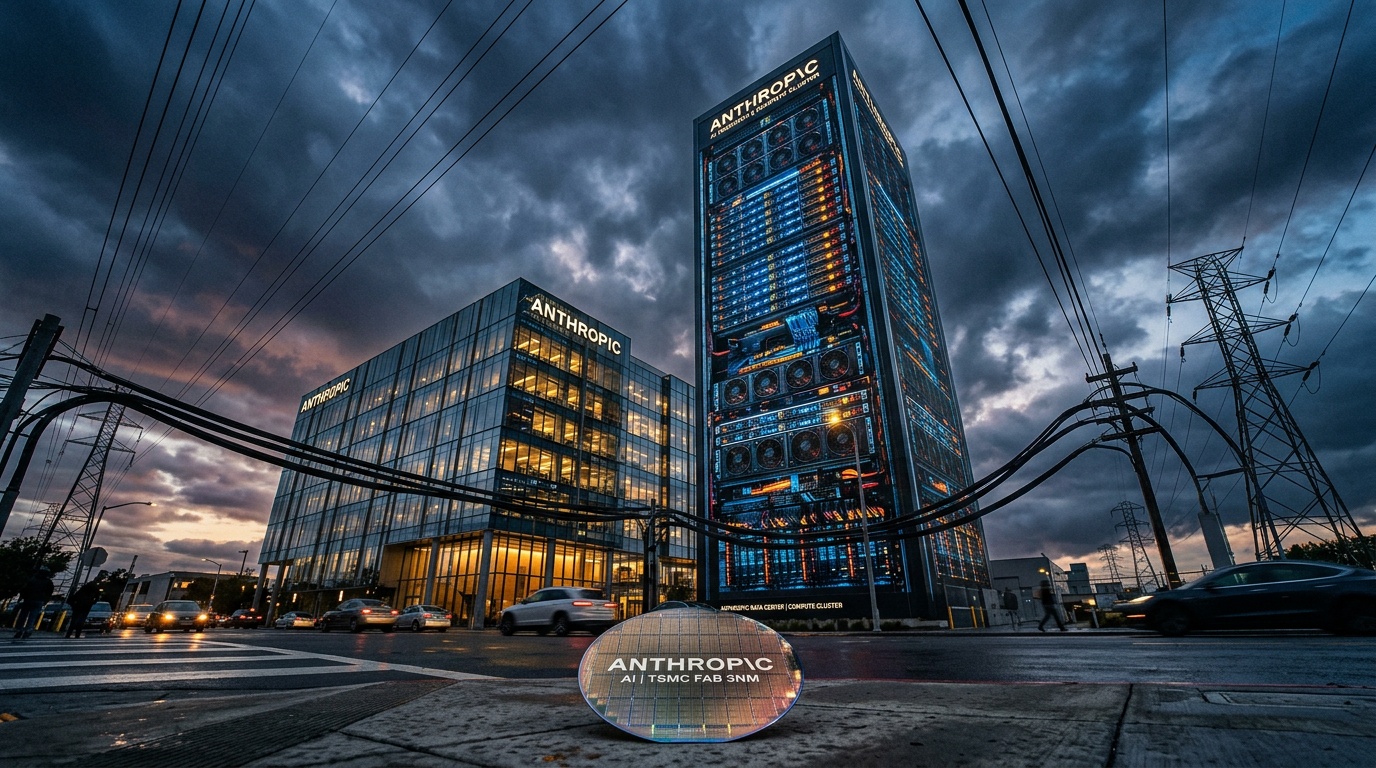
Anthropic just handed the market something unusual: a peek at its books. The AI company reported $16.3 billion in revenue for the first half of 2026, up from $1.1 billion a year earlier, according to its preliminary IPO filing. That is a lot of growth in twelve months, and it comes with an even more interesting footnote: the company's long-term infrastructure commitments, which show just how much computing capacity it expects to need to build and run its AI models.
VistaShares CEO Adam Patti reads the filing less as a financial statement and more as "a demand forecast for infrastructure." Anthropic disclosed major cloud commitments, including roughly $111 billion with Alphabet, Inc (GOOGL), $110 billion with Amazon.com, Inc's (AMZN) AWS and $31 billion with Microsoft Corp (MSFT).
Those are commitments, not checks already written. Anthropic's potential future compute spending could reach hundreds of billions of dollars, though the filing's commitments and estimates should not be treated as spending already incurred. Still, as a signal of where the AI build-out is headed, it is hard to ignore.
Two Ways to Track the Listed Semiconductor Names
If Anthropic is going to spend that kind of money on compute, someone has to sell it the chips. The VanEck Semiconductor ETF (SMH) holds Nvidia Corp (NVDA) at approximately 21%, alongside exposure to Taiwan Semiconductor Manufacturing (TSM), Broadcom, Inc (AVGO), Advanced Micro Devices (AMD) and Micron Technology, Inc (MU). These companies operate across AI computing, chip manufacturing, networking and memory.
The iShares Semiconductor ETF (SOXX) provides similar exposure to major semiconductor companies, including Nvidia, AMD, Micron and Broadcom. But here is the caveat worth repeating: stronger infrastructure spending would not automatically translate into higher returns for either ETF. Chip demand, company valuations, competition and supply constraints will also influence performance.
Patti, whose firm manages the $1 billion VistaShares Artificial Intelligence Supercycle ETF (AIS), says capacity, not demand, is becoming the central constraint.
"The constraint is supply, not demand," Patti said. In other words, the industry's immediate challenge is securing enough infrastructure to support expanding AI workloads.
"The filing says Anthropic sought more capacity than the hyperscalers could provide and is turning to third-party data centers," he added. "When the customer is asking for more than the market can build, the build-out has room to run."
Power Infrastructure Is Another Potential Winner
All those chips need electricity, and the grid needs equipment. The First Trust Nasdaq Clean Edge Smart Grid Infrastructure Index Fund (GRID) provides exposure to companies involved in electrical equipment, grid infrastructure and related services. Its holdings include Eaton Corporation (ETN), Quanta Services Inc (PWR) and Schneider Electric.
Patti argues that the investment implications extend beyond AI developers to the companies supplying chips, memory, networking equipment, electricity and cooling systems.
"Every dollar committed to cloud capacity flows into chips, memory, networking, power and cooling," Patti said. His assessment highlights how AI infrastructure spending can drive demand across several industries, not just benefit chipmakers.
That creates a potential longer-term opportunity for infrastructure suppliers, though the benefits will depend on how quickly planned projects translate into orders and revenue.
Spending Risks Remain
Anthropic's filing does not guarantee that every announced commitment will become immediate revenue for publicly traded suppliers. Infrastructure projects can be delayed, and AI spending plans and valuations remain vulnerable to changes in demand.
Patti also flagged risks, including customer concentration. "About 20% of revenue comes from two customers, and these figures come from a preliminary filing. The final S-1 and the IPO pricing will be the next checkpoints," said Patti.
For ETF investors, the filing offers a new lens for examining the AI trade: not just which companies build AI models, but which businesses supply the infrastructure needed to run them.