The AI trade spent a second week on the defensive, and this time the argument shifted from how much the buildout is worth to who will fund it.
Meta Platforms Inc. (META) delivered the trigger.
Third-quarter revenue climbed 26% to $64.6 billion, and the fourth-quarter outlook of $73 billion to $76 billion topped the $73.6 billion consensus, but free cash flow came in at negative $2.12 billion, the first cash burn since the quarter Meta went public in 2012.
Capital spending ate 104% of operating cash flow, and the company nudged the floor of its 2026 capex range up to $135 billion.
Meta lost nearly 7% on Thursday, and the Nasdaq 100 fell 2.9% in its worst session since June. The Philadelphia Semiconductor Index dropped 6.7% as Lam Research Corp. (LRCX) plunged nearly 12% on its results.
The stress is most visible in credit. CoreWeave Inc. (CRWV), the Nvidia-backed data-center operator, has seen its 2032 notes yield close to 16%, more than three times the Treasury rate, while its stock has lost about 11% this week and nearly 40% in a month.
CoreWeave's Credit Worries Weigh on The AI Trade
SpaceX (SPCX) argued the other side. The company posted its first profit since its IPO four months ago, with revenue up 161% to $14.6 billion and half of it from AI computing.
"We are also frankly hounded relentlessly by every hyperscaler and by dozens of smaller companies to rent more of our compute," CEO Elon Musk said on Tuesday's call.
The stock jumped 9% on Wednesday and surrendered it on Thursday.
The Rotation Nobody Expected To Lead
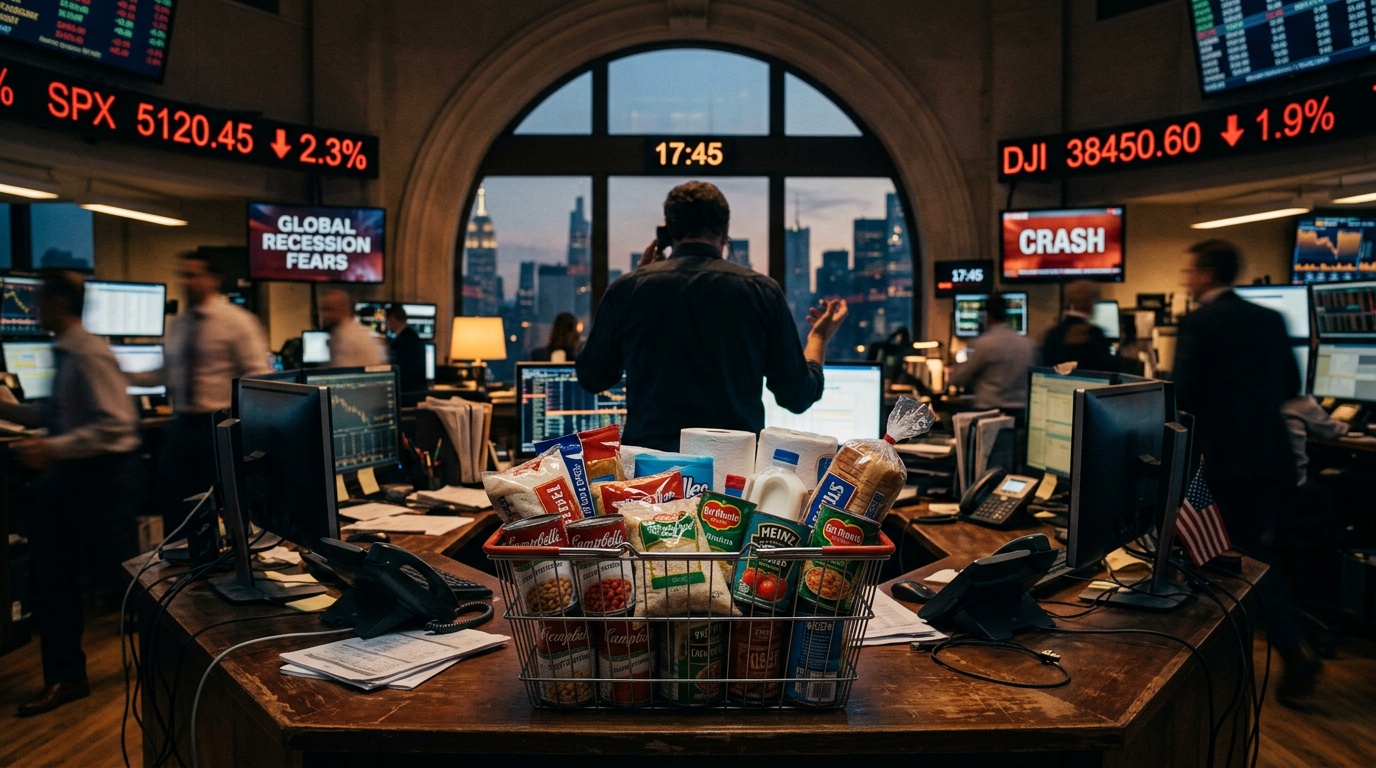
Wall Street is rotating, not retreating. Money leaving megacap tech has landed in the least glamorous corner of the market.
The Consumer Staples Select Sector SPDR Fund (NYSE:XLP) had gained 11% in October through Friday, on track for its best month since the fund launched in December 1998, while the Technology Select Sector SPDR Fund (NYSE:XLK) had lost 6.9%.
Walmart Inc. (WMT) is up about 15% this month, on pace for its best month since March 2000, and Procter & Gamble Co. (PG) rose 5.9% on Thursday after a 4% organic sales print, its biggest single-day gain since March 26, 2020.
The contrast with the broad index is striking. The equal-weight S&P 500 is beating the cap-weighted benchmark by the widest monthly margin since April 2009, even as the State Street SPDR S&P 500 ETF Trust (NYSE:SPY) sits less than 3% below its record.
Bonds absorbed the flight.
The 10-year Treasury yield closed below 5% on Thursday for the first time since Sept. 21, its biggest one-day drop since August 2024, and hovered near 4.99% Friday. The 30-year sat at 5.32% and the 2-year at 4.69%.
Consumers are not feeling the expansion.
The University of Michigan's final October sentiment index came in at 48.0, up from a preliminary 46.3 but still near record lows, with year-ahead inflation expectations at 4.7% and long-run expectations at 3.5%, both the highest since May.
"Purchasing power continues to dominate consumer views of the economy," survey director Joanne Hsu said.
Detroit Pays For 2027
General Motors Co. (GM) fell more than 10% this week, its worst since the week Silicon Valley Bank collapsed in March 2023, despite beating on both lines.
Revenue rose 2.9% to $50.02 billion against a $48.7 billion estimate and adjusted EPS of $3.70 topped the $3.63 consensus, and the board approved a new $20 billion buyback.
Investors looked past that to the outlook. GM narrowed its full-year adjusted EBIT range to $14.5 billion to $15.5 billion, and CFO Paul Jacobson flagged roughly $2 billion of additional commodity costs in 2027 if recent inflation persists.
Morgan Stanley, Barclays and UBS trimmed their targets while keeping bullish ratings.
Ford Motor Co. (F) slid about 7% ahead of its own report next Wednesday, and Stellantis N.V. (STLA) lost nearly 10%, leaving it down 65% in 2026.
The Fed, Then The Hyperscalers
Next week puts both halves of the question on the calendar.
The Fed decides on Wednesday. CME FedWatch assigns less than a 10% probability to a hike, down from about 15% a week ago and above 50% earlier this month after the hot September CPI, with a December move priced near 80%.
Bank of America is the outlier.
"We stick with our call that the Fed will raise rates by 25bp, though we acknowledge it would be a heavy lift given this week's price action," the bank's economist Aditya Bhave said on Friday, adding: "If the Fed hikes, investors might have concerns about overtightening. If the Fed holds, markets could question the Fed's credibility."
The bank also expects a hot 0.35% core PCE print and 3.5% third-quarter GDP growth on Thursday.
Then come the companies that will be asked Meta's question.
Alphabet Inc. (GOOGL) and Microsoft Corp. (MSFT) report Wednesday after the close, hours after the Fed. Amazon.com Inc. (AMZN) and Intel Corp. (INTC) follow on Thursday, with Apple Inc. (AAPL) due the following Monday.