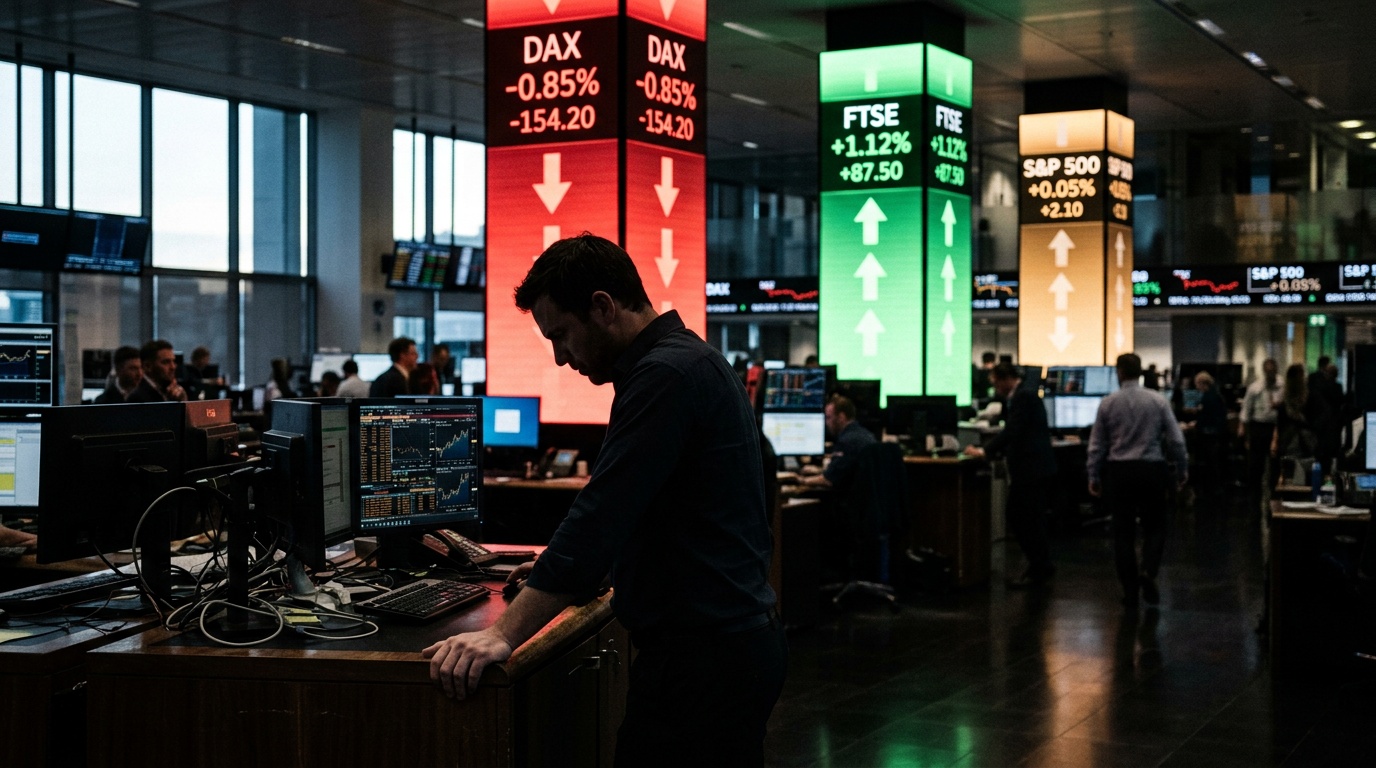
The typical S&P 500 company is having its best month against the index in more than 17 years. The index itself, however, has barely moved.
That gap is the clearest sign yet that money is leaving the artificial intelligence trade and spreading across the rest of the market.
The Invesco S&P 500 Equal Weight ETF (RSP), which gives every company in the index the same weight, has gained 4.9% in October through Thursday's close. Meanwhile, the State Street SPDR S&P 500 ETF (SPY), dominated by the largest technology names, is up just 0.2%.
As a result, the ratio between the two funds has climbed 4.7% this month. That is the biggest relative monthly jump since April 2009, when stocks were rebounding from the financial crisis lows.
The rotation has also flipped the year-to-date scoreboard. The equal-weight ETF is now up 13.5% in 2026, ahead of the 11.4% gain for SPY.
Thursday showed the shift in a single session.
The equal-weight ETF rose 0.7%, while the S&P 500 fell 1.2% as Meta Platforms Inc. (META) tumbled 7% on concerns about its AI spending. Nvidia Corp. (NVDA) lost 4.4%.
The State Street Technology Select Sector SPDR ETF (XLK) dropped 3.3%. By contrast, the State Street Consumer Staples Select Sector SPDR ETF (XLP) jumped 3.3% and the State Street Utilities Select Sector SPDR ETF (XLU) added 2.1%.
Investors Are Questioning Who Pays for the AI Build-Out
Bank of America Global Research strategist Sebastian Raedler said in a report Friday that there are "mounting signs of markets becoming increasingly unwilling to fund the AI infrastructure build-out."
In Europe, according to Raedler, cyclical sectors have trailed defensive ones by 11%, the sharpest rotation since the COVID-19 shock of March 2020.
He also pointed to Ramp data showing that AI spending by U.S. businesses has stopped rising in recent months as token prices decline.
At 22V Research, Dennis DeBusschere said the market's reflex on days when AI capex worries flare has been to buy banks, retailers, small caps, housing and transport stocks.
However, he drew a line between near-term and long-term risk.
"AI capex concerns are about 2028 and beyond. NOT 2027," DeBusschere said, adding that investors remain highly confident 2027 spending plans will be met.
Is the Rotation Now Over? This Year's Spikes Faded Fast
History offers two very different answers.
After April 2009, the equal-weight ETF kept going. Over the following 12 months, the RSP-to-SPY ratio rose another 9.4%.
This year, the pattern has been the opposite. In February, the ratio jumped 4.4% in a single month, then gave back 7.6% over the next three months.
A 3.2% gain in June was followed by a 4.3% decline through September.
There is also a key difference with 2009.
Back then, the average stock led because almost everything was rising. In October 2026, it is leading largely because the giants are falling, with defensive sectors doing much of the heavy lifting.
John Roque, also of 22V Research, sees that as a warning rather than a green light. As of Thursday morning, new lows had outnumbered new highs on the NYSE and Nasdaq for 37 and 38 straight sessions, respectively, even though the S&P 500 was only a little more than 1% below its record.
According to Roque, Nasdaq data going back to 2015 shows nine prior streaks of at least 33 days of net new lows. In seven of them, the Nasdaq went on to fall at least 18%.
He also noted that most major U.S. banks are trading below their 200-day moving averages, warning that "when banks / financials are not strong, you cannot have a strong market."
With six trading sessions left in October, the equal-weight fund is on track for a historic month.
Whether it marks the start of a broader advance, as in 2009, or a defensive retreat from AI will depend on whether the rest of the market can keep rising once the selling in megacaps stops.