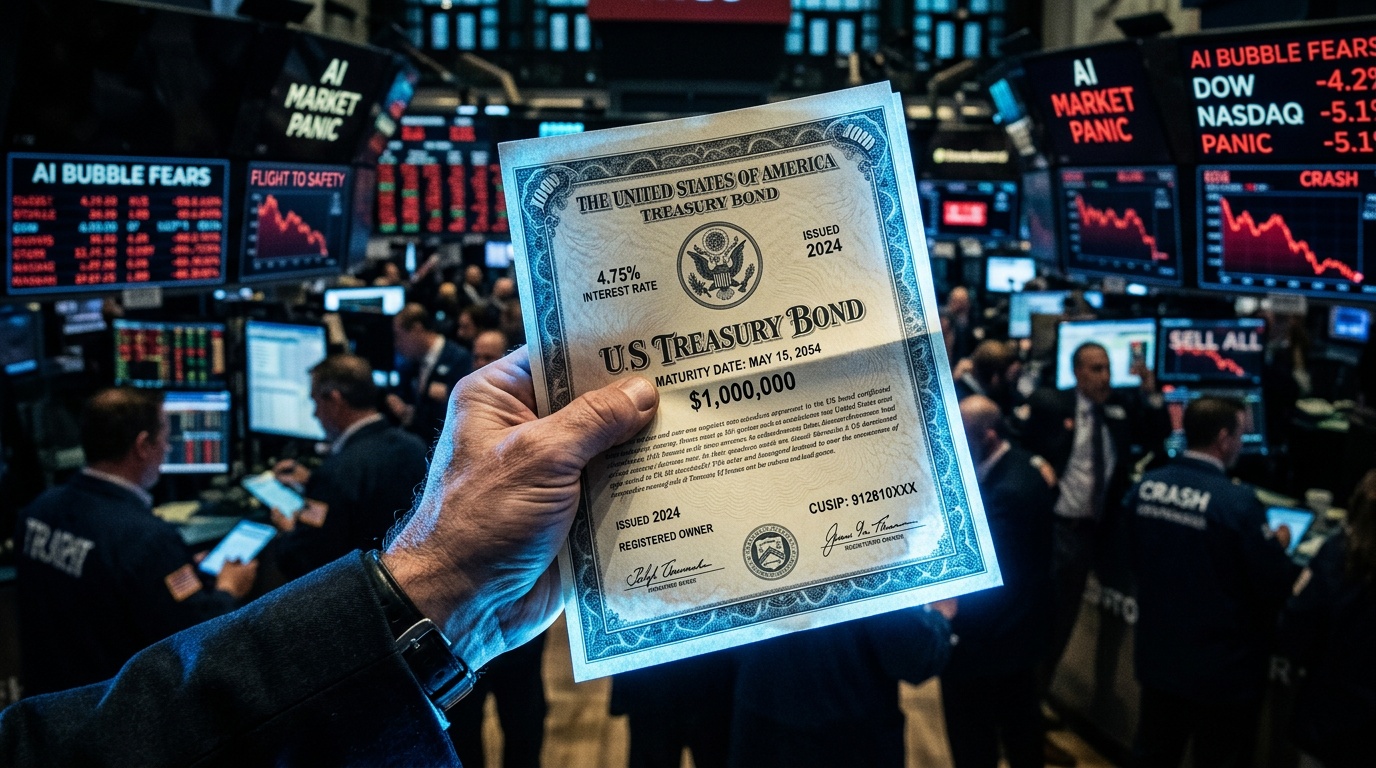
Good morning, wolves. Thursday gave the market a rebound, but it did not settle the argument. The Dow gained more than 1%, while the Nasdaq barely moved. The businesses selling AI equipment still reported strong demand. The companies borrowing to build it faced much tougher questions.
Week-to-date compares Thursday, October 15, with Friday, October 9. These are not completed weekly returns.
The S&P 500 closed at 7,744.06. The Dow was the only one of these four indexes still positive for the week through Thursday. That divergence matters more than the color of a single session.
Research cutoff: Thursday, October 15, 4:30 p.m. ET. This Friday edition reflects Thursday's close; overnight developments and Friday releases are outside that cutoff.
Sources: Closing market data
Here's a quick look at some of Thursday's biggest movers:
Up: Intuit $INTU +6.4%, ServiceNow $NOW +6.1%, Autodesk $ADSK +6.1%, Arthur J. Gallagher $AJG +5.5%, Block $XYZ +5.3%, Accenture $ACN +4.7%, NXP Semiconductors $NXPI +4.6%, Salesforce $CRM +4.6%.
Down: Hewlett Packard Enterprise $HPE and others.
AI AND CREDIT
A stock bounce is not a funding fix.
CoreWeave ($CRWV) is at the center of the AI financing debate. Its bonds sold off this week, pushing some yields above 15%, according to Axios. Investors were demanding more compensation for lending to the company even as the long-term computing story remained intact.
A higher yield on an existing fixed-rate bond does not immediately change its coupon. It does signal a tougher market for new borrowing and refinancing if that pricing persists. For a business building expensive data centers, that distinction matters.
Nvidia CEO Jensen Huang offered a more confident view Thursday. He said Nvidia does not need to backstop CoreWeave and that CoreWeave's cost of capital is decreasing. Those are his statements, not proof that credit-market concerns have disappeared.
The WOLF read: compare what executives say about financing with completed funding terms, cash generation, and the timing of customer payments. The share price alone cannot answer those questions.
Sources: CoreWeave bond-market reporting
INFLATION
The price pressure did not take a break.
September producer prices rose 1.3% in one month and 6.3% from a year earlier, BLS reported Thursday. The monthly increase was the largest since March 2022. Energy prices were a major contributor, but services prices rose too.
Wednesday's consumer-price report told a similar story: headline CPI increased 3.7% year over year, up from 3.4% in August. Core CPI, which excludes food and energy, rose 2.6% over the year.
The supplied closing briefing put the 10-year Treasury yield near 5.09%, down about 10 basis points Thursday. That is a decline of roughly 0.10 percentage point. Falling yields alongside hot inflation can reflect several forces, including demand for safer assets; they do not establish that inflation is under control.
Watch the margin squeeze: higher input costs have to be absorbed, passed on to customers, or offset by productivity. Earnings guidance will show which companies have room to maneuver.
Sources: BLS producer prices · BLS consumer prices
SEMICONDUCTORS
TSMC delivers. Investors still ask who pays.
Taiwan Semiconductor ($TSM) reported third-quarter revenue of $46.72 billion and earnings of $4.60 per ADR. Gross margin was 66.4%. Revenue in U.S. dollars grew 41.2% from a year earlier.
The company's fourth-quarter revenue outlook of $52.3 billion to $54.3 billion points to further growth. That supports the operating-demand side of the AI story, even as investors question how some customers will fund deployment.
Keep the two questions separate: are customers ordering chips, and can they earn an adequate return on the infrastructure those chips power? Strong foundry revenue helps answer the first. It cannot settle the second.
The embedded earnings recap includes its own consensus estimates. Our figures above are company-reported results and guidance, rather than a comparison between different estimate providers.
Sources: TSMC quarterly results
FINANCIAL EARNINGS
Trading is busy. The earnings mix matters.
Morgan Stanley ($MS) reported $20.3 billion in quarterly net revenue and $3.03 in diluted earnings per share Wednesday. Equity-trading revenue rose 41% from a year earlier to about $5.8 billion.
The strength was not uniform: fixed-income revenue fell 7% from a year earlier. Wealth management attracted $232.4 billion in net new assets. Different parts of the same business are responding to different market conditions.
That is a useful lens for the rest of earnings season. Separate trading activity from recurring fees, funding costs, and credit losses. A busy market can help a broker without telling us that households or corporate borrowers are getting healthier.
Comparison note: the tweet's 12% net-income decline is versus the prior quarter. Net income applicable to Morgan Stanley increased about 6% year over year, according to the company's filing.
Sources: Morgan Stanley earnings filing
The WOLF read: Thursday's bounce is a starting point. A more durable improvement would pair broader stock participation with easier corporate financing and credible earnings guidance. Treasury yields falling is helpful, but it is not the same as a stressed borrower securing cheaper capital.
For the next session, watch the combination: AI suppliers' order books, borrowers' funding terms, and companies' ability to defend margins. That is where this week's inflation, credit, and earnings stories meet.
Sources: Federal Reserve calendar · BLS release calendar · Industrial production schedule