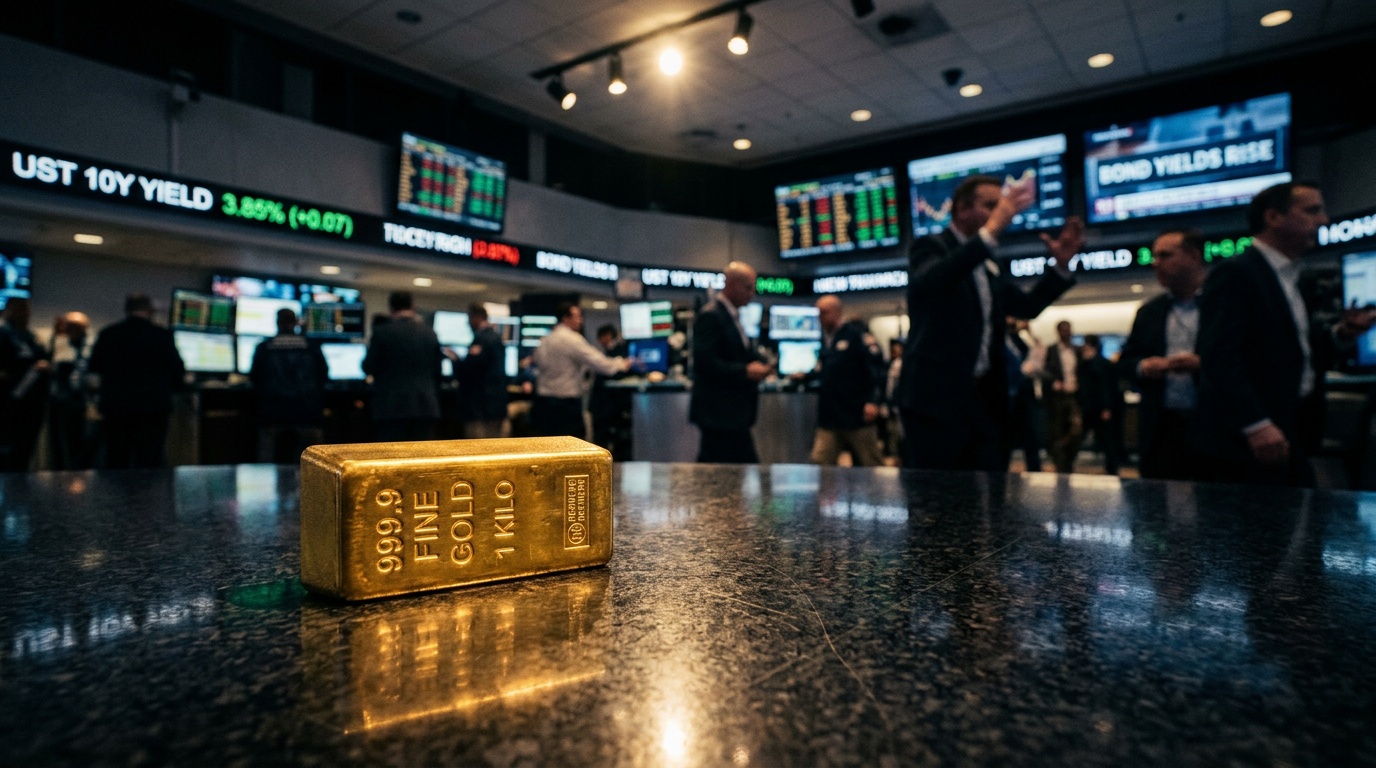
Gold closed at $3,976 per ounce on Thursday. It was the lowest close of the year, erasing nearly all of the gains of the last three quarters.
The yellow metal has entered a drawdown of about 26% below its January peak near $5,600—only its fifth drawdown of more than 25% since 1960, according to Morgan Stanley analysts.
The catalyst is geopolitical. Renewed U.S.–Iran hostilities in the Middle East have driven Brent crude above $85 a barrel, rekindling fears of sticky inflation. Those fears have hardened expectations that the Federal Reserve will keep nominal interest rates elevated, which is a headwind for non-yielding metals.
“Precious metals have come under selling pressure as oil prices move back into the $80s/bbl range,” Ryan McKay, senior commodity strategist at TD Securities, said, according to Bloomberg.
TD’s pricing simulation model shows only modest bearish positioning in gold for now. But McKay flagged a specific trigger. Trend-following commodity trading advisors (CTAs) are likely to unleash another round of automated selling if prices slide to around $3,790.
Lessons From The 1970s
For veteran investor Rick Rule, the retreat is a temporary occurrence in a broader bull market.
“We’re in a hiatus in what has been a very good market,” Rule said on the sidelines of his conference in Boca Raton, Florida.
While capital markets expect a hawkish Fed under new chairman Kevin Warsh, Rule argues that fiscal reality will prevail.
“I think the political class will lose their courage much like they did in 1975,” he said, contending that mounting debt-service burdens and credit-constrained consumers will eventually force Congress to pressure the Fed into cutting rates. He draws a direct parallel to that era. In 1975, rising rates halved gold’s price, from $200 to $100.
“When Congress lost their nerve and forced interest rates down,” Rule said, gold “went on a romp that began at $100 and ended five years later at $850.” He expects a similar interest-rate-driven resolution today.
Value, Work and Risk Appetite
For investors willing to spend only “an hour or two a month” on their portfolios, Rule advises sticking to top-tier royalty and major mining names. His three picks:
- Franco-Nevada Corp. (FNV) — a premier gold-focused royalty and streaming giant offering low-risk exposure.
- Wheaton Precious Metals Corp. (WPM) — a world-class streaming company providing margin security and high-quality asset exposure.
- Agnico Eagle Mines Limited (AEM) — a top-tier, low-political-risk senior gold producer with high operational standards.
For investors who’re willing to do more work, Rule suggests going after M&A targets.
“There are intermediate gold producers who are selling at substantial discounts by most measures to their largest peers. Either those discounts disappear, or they get taken over,” he said, pointing to a lower risk in the category.
Still, for those tolerant of high risk, Rule sees advanced explorers – citing the example of Rupert Resources Limited (RUPRF), recently acquired by Agnico Eagle.
“Ruperts of the world that are trading at 20% of NAV. If somebody buys Rupert for 50% of NAV, you have a double in the price, and the acquirer still gets the asset at a discount,” he said, elaborating how these opportunities don’t come and go overnight.
“Rupert was obviously a strategic asset to Agnico for four years, before Agnico bought it. The investors had lots of time to act, but they didn’t. So Agnico did. You’re going to see that repeated.”