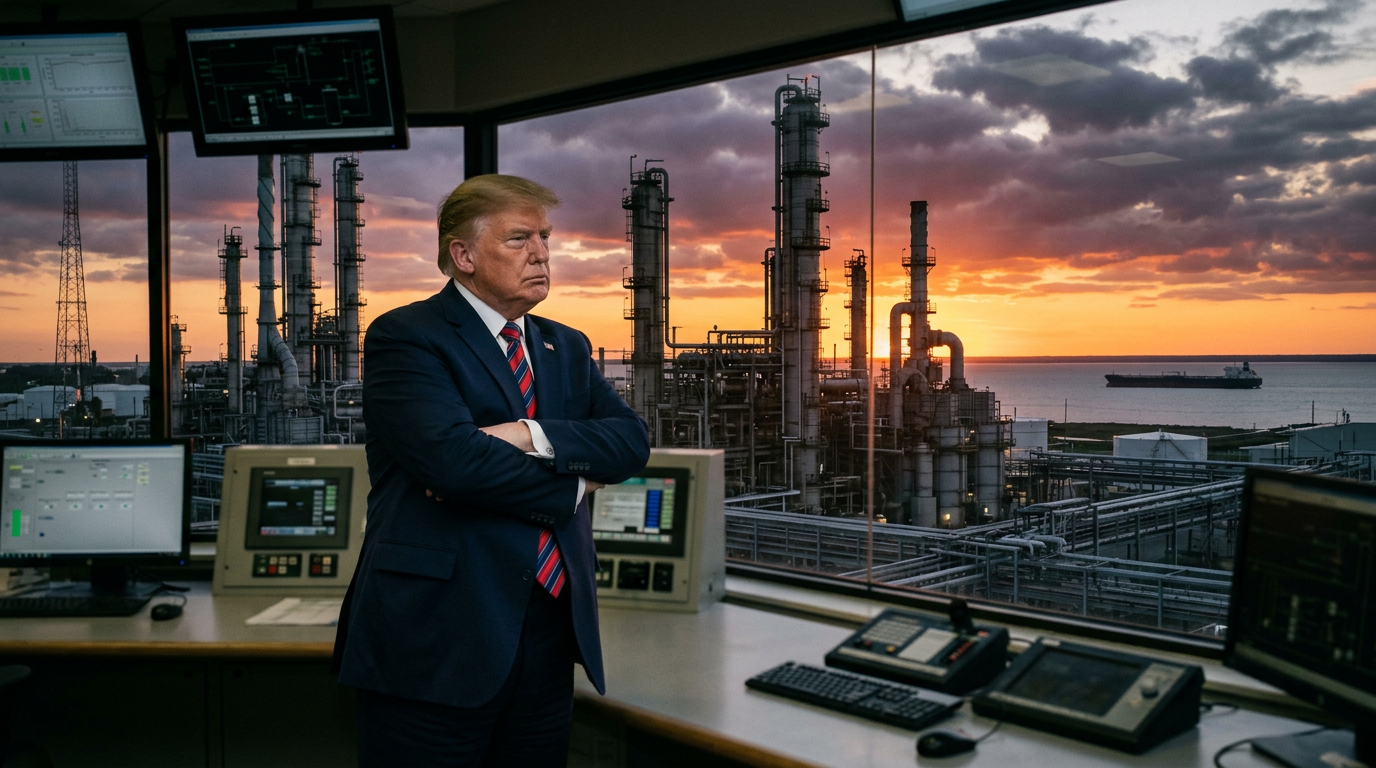
President Donald Trump took to Truth Social on Tuesday to declare that "Oil is flowing like never before" thanks to U.S. military efforts keeping the Strait of Hormuz open. But while the president is celebrating, the data tells a more complicated story: a severe global refining shortage has left roughly 10% of the world's refining capacity offline, and oil refiners are making historic profits.
Let's break down what's actually happening.
A 'FULL Blockade' and Gulf Deals
Trump praised military leadership—including Secretary of War Pete Hegseth and Chairman of the Joint Chiefs of Staff Dan Caine—for securing maritime routes. He announced that the Strait of Hormuz is open to all vessels except those associated with Iran, citing the nation's "lying, violent, malicious leadership." To counter Iran, Trump ordered a "FULL Blockade" explicitly targeting ships arriving at or departing from Iranian ports, as well as those carrying Iranian cargo.
Additionally, Trump stated he is replacing a 20% United States Reimbursement Fee with major "Trade and Investment Deals" from Gulf States. These investments, which he claims will be "MASSIVE," are expected to bring factories and equipment to the U.S., creating "millions of High Paying AMERICAN Jobs." Furthermore, Trump boldly declared that "IRAN WILL NEVER HAVE A NUCLEAR WEAPON!"
Refining Capacity Crisis and Historic Profits
Despite Trump's assurance of freely flowing oil, market data presents a challenging economic reality. According to Bloomberg data shared by the Kobeissi Letter, oil refiners are currently enjoying "historic profits," with the 3-2-1 WTI refining margin hitting a record high of $59 per barrel. These margins have nearly tripled since the beginning of 2026.
A severe shortage of global refining capacity drives this surge in profitability. Factors such as the Iran War, attacks on Russian refineries, and reduced fuel exports have severely tightened the global supply chain. Consequently, an estimated 8 million barrels per day—roughly 10% of global refining capacity—is currently offline. This supply shortage has kept prices for gasoline, diesel, and jet fuel elevated, even as crude oil trades approximately $40 per barrel below its March peak.
Crude and Oil Refiners In Focus
Crude Oil WTI futures were trading higher by 0.47% to hover around $79.71 per barrel at the last check. Meanwhile, the ETF tracking it, the United States Oil Fund LP (USO), was down 0.03% in overnight trading.
Similarly, Brent Oil Futures were trading higher by 0.70% to hover around $85.32 per barrel, and the same ETF was 0.36% higher in overnight trading.
Here are some major U.S.-listed oil refiners that are likely to be affected by the tightening global refining capacity and historic processing margins, along with their recent stock performance as of mid-July 2026.
Disclaimer: This content was partially produced with the help of AI tools and was reviewed and published by MarketDash editors.