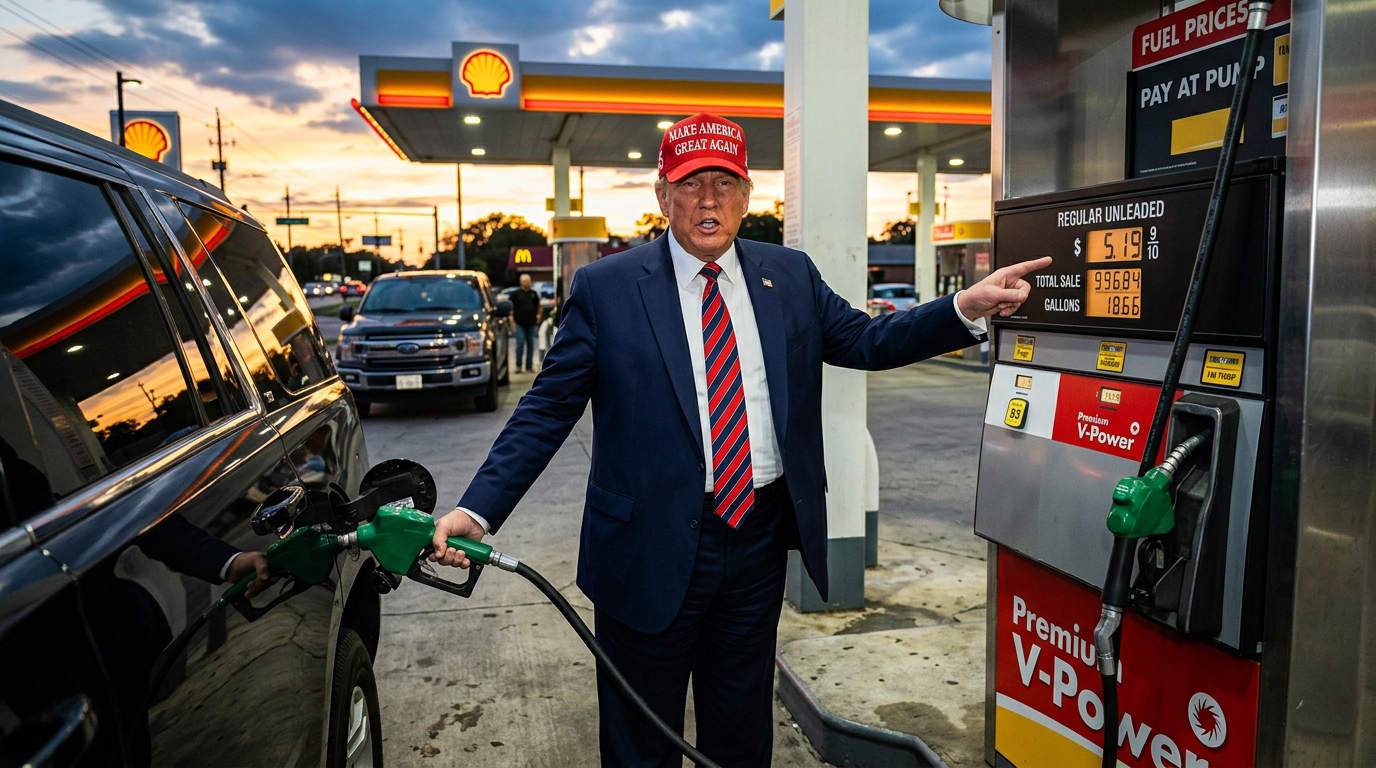
President Donald Trump wants lower gas prices, and he wants them now. But the data suggests they're already falling faster than they did during the last big spike.
On Thursday, Trump posted on X that "gas prices aren't declining fast enough," even as crude oil prices have dropped. But GasBuddy analyst Patrick De Haan pushed back, citing the numbers. "GasBuddy data shows the decline is faster than it was in 2022 when gas prices reached a record $5/gal," De Haan said, sharing a chart comparing the current drop to the one three years ago.
The national average for a gallon of gas stood at $3.9010 on Friday, according to AAA. That's down from recent highs, but still painful—especially on the West Coast. California drivers are paying $5.4860/gallon, and Washington isn't far behind.
Meanwhile, crude oil prices continue to slide. West Texas Intermediate (WTI) crude traded at $69.41/bbl on Friday, while Brent crude fell to $72.67/bbl.
But the picture is complicated by geopolitical risk. On Thursday, the Islamic Revolutionary Guard Corps (IRGC) warned ships away from the designated route through the Strait of Hormuz after a vessel was struck off the coast of Oman. That prompted Sen. Richard Blumenthal (D-CT) to argue that Trump had given away leverage over Iran through the Memorandum of Understanding (MoU) and called for suspending sanctions relief for Tehran.
Trump, for his part, has directed the DOJ to investigate oil producers for not lowering gasoline prices enough in line with cheaper crude. That move drew sharp criticism from economist Peter Schiff, co-founder of Echelon Wealth Partners, who called it a "socialist" approach. Schiff argued that probing companies for not cutting prices fast enough is a government overreach that undermines free markets.
So, are gas prices falling fast enough? The data says yes—faster than in 2022. But for drivers in California and politicians in Washington, "fast enough" is still a moving target.