Imagine the world's most important oil faucet gets turned off for half a year or more. According to Ken Griffin, that's not just a market headache—it's a one-way ticket to a global recession.
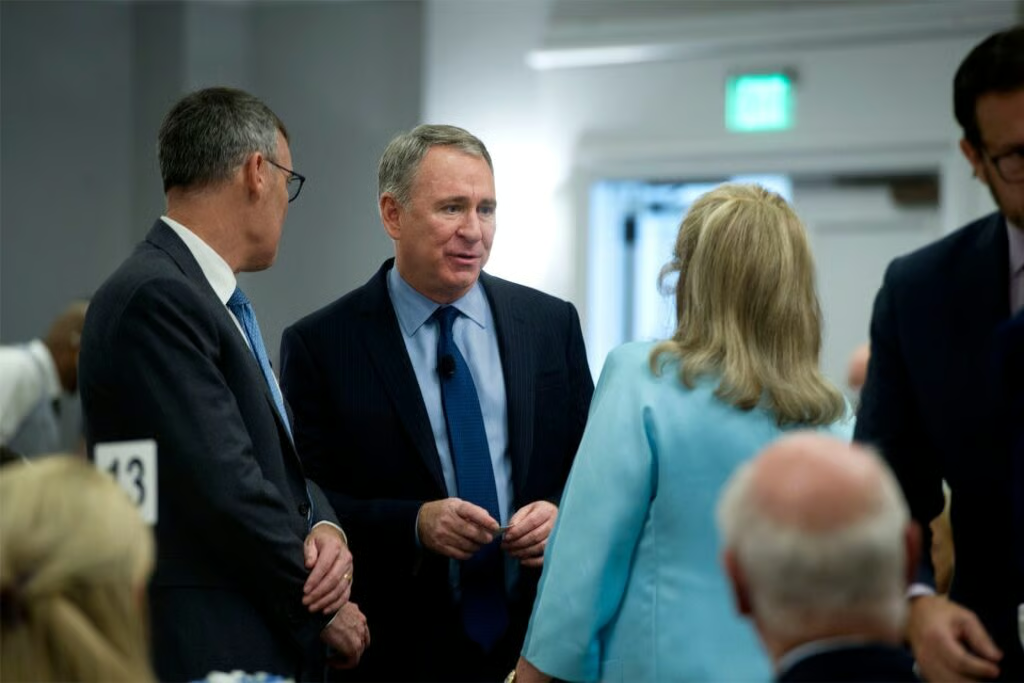
The Citadel founder laid out this stark scenario at the Semafor World Economy Summit in Washington, DC. "Let's assume it's shut down for the next six to 12 months… the world's going to end up in a recession. There's no way to avoid that," he said. The faucet in question is the Strait of Hormuz, the narrow waterway that funnels roughly one-fifth of the planet's oil. When that gets blocked, things get messy fast.
You'd see it first in the energy markets. Funds that track oil prices, like the United States Oil Fund (USO), or those offering broad energy exposure, like the State Street Energy Select Sector SPDR ETF (XLE), would likely jump on the news of a supply shock. But Griffin is pointing to something bigger than a spike at the pump. This is a classic energy shock—the kind that doesn't just raise prices but starts messing with the whole economic engine.
The real problem is what comes after the initial price surge. A sustained disruption doesn't just mean expensive oil; it means weaker consumer demand as people and businesses cut back. It puts central bankers in a terrible bind: do they tolerate the resulting inflation, or do they hit the brakes with higher interest rates again, risking a deeper slowdown? That kind of uncertainty is a recipe for volatility across the board, including in broad market benchmarks like the SPDR S&P 500 ETF Trust (SPY).
"This really is a very, very treacherous moment for the world economy," Griffin noted. You can already see the market jitters. Bonds have gotten jumpy, with investors sometimes flocking to the relative safety of long-term Treasuries, tracked by funds like the iShares 20+ Year Treasury Bond ETF (TLT), even as inflation fears simmer in the background.
There might be a silver lining, or at least a long-term shift, in all this. Griffin suggested that a prolonged crisis could finally give a serious push to alternatives like nuclear and wind power. In that world, clean energy-focused investments like the iShares Global Clean Energy ETF (ICLN) could see a tailwind.
Of course, this is all a conditional nightmare. If the strait stays open, the shock passes and the economy sighs in relief. But if it stays shut? Griffin's message is pretty clear: batten down the hatches.

.jpeg)