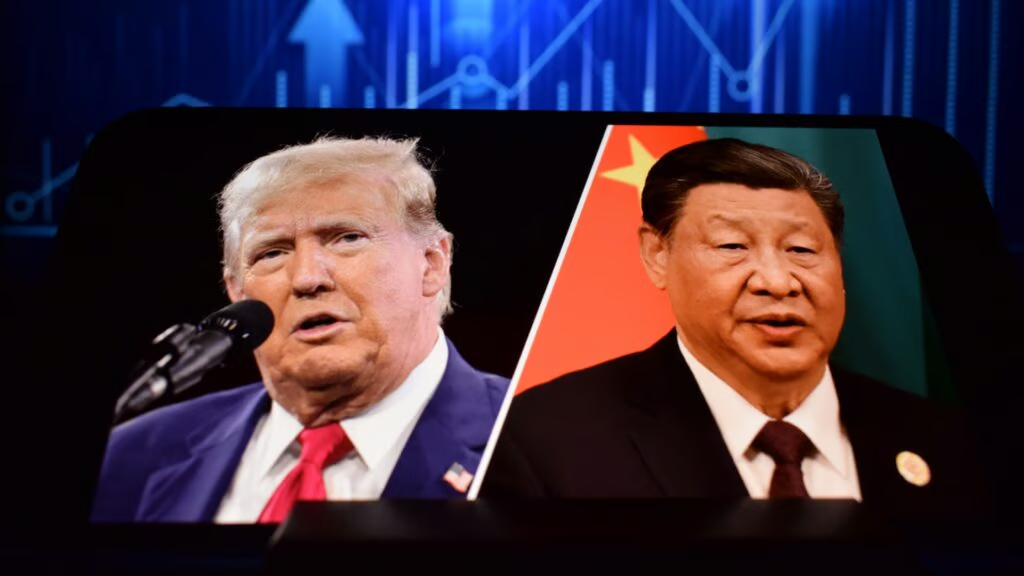
So here's a thing that happens in international relations: sometimes world leaders give speeches that sound like they're about abstract principles, but everyone in the room knows exactly who they're talking about. Chinese President Xi Jinping did that on Tuesday. While meeting with Spanish Prime Minister Pedro Sanchez, Xi declared that the "international order is crumbling into disarray." He didn't name the United States. He didn't have to.
In another meeting, this time with Abu Dhabi Crown Prince Sheikh Khaled bin Mohammed, Xi made his pitch for what comes next. He committed that China will "continue to play a constructive role" in the Middle East. The key phrase, though, was his warning that the world should not "revert to the law of the jungle." It's a classic diplomatic move: position yourself as the adult in the room while suggesting the other guy is the one swinging from the vines.
This rhetoric isn't happening in a vacuum. It's the verbal backdrop to a very concrete, very tense situation in the Strait of Hormuz. China has come out swinging against the U.S. blockade of Iranian ports there, calling it a "dangerous and irresponsible act."
Guo Jiakun, a spokesperson for the Chinese Foreign Ministry, spelled out the concern. He argued that the escalated U.S. military presence, combined with the blockade itself, could blow up an already fragile ceasefire in the region. His solution? A "comprehensive ceasefire" to ease the crisis. This marks a shift for Beijing. Earlier statements had just urged "restraint" from everyone. Now, they're pointing a finger.
Of course, when you point a finger, someone usually points one back. The recent condemnation from China comes after a weekend of warnings from President Donald Trump. On Saturday, Trump cautioned Beijing that it would face "big problems" if it went ahead with reported plans to supply Iran with air defense systems.
Then, on Sunday, he upped the ante. In an interview with Maria Bartiromo on Fox News's "Sunday Morning Futures," Trump threatened to impose a 50% tariff on China. The trigger? A report suggesting Beijing was planning to deliver a shipment of new air defense systems to Iran.
Beijing's response to the arms claim was swift and blunt. Spokesperson Guo called the allegations "completely fabricated." So we have a classic he-said-she-said, but with trillion-dollar economies and a major global shipping chokepoint in the balance.
Speaking of that chokepoint, the U.S. blockade officially took effect on Monday. But in the messy real world, blockades are rarely absolute. Maritime data from Kpler showed that some sanctioned tankers were still making their way through the Strait of Hormuz. One vessel, the Rich Starry, owned by Shanghai Xuanrun Shipping Co., reportedly carried 250,000 barrels of methanol through the waterway. For the record, that company was sanctioned by the U.S. back in 2023. Its exact routing was unclear, but its passage highlights the gap between a policy announcement and total control over one of the world's busiest sea lanes.
So, to recap: The U.S. is blockading Iran. China is calling it reckless. Trump is threatening tariffs over alleged arms deals. China is denying everything. And tankers, some linked to sanctioned Chinese firms, are still sailing through. Xi Jinping might be right that things feel a bit disordered. The question is what kind of order he's proposing to build in its place, and whether the U.S. is going to like it.

.jpeg)