





So here's the situation: the U.S. and Iran are still talking, but they're also flexing muscles in a crucial shipping lane. On Monday, Vice President JD Vance offered a glimpse of what a diplomatic breakthrough might look like, while markets seemed to take the tension in stride—oil prices actually dropped, and Asian stocks had a great day.
Vance Says Iran Deal Still Possible If Nuclear Demands Met, As Oil Prices Dip Below $100
MarketDash
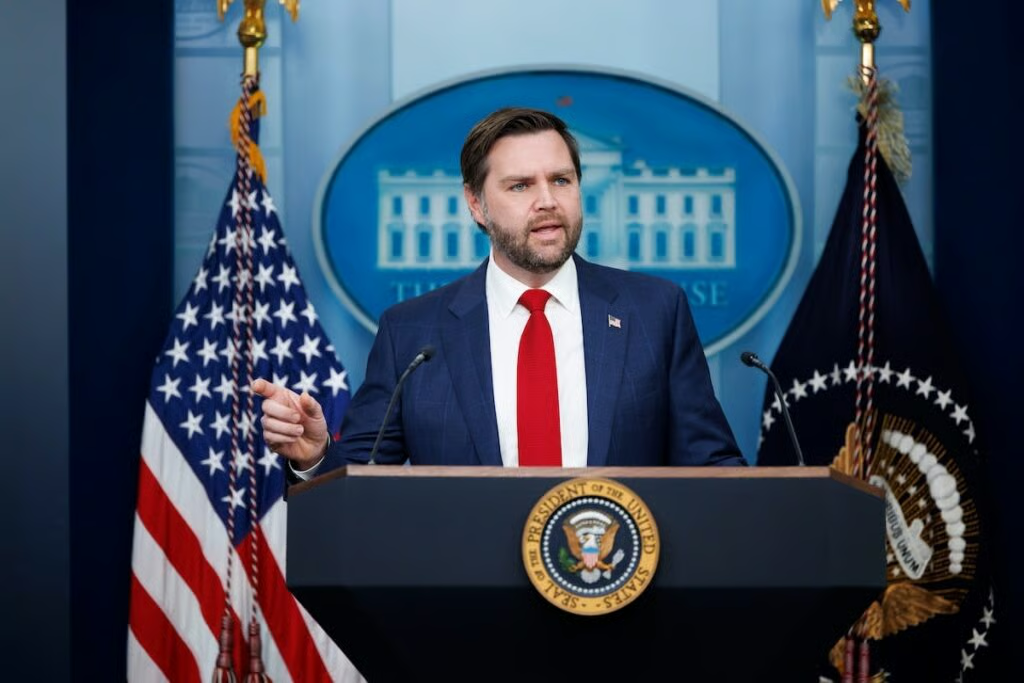
Vice President JD Vance outlined a potential path forward in U.S.-Iran talks, while markets saw oil prices decline and Asian equities surge.
Get Market Alerts
Weekly insights + SMS alerts
Markets Steady As Oil Prices Slide
Let's start with the numbers, because they tell an interesting story. While all this geopolitical chatter was happening, Dow futures rose 5.00 points, or 0.01%, to 48,430.00. S&P 500 futures gained 3.00 points, or 0.04%, to 6,925.75. Nasdaq 100 futures climbed 47.25 points, or 0.18% as of 8:54 p.m. EDT.
But the real action was in commodities. WTI crude for May delivery fell 2.81% to $96.30 per barrel. June contracts declined 2.56% to $90.57 per barrel. Brent crude dropped 2.61% to $96.77 per barrel. RBOB gasoline futures slipped 1.79% to $3.0601 per gallon, while natural gas futures edged down 0.49% to $2.614 per MMBtu.
Meanwhile, the U.S. dollar index fell 0.04% to 98.333.
Over in Asia, markets were having a party. South Korea's KOSPI surged 3.19% to 5,994.15, while Japan's Nikkei 225 jumped 2.34% to 57,836.27. So while oil was getting cheaper, stocks in some major Asian economies were getting more expensive.
Vance Signals Conditional Breakthrough In US-Iran Talks
Now, back to the diplomacy. In a conversation with Fox News, Vance laid out what it would take to get a deal done with Iran. The short version: Iran needs to meet America's "red lines" on nuclear issues.
"If America's 'red lines' are met, then this can be 'a very, very good deal for both countries,'" Vance said, adding that the next move rests with Iran. "The ball is very much in their court," the Vice President stated.
He explained that negotiations had shown some progress but ultimately fell short. "We put a lot on the table," Vance noted. "They moved in our direction, which is why I think we would say that we had some good signs, but they didn't move far enough."
According to Vance, the U.S. is insisting on two key conditions: the removal of enriched uranium from Iran and strict verification measures to prevent nuclear weapon development. So it's not just about limiting future production—it's about dealing with what's already there.
US Turns Up Pressure With Strait Of Hormuz Move
While Vance was talking about potential deals, the administration was also turning up the pressure. The administration of Donald Trump moved to block vessels linked to Iran near the Strait of Hormuz.
This is a big deal because the Strait of Hormuz is one of the world's most important oil shipping lanes. About 20% of the world's oil passes through there. The move came after talks in Islamabad ended without a deal and is aimed at pushing Tehran back to the negotiating table.
Vance connected the strait situation directly to the negotiations. "We need to see the Strait of Hormuz fully open," he said, warning that failure to do so could "fundamentally change the negotiation."
Meanwhile, Trump took to Truth Social with a more direct message: any Iranian vessels approaching the U.S. blockade would be "immediately eliminated."
Iran Signals Willingness To Continue Talks
On the other side, Iranian President Masoud Pezeshkian said Tehran remains open to further discussions, provided they take place within international legal frameworks, according to reports via Iranian official news agency YJC.
He cautioned that threats such as a blockade could disrupt global trade and reiterated that Iran prefers diplomacy over escalation. So you've got both sides saying they want to talk, but also taking actions that make talking harder.
What's interesting here is how the markets are reacting. Normally, you'd expect oil prices to spike when there's tension in the Strait of Hormuz. But they're going down. Maybe traders think the U.S. pressure will work. Maybe they think a deal is actually possible. Or maybe they're just focused on other things.
Either way, we've got a classic geopolitical standoff with financial markets watching closely. Vance says a good deal is possible if Iran meets certain conditions. The U.S. is applying pressure in a key shipping lane. Iran says it's willing to talk but doesn't like the pressure. And oil traders seem to be betting that somehow, this all works out.
More News
Vance Says Iran Deal Still Possible If Nuclear Demands Met, As Oil Prices Dip Below $100
.jpeg)
Inside: Pre-IPO Ticker + The Next Elon Musk?
Elon Musk's Social Media U-Turn: From 'Thirst Trap' Critic to Potential Instagram and TikTok Promoter for SpaceX IPO
JPMorgan's Q1 Earnings: Can the Banking Behemoth Keep Its Streak Alive and Lift the Dow?

Software Stocks, Left for Dead, Just Had Their Best Day in a Year
Mar-a-Lago Bombshell
Intel's Stock Hits a 52-Week High. Here's What's Fueling the Rally.
A Congressman Bought BP Stock After Iran Strikes. Here's Why That's Interesting.
Get Market News Alerts
Real-time alerts on price moves, news, and trading opportunities.
Join 20,000+ investors. No spam, ever.
Featured Articles
View all newsElon Musk's Social Media U-Turn: From 'Thirst Trap' Critic to Potential Instagram and TikTok Promoter for SpaceX IPO
By MarketDash
April 13, 2026
Trump's Executive Order 14330: What Wall Street Doesn't Want You to Know (Ad)
By The Oxford Club
JPMorgan's Q1 Earnings: Can the Banking Behemoth Keep Its Streak Alive and Lift the Dow?
By MarketDash
April 13, 2026
Software Stocks, Left for Dead, Just Had Their Best Day in a Year
By MarketDash
April 13, 2026
Intel's Stock Hits a 52-Week High. Here's What's Fueling the Rally.
By MarketDash
April 13, 2026

How To Claim Your Pre-IPO Stake In SpaceX! (Ad)
By Paradigm Press
A Congressman Bought BP Stock After Iran Strikes. Here's Why That's Interesting.
By MarketDash
April 13, 2026

The Ceasefire Trade: Why Emerging Markets Are Rotating, Not Rallying
By MarketDash
April 13, 2026