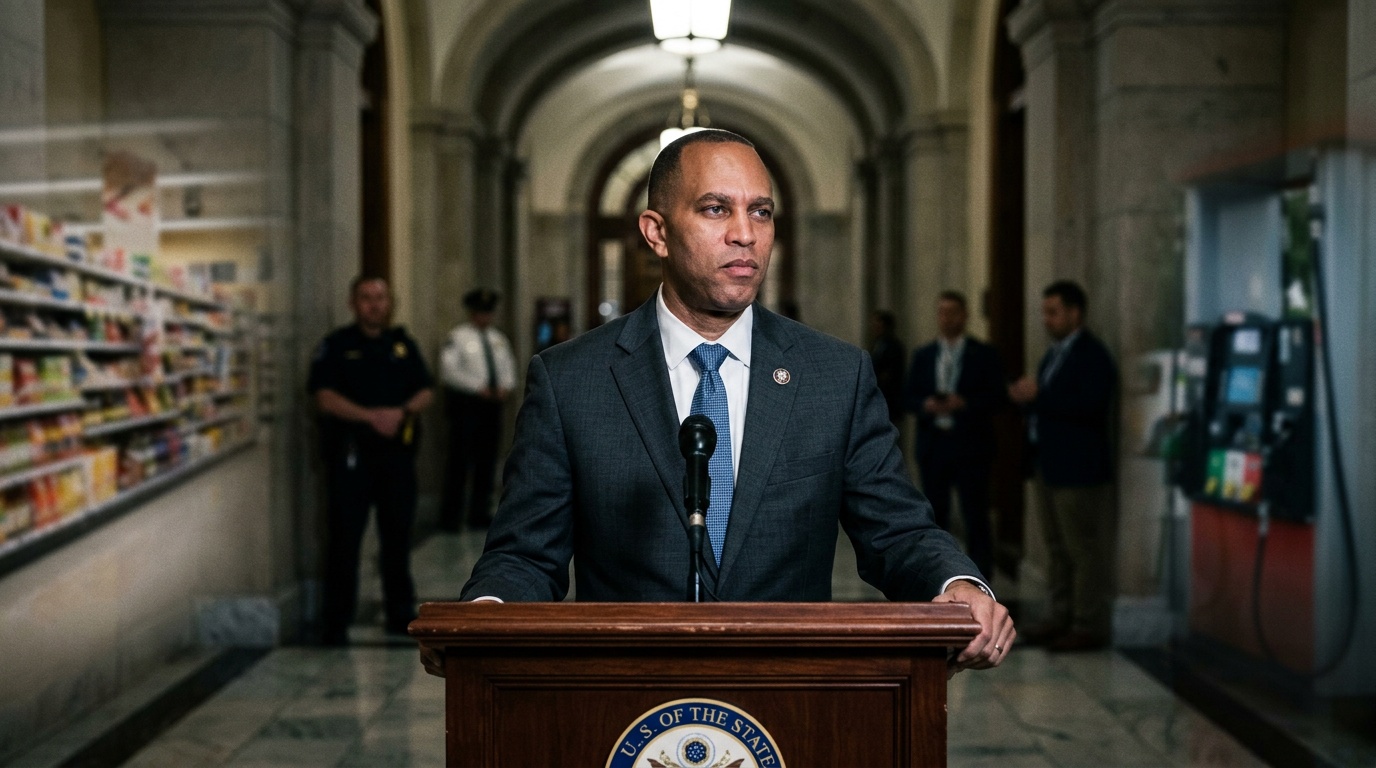
Let's talk about what happens when the world gets noisy. In November 2025, the noise was a historic U.S. government shutdown, AI valuation panic, and the usual geopolitical rumblings. But in the background, something quieter and arguably more interesting was happening: a portfolio built on the very old, very boring principles of Benjamin Graham—buying assets for less than they're worth—was having a pretty good month.
This isn't about chasing the next big thing. It's about finding companies trading for a fraction of the value of their factories, land, ships, or power plants. In November, that approach meant watching an Argentine power company soar 76%, a Hong Kong property developer climb nearly 15%, and a Japanese automaker gain over 18%. All while the S&P 500 was busy having a relief rally about the government finally reopening.
The Backdrop: A Sigh of Relief (and a Lot of Other Stuff)
First, the noise. The U.S. government shutdown that started on October 1 finally ended after roughly 40 days when the Senate advanced a funding bill on November 9. It was the longest in American history. About 750,000 federal employees were furloughed, another 2 million worked without pay, and airlines canceled thousands of flights. It was a mess, and markets had priced in a lot of fear.
When the resolution came, a classic relief rally erupted. Investors who had been sitting on cash rushed back into stocks. The S&P 500 gained 1.54% on November 9. The Nasdaq jumped 2.27%. This buoyancy spread globally, lifting European and Asian markets. But here's the thing about relief rallies: they're broad and emotional. The value portfolio's moves were specific and, in theory, rational—based on what a company actually owns.
Beneath the rally, bigger shifts are still playing out. The era of easy globalization might be over, replaced by strategic decoupling and a focus on national security. Trade policy is now a weapon. But if the U.S. accounts for only about 15% of global goods trade, that means 85% of the action is elsewhere. For a value investor, that's not a threat; it's a hunting ground.
Region by Region: Where the Value Was
United States: Shutdown Drag, Sector Rotation
The shutdown was a measurable drag on the U.S. economy. Consumer sentiment took a hit. More concerning, job cuts accelerated sharply. In the first nine months of 2025, 946,426 jobs were cut—a 55% increase from the same period in 2024. About a third came from the Department of Government Efficiency (DOGE). AI-related dismissals are also accelerating, with 17,375 jobs eliminated due to AI through September.
In the markets, there was a rotation away from high-flying tech stocks early in the month. The Nasdaq had its worst week in nearly seven months at one point. But as the shutdown fears eased, risk appetite returned.
The portfolio's U.S. holdings had a mixed month in this volatility. Peabody Energy (BTU), the coal producer, dipped 1.68% but is still up 47% for the year. It got a boost from the administration labeling metallurgical coal as essential for national security and from surging data center power demand. Assured Guaranty (AGO) (the bond insurer) gained 8.71%. The grocery chain Ingles Markets (IMKTA) rose 4.14%. Dry bulk shipper Genco Shipping & Trading (GNK) was a standout, up 11.08% for the month.
Other notable moves: watchmaker Movado Group (MOV) (+8.40%), outdoor gear company Johnson Outdoors (JOUT) (-3.66%), and diversified operator NACCO Industries (NC), which surged 21.84% in November.
Europe: Stagnation, But Earnings Beat
Europe is, to put it politely, not booming. "The German economic locomotive continues to sputter," as the reports noted. Business confidence in the U.K. hit a multi-year low. Yet, corporate earnings kept beating expectations. Go figure.
The portfolio's European picks reflected deep value. Danish shipping giant A P Moller-Maersk (AMKBY) gained 5.08%. French conglomerate Bollore SE (BOIVF), trading at a mere 0.52 times its tangible book value, dipped slightly. The star was German holding company Porsche Automobile Holding (POAHY), which surged 12.20%. It trades at an almost absurdly cheap 0.33 times tangible book value—you're basically buying a massive stake in Volkswagen Group at a 67% discount to the assets on its balance sheet.
Swiss watchmaker The Swatch Group (SWGAY) jumped 16.15% on news Switzerland was close to a deal with the U.S. to lower tariffs.
China & Hong Kong: Green Shoots in Property
Here, the story was about tentative stabilization. China's consumer prices actually rose 0.2% year-over-year in October, a turn from deflation. Cross-border stock trading activity surged. But the real action was in Hong Kong's property market, which showed clear signs of recovery. Prices rebounded 4% from their bottom.
The portfolio's big winner here was Sun Hung Kai Properties (SUHJY), up 14.67% in November and 46.76% year-to-date. CLSA upgraded the stock, citing strong sales—one new project sold all 160 units in a day. It trades at just 0.48 times tangible book value. Yue Yuen Industrial (YUEIY), the footwear maker, gained 13.30%, while cement giant Anhui Conch Cement (AHCHY) dipped slightly.
Japan: Politics, Yen, and a Rocketing Nikkei
Japan had a wild ride. The Nikkei fell in early November on AI worries, then rebounded sharply. The bigger story was political: new Prime Minister Sanae Takaichi struck a governing accord, and the Bank of Japan stayed on the sidelines. The yen weakened, and stocks soared—the Nikkei's 16.6% rally in October was its biggest monthly advance since 1990.
In this environment, Subaru Corp (FUJHY) was the portfolio's star, surging 18.87% in November. Kyocera (KYOCY) gained 4.03%, and Dai Nippon Printing (DNPLY) rose 4.15%. Semiconductor firm Rohm Co (ROHCY) dipped 4.23% but is still up over 52% for the year.
The Rest of the World: Argentina's Moment
This is where it gets fun. Under President Javier Milei's pro-market reforms, Argentina's market has been on a tear. The portfolio's holding there, power generator Central Puerto (CEPU), delivered a mind-bending 76.75% return in November alone. The company is investing in lithium and solar projects and holds over 20% of Argentina's private energy market with dollar-denominated contracts. It's the highest multiple in the portfolio at 1.49 times tangible book—a sign the market is pricing in real change.
Elsewhere, Greek container shipper Danaos Corp (DAC) (trading at 0.48x book) advanced 12.53%. Monaco-based Scorpio Tankers (STNG) rose 15.30%.
The Discipline: What Actually Matters
All of this isn't random stock-picking. It's a system. The portfolio of 27 stocks follows a simple, rigid framework straight from the Benjamin Graham playbook:
- Valuation: Buy at a discount to tangible book value. The portfolio average is 0.88, meaning you're theoretically buying $1 of net assets for 88 cents. Some, like Porsche Holding, are far cheaper.
- Balance Sheets: Avoid debt. The average equity-to-asset ratio is 0.68. These companies aren't leveraged to the moon; they own stuff.
- Income: Get paid to wait. The average dividend yield is 3.73%, ranging from 0% to over 8%.
- Diversification: Spread the bets. Holdings span 17 countries and multiple sectors—real estate, shipping, industrials, energy. No single story can sink it.
This is the "margin of safety" in action. You're not betting on a brilliant new product or a charismatic CEO. You're betting that a factory, a fleet of ships, or a Hong Kong land bank is worth more than the market says it is. Sometimes you wait. In November, in a few places, you didn't have to wait long.
So What's Next?
The shutdown is over, but the structural challenges—trade tensions, geopolitical risk, uneven growth—aren't. The portfolio isn't trying to predict any of that. It's just looking for cheap assets with strong balance sheets. Right now, those seem to be in a few key areas:
- Asian Real Estate: The Hong Kong recovery looks real, and developers trade at deep discounts to their land value.
- Global Shipping: Companies like Danaos and Maersk trade below asset value despite decent industry fundamentals.
- European Value: Earnings are beating expectations even in a stagnant economy. The market hasn't fully priced that in.
- Latin American Reform: Argentina's experiment is high-risk, but for companies with dollar revenues, it could be high-reward.
- Energy Transition Plays: Both traditional energy (trading below book) and renewable projects in emerging markets offer value.
Of course, there are risks: a worse Chinese slowdown, trade wars, or a reversal of reforms in places like Argentina. But the whole point of buying at a discount to tangible assets is that those assets provide a cushion. The factory is still there. The ships still float.
The Takeaway
November 2025 was a month where the headlines were about political dysfunction and market relief. But for a specific type of investor, it was a month where the basic math of value investing worked. A power plant in Argentina was worth more. A property portfolio in Hong Kong was worth more. A collection of industrial assets in Europe was worth more.
Benjamin Graham famously said the market is a voting machine in the short term and a weighing machine in the long term. In November, amid all the noisy voting, the weighing machine did some work. It looked at assets and prices, and in several cases, decided the prices were just too low. That's a boring story. But boring, in finance, can sometimes be very profitable.