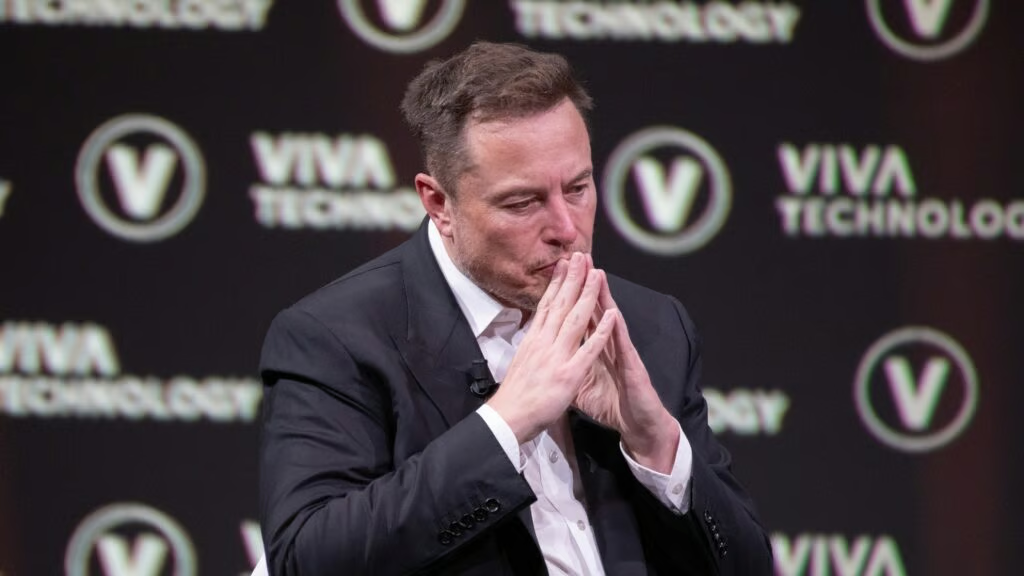
If you're looking for a year that had everything, look no further than Elon Musk's 2025. The Tesla Inc. (TSLA) and SpaceX CEO, who also happens to be the world's richest person, managed to pack political kingmaking, public feuds, declining car sales, reinstated mega-pay packages, and the promise of autonomous vehicles into twelve eventful months. And somehow, through it all, his net worth kept climbing.
For a 54-year-old businessman juggling Tesla's robotics ambitions and SpaceX's looming IPO, 2025 proved to be nothing if not pivotal. Here's how it all went down.
The Trump Alliance That Changed Everything
Let's start with the elephant in the room: Musk went all-in on Donald Trump's 2024 presidential campaign. And by all-in, we're talking about $250 million in funding. That kind of investment buys you a seat at the table, and Musk got exactly that, becoming a key member of Trump's inner circle after the election victory.
The reward? Leadership of the Department of Government Efficiency, or DOGE (yes, really), alongside GOP lawmaker Vivek Ramaswamy. This wasn't a traditional government agency but rather a non-governmental body tasked with slashing federal spending through budget cuts and workforce reductions.
Musk's initial promise was ambitious, to put it mildly. He claimed DOGE could trim about $2 trillion from federal spending. Reality, as it often does, had other plans. By the end of 2025, DOGE reported savings of approximately $175 billion. Still a substantial figure, but nowhere near the headline-grabbing number Musk had floated. His efforts drew particular criticism when it came to funding cuts at the United States Agency for International Development, which didn't exactly win him fans among humanitarian advocates.
When the Bromance Went South
If you thought Musk and Trump would remain best friends forever, you haven't been paying attention to either of their personalities. Despite their initially cozy relationship, cracks started appearing soon after Trump settled back into the White House.
The breaking point? Trump's Big Beautiful Bill, which included policy changes that directly threatened Musk's business empire. We're talking about the $7,500 federal EV credit that helped make Teslas more affordable, and relaxed Corporate Average Fuel Economy standards that gave Tesla breathing room. The administration also effectively killed off ZEV credit sales, a revenue stream that had brought Tesla over $2.7 billion. That's not pocket change, even for someone as wealthy as Musk.
Musk eventually exited DOGE, and what followed was a social media spectacle for the ages. At one point, Musk attacked Trump over alleged ties to convicted sex offender Jeffrey Epstein. He also floated the idea of creating his own political party, the America Party, as an alternative to the traditional Democratic and Republican two-party system. Subtle, this was not.
The ultimate snub came when Trump hosted a White House Rose Garden dinner for tech luminaries. The guest list included Microsoft Corp. (MSFT) founder Bill Gates, OpenAI's Sam Altman, Apple Inc. (AAPL) CEO Tim Cook, and Meta Platforms Inc. (META) CEO Mark Zuckerberg. Musk's name? Conspicuously absent, making him the most high-profile person not invited.
The good news is that relationships in politics are fluid. By year's end, Musk was back in Trump's good graces. "I like Elon a lot; he really helped during the election with his endorsement," Trump said during a White House press briefing. Crisis averted, at least for now.
The Pay Package That Keeps on Giving
Another major storyline of Musk's year revolved around compensation. In November, Tesla shareholders voted overwhelmingly in favor of a trillion-dollar performance-based pay package for their CEO, despite opposition from major investors, proxy advisory firms, and analysts who thought the whole thing was excessive.
This isn't just free money being handed to Musk. The package is structured around performance milestones that Tesla needs to hit. But here's where it gets interesting: Musk's previous $56 billion pay package, which had been struck down by a Delaware court, was recently reinstated by that same court. If Musk exercises all the stock options tied to his 2018 compensation plan, his stake in Tesla would jump from roughly 12.4% to about 18.1% of the company's expanded share base.
For context, this pay package could genuinely make Musk the world's first trillionaire. We're not talking metaphorically here, we're talking actual twelve-zeros-after-a-number wealth.
The Sales Problem Nobody Wants to Talk About
Here's where things get uncomfortable for Tesla bulls: Musk's political activism appears to be hurting sales. November U.S. sales dropped 23%, and the company has consistently posted declines in European markets. It turns out that when your CEO becomes one of the most polarizing political figures in America, some customers decide they'd rather buy a different electric vehicle.
Even the Cybertruck, which Musk has repeatedly called Tesla's best vehicle, is struggling. During Q3 2025, Tesla sold just 5,385 Cybertruck units in the United States, representing a 62.6% year-over-year decline. Tesla's Q4 delivery estimates also came in below market expectations.
The irony? Despite all this, Tesla remains the most valuable automaker in the world, worth over $1.6 trillion. The market, it seems, is betting on Musk's future promises rather than current sales figures.
Robotaxis: Still Waiting for the Robot Part
Speaking of future promises, let's talk about Tesla's robotaxi ambitions. The service kicked off in Austin earlier this year, though with an important caveat: there's still an onboard safety operator. Not quite the fully autonomous experience Musk had promised.
Initially, Musk predicted that Tesla robotaxis would serve half the U.S. population. Then he walked that back to 8-10 major cities. Most recently, he's been touting driverless operations, but Tesla has had limited success actually demonstrating the technology. There are ongoing doubts about whether the Full Self-Driving system's vision-based approach can truly achieve the level of autonomy needed for robotaxis.
Still, Musk recently claimed he was driven around Austin autonomously, suggesting that real autonomy might be closer than skeptics think. Whether that's true remains to be seen, especially given that the NHTSA launched a probe into Tesla's robotaxi service earlier this year. Regulators tend to have questions when you're putting people in cars without human drivers.
SpaceX Prepares for Its Close-Up
While Tesla has been stumbling, SpaceX continues to soar (pun absolutely intended). The commercial space flight company is reportedly gearing up for an IPO in 2026, with a potential valuation reaching $1.5 trillion. SpaceX has become a dominant force in the space industry and plays a crucial role in NASA's Artemis mission to return humans to the moon.
Musk's space ambitions got an additional boost when Trump named Jared Isaacman as NASA's Administrator. Isaacman, the former CEO of Shift4 Payments Inc. (FOUR), is a close Musk ally and had previously withdrawn his nomination before being named again. Having a friend running NASA doesn't hurt when you're trying to get to Mars.
Following the Money
Let's talk numbers. Forbes estimates Musk's current net worth at around $730 billion, while Bloomberg pegs it closer to $623 billion. Either way, we're looking at a roughly $190 billion increase since the start of the year. Your personal savings account probably didn't see quite the same percentage gains.
With Tesla valued at over $1.6 trillion and SpaceX potentially reaching a similar valuation after its IPO, the approved pay package could genuinely push Musk into trillionaire territory. That would make him not just the richest person in the world, but the richest person in recorded human history by a comfortable margin.
What Comes Next
Musk has recently refocused his attention on Tesla, coinciding with a change in the company's mission statement to "amazing abundance." The automaker is pushing hard into autonomous driving and robotics, while SpaceX prepares for its public debut. If 2025 was eventful, 2026 promises to be even more so.
The big question is whether Musk can navigate the political drama, repair Tesla's brand image with consumers, deliver on his autonomous vehicle promises, and successfully take SpaceX public. That's a lot of spinning plates for even the world's richest person. But if there's one thing we've learned from watching Musk over the years, it's that betting against him tends to be expensive. Just ask the Tesla short-sellers who've been burned repeatedly over the past decade.
Whatever happens, you can be sure it won't be boring. And in the world of Elon Musk, boring was never really an option anyway.