Why $300 a Month for 30 Years Beats Betting on a Stock
MarketDash Editorial Team
Author
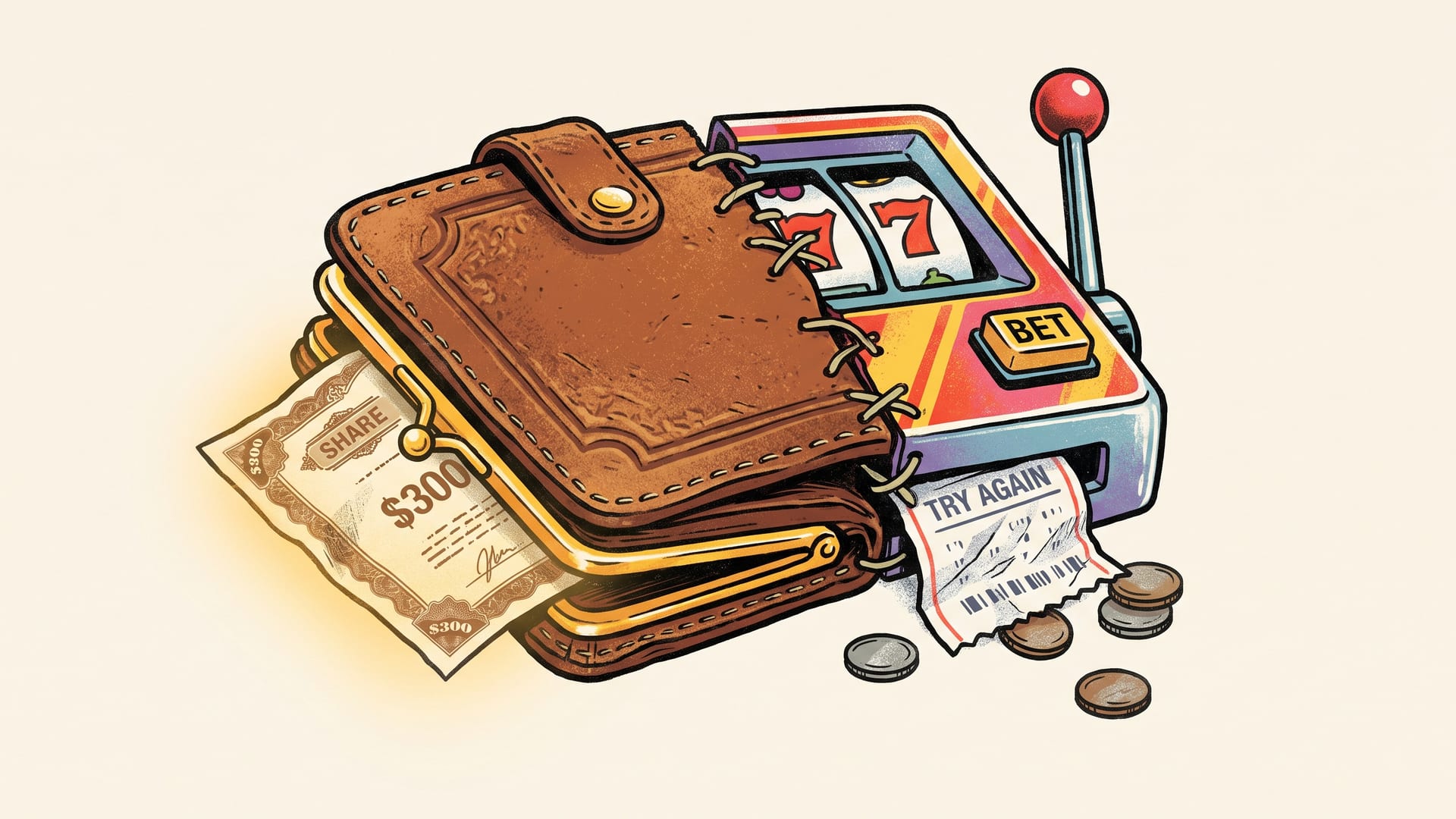
A bet needs a loser. A business does not.
Casino games are closed loops. For you to win, another player has to lose, and the house takes a cut of the table either way. The money never leaves the building.
A stock is not that. It is a share of a company. The company sells things to customers, pays its costs, and keeps what is left. Some of that leftover profit comes back to you as dividends, which is simply a yearly payment per share divided by the share price. The rest gets reinvested so the business can earn more later. Nobody has to lose for you to make money. The customer got something they wanted, the company got paid, and you own a piece of the machine.
That is the whole difference between investing and betting: an investment pays you out of the business's profits, and a bet pays you out of the next person's mistake.
The casino feeling is real. Respect it.
Here is the honest part. Anything you can trade in ten seconds, you can gamble on. A stock's price changes all day, and every change is a tiny invitation to have an opinion. Nobody has ever panic-sold a savings account at eleven at night.
Trading is the part that feels like a casino, because it is one. When you buy a stock only because you think someone will pay more for it later, you are not backing a business. You are betting on the next person. After fees and taxes, one side wins and one side loses, and the people who play most often tend to be the ones paying for the building's lighting.
A falling price, though, is not a verdict on the business. Compare the share price to a year of profit per share and you get the P/E ratio, a quick read on what the market is charging for each dollar of earnings. If profit stays flat and the price drops, the P/E drops. The company did not get worse. It got cheaper. The quote moved; the business did not.
Keep two pockets, and label them
Most people who feel like gamblers are running one pocket for two different jobs.
The investing pocket holds money you will not touch for a long time. It goes into a broad fund on a schedule, in the same amount, whether the mood is good or foul. Its job is to own the profit machine for decades and let the boring math work.
The trading pocket is money you can lose entirely without changing your life. It gets a fixed number, and the number does not grow because you had a good month. If you would rather not have a trading pocket at all, that is a perfectly good answer. Most people do not need one.
Keep your retirement account out of the game entirely, too. Taking money out of a traditional IRA or 401(k) before age 59½ usually means income tax plus a 10% penalty, with some exceptions. The rules are built to reward leaving it alone.
Three hundred dollars a month, no hunch required
Start with $0, add $300 a month for 30 years, and earn 8% a year before taxes and fees, not adjusted for inflation. You end with about $447,000. You put in about $108,000. The other $339,000 is growth, and you never had to be right about a single company to get it.
Divide 72 by a yearly return and you get a rough doubling time. At 8% a year, money doubles in about 9 years. That rule is why starting early beats starting clever.
Fees are the one house edge you actually control. The same $300 a month for 30 years at 8% a year before fees ends at about $443,000 with a 0.05% yearly fee, and about $332,000 with a 1.5% yearly fee. The pricier fund costs about $111,000. Nobody hands you a receipt for that. It just shows up as a smaller number decades later.
The other number worth knowing is the 4% rule. Research from the 1990s (William Bengen in 1994, the Trinity study in 1998) found that withdrawing 4% of a stock-and-bond portfolio in your first year of retirement, then raising the amount with inflation, lasted at least 30 years in most historical periods. Flipped around, it means saving 25 times your yearly spending. That is a target, not a promise, but it turns "enough" into something you can measure.
Check it yourself in MarketDash
Pick a company whose business you actually understand and open its stock page. In the Intrinsic Value section, look at the discounted cash flow estimate and the similar-companies comparison behind it. That range is an attempt to value the business, not the ticker. Then read the Wall Street section, where each analyst's rating, price target, upside, and date sits in the open.
Two things tend to jump out. The professionals disagree, sometimes badly. And the price swings while the business estimate barely budges. That gap is the whole game. If you cannot write down why the business will earn more in ten years, you are at the tables, not in the business.
So do the dull thing before the market hands you a reason to do something else: set up an automatic transfer into a broad fund for the same day every month, and then leave it alone. Your edge is not a hunch. It is the schedule.
Get Market News Alerts
Real-time alerts on price moves, news, and trading opportunities.
Join 20,000+ investors. No spam, ever.
Featured Articles
View all news
S&P 500 Opening Odds: Futures Edge Higher As Anthropic IPO, Fed Meeting And Earnings Collide

Stephen Moore Says Kevin Warsh May Need Another Rate Hike to Crush Inflation, Even as Trump Pushes for Cuts

Trump Approval Sinks to Record Low as 75% Call Economy 'Not So Good' or 'Poor'

Celestica Stock Jumps 11% After Q3 Beat and Raised Guidance

Cadence Design Systems Beats Q3 Estimates, Raises 2026 Outlook on AI Momentum

Trump's 32% Approval Offers GOP Little Relief as 73% Say Cost of Living Is Heading the Wrong Way

Amkor Stock Jumps 6% After Q3 Double Miss: Here's Why Investors Shrugged It Off