Semiconductor companies are capturing a growing share of the artificial intelligence investment boom. Hyperscaler spending, tight memory supply and demand for advanced manufacturing, packaging and custom silicon are lifting valuations across the chip industry.
Several major chipmakers crossed or briefly exceeded the $1 trillion market-capitalization threshold in 2026. Meanwhile, established AI leaders pushed deeper into multi-trillion-dollar territory.
Taiwan Semiconductor, Samsung and Intel Benefit From Foundry Demand
Samsung Electronics Co. Ltd. (OTC: SSNLF) crossed $1 trillion in May.
Contract-chip manufacturing leader Taiwan Semiconductor Manufacturing Co. Ltd. (NYSE: TSM), meanwhile, entered the $2 trillion club in February.
Counterpoint Research views Taiwan Semiconductor as the biggest beneficiary of the AI semiconductor boom.
The company is benefiting from strong demand for advanced manufacturing nodes and limited advanced packaging capacity.
Taiwan Semiconductor also holds roughly 42% of the Foundry 2.0 market, according to Counterpoint.
Samsung is also benefiting from demand for its 4-nanometer, or SF4, and 5-nanometer, or SF5, manufacturing nodes. Higher wafer prices are adding another tailwind.
Intel Corp. (NASDAQ: INTC) is gaining traction in advanced packaging. Alphabet Inc.'s (NASDAQ: GOOGL) Google adopted Intel's EMIB-T packaging technology for its next-generation tensor processing unit.
Counterpoint said Samsung and Intel are benefiting as chip customers seek more manufacturing options. However, both still trail Taiwan Semiconductor in manufacturing scale, yields and packaging execution.
Broadcom Inc. (NASDAQ: AVGO) also briefly touched a $2 trillion valuation in April, reflecting investor enthusiasm for custom AI accelerators and networking chips.
Memory Boom Pushes Micron, SK Hynix Past $1 Trillion
AI demand is also reshaping the memory market.
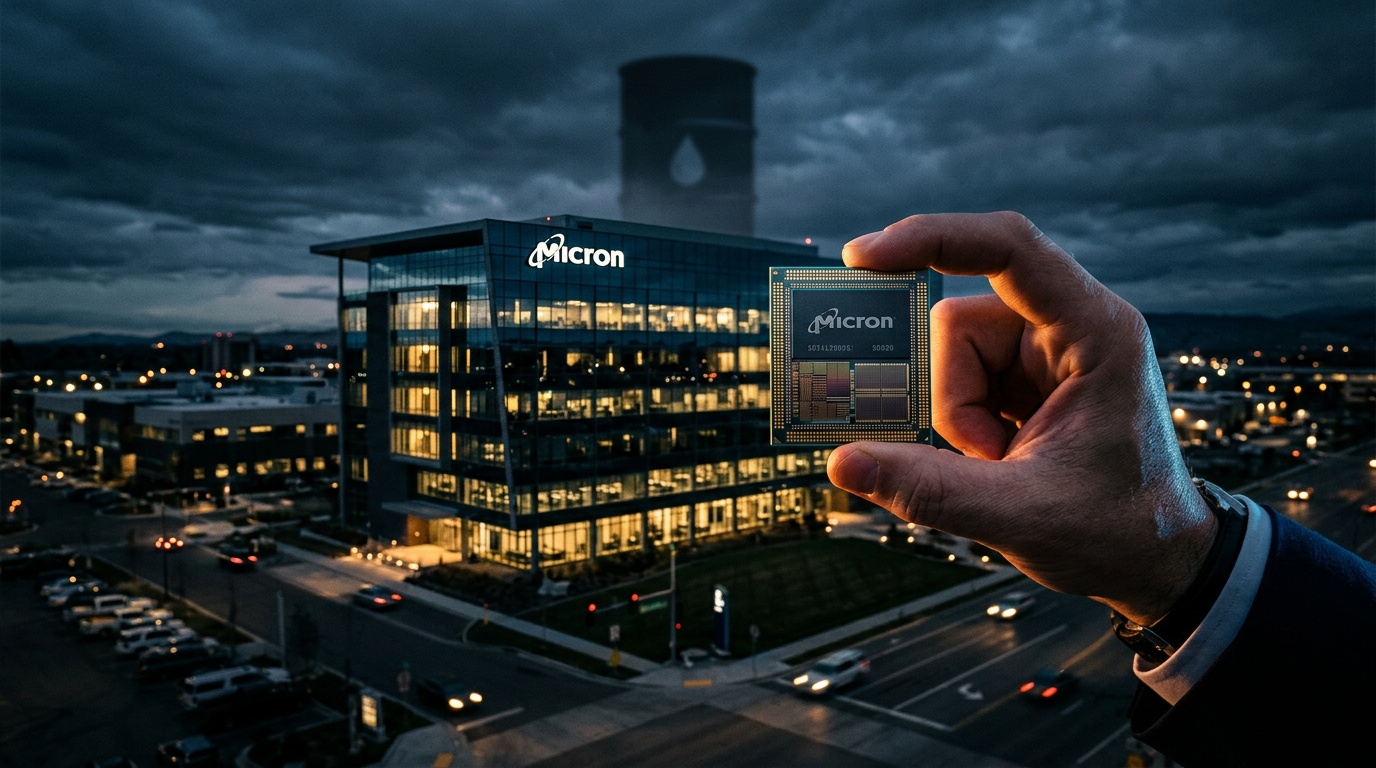
Micron Technology Inc. (NASDAQ: MU) and SK Hynix Inc. (NASDAQ: SKHY) joined the $1 trillion club in May.
Surging demand for high-end memory chips has tightened supply and boosted prices. High-bandwidth memory has become particularly important because AI accelerators require large amounts of fast memory to process increasingly complex workloads.
Mirae Asset Securities analyst Kim Young-gun told Reuters in May that he expects memory demand to exceed supply through 2028. That could keep prices elevated. Kim raised his price forecasts for SK Hynix and Samsung by 18.8% and 14.6%, respectively.
UBS also turned more bullish on Micron, more than tripling its price forecast to $1,625 in May. The firm said AI has structurally changed the memory industry. UBS expects investors to assign Micron a more conventional valuation multiple as those changes become clearer.
AMD Expands AI Opportunity Beyond GPUs
Advanced Micro Devices Inc. (NASDAQ: AMD) briefly crossed $1 trillion in market value in September after a sharp rally tied to AI infrastructure and agentic workloads.
AMD, Intel and Marvell Technology Inc. (NASDAQ: MRVL) gained roughly 30% or more during September. Arm Holdings Plc. (NASDAQ: ARM) climbed more than 20%.
CNBC's Jim Cramer said agentic AI could create another growth opportunity for AMD. AI agents require substantial computing power, potentially expanding demand beyond GPUs to CPUs and other processors.
Cramer still views NVIDIA Corp. (NASDAQ: NVDA), valued at nearly $6 trillion, as the leading AI-chip supplier.
However, he believes AI demand can support several chipmakers. He also views AMD's products as more competitive than some investors recognize.
Cramer cautioned that AMD's sharp rally could leave the stock vulnerable to pullbacks. Still, he sees rising CPU and GPU demand supporting AMD's longer-term AI opportunity.
Hyperscaler Spending Supports Chip Demand
The AI infrastructure cycle continues to draw support from aggressive spending by the world's largest technology companies.
UBP estimates five hyperscalers will spend about $820 billion on capital expenditures in 2026. That would exceed their roughly $750 billion in combined operating cash flow.
The firm expects capital spending to climb to between $1 trillion and $1.3 trillion in 2027. That could create a financing gap that operating earnings alone cannot cover.
For semiconductor companies, the spending boom stretches across much of the supply chain. Data centers require GPUs, CPUs, memory, networking equipment, advanced packaging and custom silicon.
Anthropic's expected IPO at a valuation above $2 trillion could further highlight the scale of AI investment. A large offering could signal investors remain willing to fund companies that require substantial computing infrastructure.
Agentic AI Opens Another Demand Channel
The next phase of AI investment is also moving beyond infrastructure toward agents and applications.
Google and Meta Platforms Inc. (NASDAQ: META) are pushing deeper into agentic AI as they look for new ways to monetize enterprise and consumer demand.
Google's Gemini 4 Argon targets coding, cybersecurity, financial analysis and legal research. It also supports the company's Spark agent.
Meta's Muse is gaining traction as a personal AI agent.
Google says Argon matches OpenAI and xAI in cybersecurity testing. The company also plans broader enterprise API and consumer access.
The expansion of AI agents adds another potential demand driver for the semiconductor industry. More capable agents could require greater computing power both in data centers and on devices, supporting demand for processors, memory and networking hardware.
Price Action: Intel shares fell 0.93% to $119.11, while Advanced Micro Devices shares declined 0.75% to $607.15 at the time of publication Thursday. Micron Technology fell 2.33% to $1,040.30.
Arm Holdings gained 0.33% to $290.62. Taiwan Semiconductor slipped 0.25% to $455.07. Marvell Technology rose 0.10% to $264.47, while SK Hynix gained 0.51% to $185.08, according to market data.