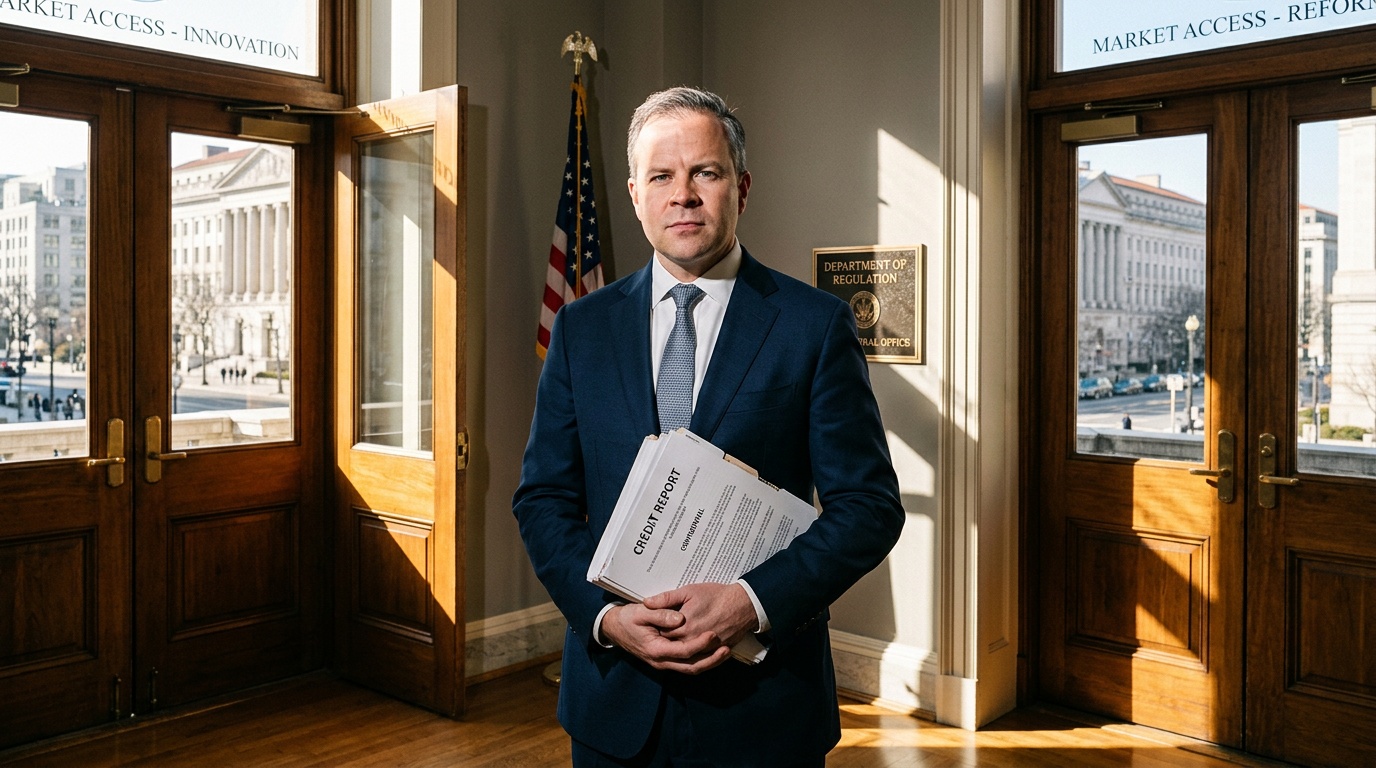
The world's biggest lithium producer is getting a new boss, and he's walking into a market that's anything but calm.
Albemarle Corp. Albemarle (ALB) announced that Ragnar "Rag" Udd, currently the Chief Commercial Officer at BHP Group Limited BHP (BHP), will take over as CEO on Feb. 1, 2027. He'll succeed Kent Masters, who will move into the executive chairman role at the company's 2027 annual meeting. The news came just a day after BHP said Udd would be leaving the world's largest miner at the end of January.
"Rag brings extensive commercial and operational expertise in natural resources and has successfully led global commercial strategy and advanced disciplined growth across complex businesses," said lead independent director Gerald Steiner.
This leadership change isn't happening in a vacuum. Albemarle is at an inflection point. After the historic margin compression that followed the 2022 lithium boom, the company is now retooling for a market increasingly driven by grid-scale storage rather than passenger cars.
China's Supply Chokehold and the Pricing Hangover
For years, Chinese refining capacity and low-cost domestic output pushed the lithium market into surplus. That hangover is still very much present. JPMorgan analyst Jeffrey Zekauskas recently cut Albemarle's 2026 adjusted EBITDA estimate by 14.4% to $2.88 billion.
His reasoning? Chinese lithium prices have averaged about $21,625 a ton so far in the third quarter, down from $24,810 in the second. And here's the kicker: each $1-per-kilogram move in prices shifts Albemarle's annual EBITDA by roughly $250 million. That's the kind of sensitivity that keeps CFOs up at night.
Meanwhile, Beijing's grip on the market is starting to cut both ways. Chinese regulators revoked environmental approval for CATL's Jianxiawo mine, the country's largest by capacity. That move prompted Benchmark Mineral Intelligence to halve its 2026 output forecast for the site to 32,000 tons of lithium carbonate equivalent. And with inspections across Jiangxi province ongoing, more supply could be at risk.
On the demand side, things are getting weird. Chinese EV sales fell 13% in the first half of 2026 after the government pulled back subsidies. Yet global lithium consumption jumped 45% through May, blowing past Albemarle's own forecast range of 15%-to-40% growth.
What's filling the gap? Stationary storage. The company describes demand there as "off the charts," with lithium iron phosphate chemistry commanding a staggering 99.9% of the storage market. That's a massive shift from the EV-centric narrative that drove the last boom.
Trade friction is adding another layer of complexity. On Aug. 6, the U.S. Commerce Department imposed a one-year block on exports of lithium-ion battery black mass, effectively redirecting recovered metals toward domestic processing. It's a move that could reshape recycling economics.
Capex Retrenchment and Udd's Commercial Playbook
Kent Masters spent the downturn protecting cash flow and executing what Steiner called "disciplined execution across cycles." The recent second-quarter results suggest that discipline is paying off. Energy Storage sales rose 78% to $1.28 billion, driven by an 11% volume increase and a 60% jump in realized prices.
"I am proud of what we have achieved together, and I am confident now is the right time to transition the leadership to Rag," Masters said.
Udd's mandate leans on more than 25 years running resource businesses across Australia, Asia, and the Americas. That footprint mirrors Albemarle's own assets in Chile, Western Australia, and the U.S. At BHP, he oversaw global sales, marketing, procurement, and commodity strategy, and previously ran the miner's copper and potash businesses. That's a background that should serve him well in a commodity as cyclical as lithium.
"Albemarle has world-class natural resources, deep technical expertise and strong customer partnerships," Udd said, adding that he plans to build on the Energy Storage and Specialties businesses.
But the near-term hurdles are real. JPMorgan expects third-quarter adjusted EBITDA to fall to $668 million from $858 million. And the Greenbushes CGP3 plant won't reach full rates until early 2027, following a fire in June. That's a reminder that even the best-laid plans can be disrupted by a spark.
Still, there's reason for optimism. Fastmarkets has lifted its 2027 carbonate forecast to $31.40 a kilogram, and inventories are near historic lows. Udd inherits a company that's positioned to capitalize when the glut finally clears. The question is how long that takes.
Albemarle Price Action
ALB Price Action: Albemarle shares were down 2.73% at $128.55 during premarket trading on Friday.