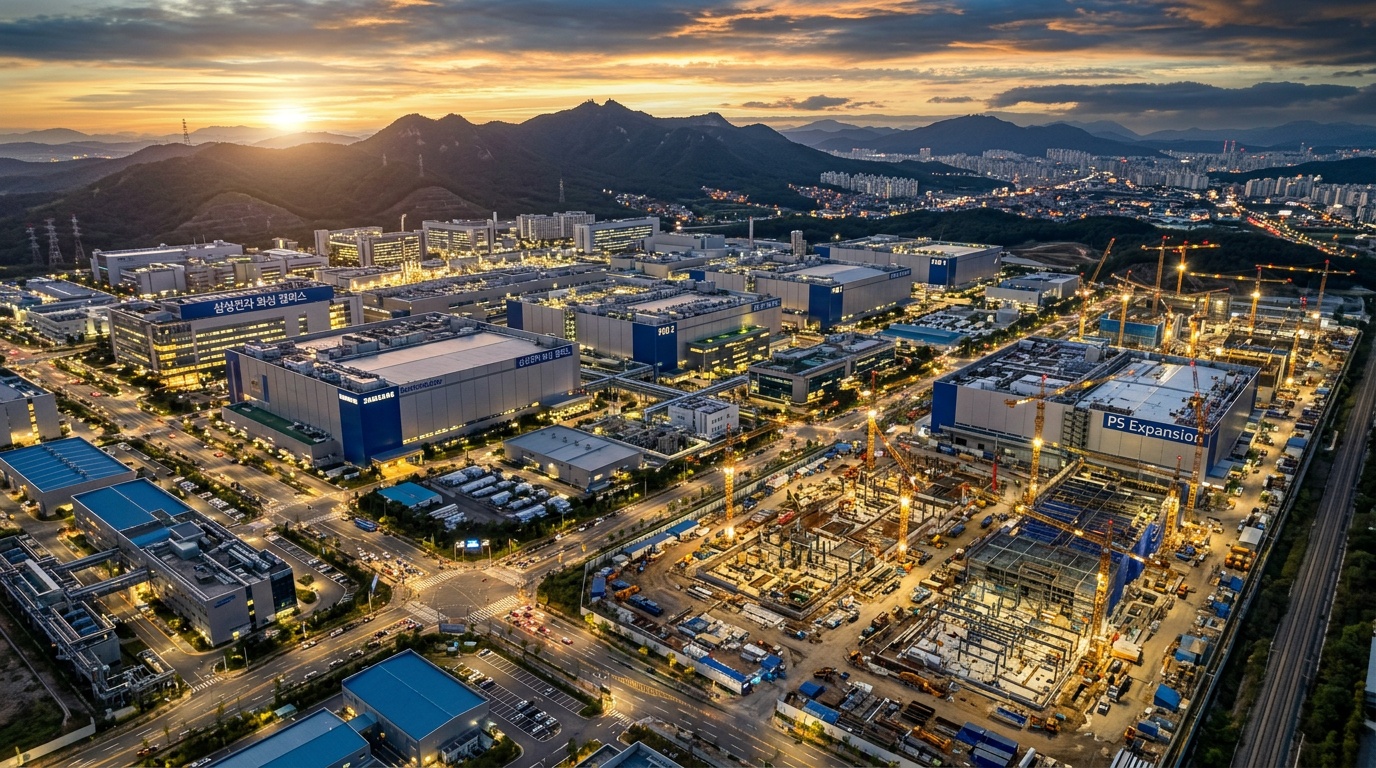
If you thought the AI boom was just about software and chatbots, think again. The real bottleneck is in the physical world: factories, equipment, and construction workers. Taiwan Semiconductor Manufacturing Company Ltd. (TSM) is living that reality right now, scrambling to expand capacity at a pace it has never attempted before.
The world's largest contract chipmaker has sharply increased its equipment purchases and factory construction plans, all in a bid to keep up with insatiable demand for AI chips. During a fireside chat at Semicon Taiwan, Deputy Co-COO Cliff Hou revealed that the company has raised its estimate for quarterly chipmaking equipment purchases to about 1.9 times the level it projected back in December. That's a near doubling of its planned spending on the tools that make chips.
The reason? AI developers and the global expansion of data centers are driving customers toward more advanced chips at a pace that's hard to overstate. Bloomberg reported on Wednesday that TSMC's tool needs have almost doubled this year, a clear signal of how quickly the landscape has shifted.
But it's not just about buying more machines. Taiwan Semiconductor is also working to build and equip about 20 factories simultaneously, both in Taiwan and overseas. To put that in perspective, the company historically juggled only four or five new buildings at a time. Now it's managing four times that many, and the strain is showing.
One of the biggest challenges? Finding enough experienced construction workers in Taiwan. The company is accelerating factory development so fast that the labor pool can't keep up. Hou put it bluntly: "Right now you're almost 4x or 5x, trying to catch up, but still you cannot meet demand."
That quote captures the essence of the current situation: even with a massive expansion effort, TSMC still can't fully satisfy its customers.
NVIDIA and AMD Keep the Pressure On
TSMC's CEO, C.C. Wei, has said the company will keep working into next year to close the gap between chip supply and customer demand. But that gap is being widened by some of the biggest names in tech.
NVIDIA Corp. (NVDA) relies exclusively on TSMC to manufacture its most advanced AI accelerators. And NVIDIA is not slowing down. The company recently projected that its sales, which are already approaching $100 billion per quarter, would grow another 70% next year. That kind of growth doesn't happen without a lot more chips, which means a lot more pressure on TSMC's fabs.
Advanced Micro Devices Inc. (AMD) is also increasing orders, adding to the capacity crunch. When your two biggest customers are both ramping up aggressively, there's no such thing as too much capacity.
MediaTek CEO's Plea: 'Can I Get More Capacity?'
The tight supply environment isn't just affecting the usual suspects. MediaTek Inc. CEO Rick Tsai made the industry's frustration clear during the same Semicon Taiwan session. He opened his remarks with a direct, almost pleading request to Hou: "Cliff, can I get more capacity?"
It's a moment that underscores just how widespread the imbalance is. TSMC is ramping up equipment purchases and factory construction as fast as it can, but customers like MediaTek are still pressing for more. The comments from Hou, Wei, and Tsai paint a picture of an industry where demand is running far ahead of supply, and everyone is feeling the pinch.
Stock Performance and Technical Analysis
So how is TSMC's stock reacting to all this? In Friday premarket trading, shares rose nearly 1%, helped by a broader uptick in semiconductor stocks and U.S. index futures. Nasdaq futures climbed 0.55%, while S&P 500 futures edged 0.10% higher.
Technically, the stock remains within its longer-term uptrend, though short-term signals are mixed. Here's a closer look at the levels traders are watching:
TSMC is hovering near its short-term moving averages. The stock sits about 0.3% above its 20-day simple moving average of $419.49 and roughly 0.1% above its 50-day SMA of $420.53. That's a tight range, suggesting the stock is consolidating.
The longer-term trend, however, is firmly bullish. Shares are about 13.1% above the 200-day SMA of $372.10, indicating that the broader uptrend is intact.
Momentum is neutral, with the relative strength index at 49.34. That means the stock is neither overbought nor oversold, leaving room for movement in either direction.
One cautionary note: the 20-day SMA is below the 50-day SMA, which signals some short-term weakness. But the 50-day SMA is still above the 200-day SMA, which supports the longer-term bullish narrative.
Traders are keeping an eye on resistance near $429.50. A break above that level could put the June highs back in focus. On the downside, support sits near $405.50, where buyers previously stepped in. A move below that could weaken the short-term technical picture.
Analyst Outlook
Wall Street remains optimistic about TSMC's prospects. The stock trades at a price-to-earnings ratio of about 30.9, which reflects a premium valuation. But analysts see more upside.
The consensus rating is Buy, with an average price forecast of $547.38. That implies significant upside from current levels.
Recent analyst actions have been positive. Stifel initiated coverage on Wednesday with a Buy rating and a $515 price target. Bernstein maintained an Outperform rating on Aug. 11 and raised its forecast to $554. Needham maintained a Buy rating on July 27 and lifted its target to $530.
These moves suggest that the Street sees the current capacity crunch as a long-term opportunity, not a short-term problem.
MarketDash Edge Rankings
MarketDash's screening tools give TSMC strong scores across several key metrics. The stock has a Momentum score of 87.94, a Quality score of 97.24, and a Growth score of 88.95. Its Value score, however, is much lower at 31.08.
What does that tell us? The high momentum, quality, and growth scores indicate a company that is firing on all cylinders, with strong business fundamentals and a bright growth outlook. The low value score, though, is a reminder that investors are already paying a premium for those strengths. You're not getting TSMC on the cheap.
ETF Exposure
For investors who prefer a diversified approach, TSMC is a significant holding in several ETFs. The VanEck Semiconductor ETF (SMH) has a 9.28% weighting in the stock. The Harbor International Compounders ETF (OSEA) has a 6.77% weighting, while the Brown Advisory Flexible Equity ETF (BAFE) has a 5.96% weighting.
TSMC's sizable weighting in these funds means that flows into or out of them can have a meaningful impact on demand for its shares. If investors pile into semiconductor ETFs, TSMC gets a boost; if they pull out, it feels the pinch.
Price Action
In Friday premarket trading, TSMC shares rose 0.91% to $420.80, according to market data. The stock's ability to hold above its moving averages and the broader market's positive tone suggest that investors are feeling good about the company's prospects, even as it races to build out capacity.
The bottom line: TSMC is in the middle of an unprecedented expansion, driven by the AI boom. It's a high-class problem to have, but it's still a problem. The company is spending heavily, building faster than ever, and still can't fully meet demand. For investors, that's a sign of strength, but it also means the stock isn't cheap. As always, the key is to watch how well TSMC executes on its ambitious plans.