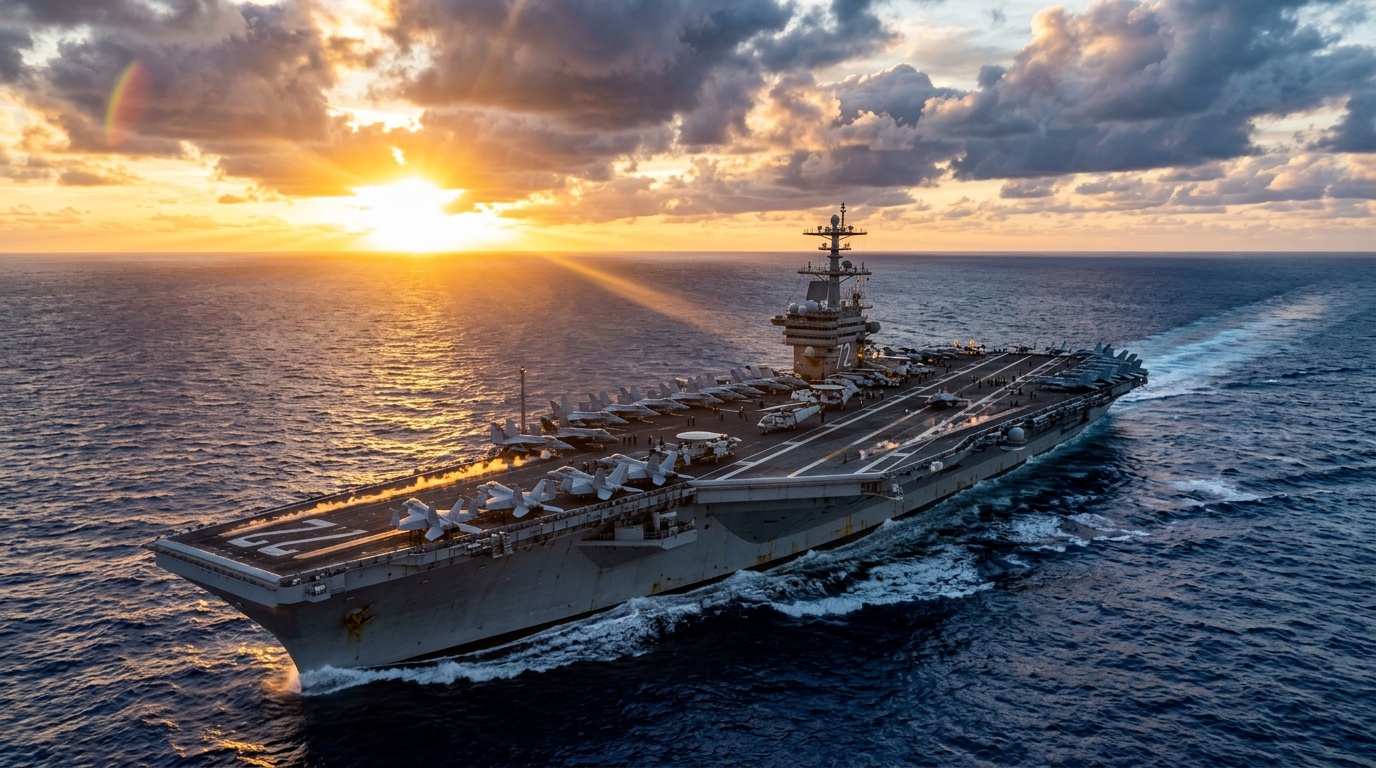
The USS Abraham Lincoln is finally leaving the Middle East after a roughly nine-month deployment, ending an unusually extended mission that drew scrutiny over crew welfare and operating conditions.
A U.S. official confirmed the departure of the USS Abraham Lincoln from the Middle East, as reported by CBS News on Thursday. The sailors and Marines on board are now heading back home, and the carrier is expected to arrive at its home port in San Diego in about three weeks.
The USS George Washington, a U.S. aircraft carrier based in Japan, has reached the Middle East to fill the void left by the USS Lincoln.
USS Lincoln Endures Extended Deployment
The USS Abraham Lincoln's deployment has been under scrutiny due to its extended duration and reported conditions on board. U.S. Central Command chief Adm. Brad Cooper defended the crew's resilience, stating that the carrier had "among the lowest" number of mental health cases across the Navy's 11 active aircraft carriers.
The carrier and its roughly 5,000 crew members departed San Diego on Nov. 21. The war with Iran extended their deployment and increased their workload, with the carrier supporting thousands of aircraft sorties during the strikes.
President Donald Trump also dismissed reports of deteriorating conditions aboard the USS Abraham Lincoln as "fake." He asserted that the carrier was "beautifully maintained and beautifully taken care of," despite its extended deployment.
Lawmakers Raise Alarm Over Carrier Crew Strain
Family concerns reported by Military Times and Stars and Stripes have raised concerns in Congress over sailors' mental health aboard the USS Abraham Lincoln. The Navy said it has not observed an increase in reported suicide attempts or suicidal ideation while investigating an Aug. 3 incident in which a sailor fell overboard and was rescued.
House Democrats voiced concerns, and lawmakers cited sailors' mental health, food supplies and safety, urging Acting Navy Secretary Hung Cao to address conditions aboard the ship. Lawmakers said the aircraft carrier's deployment has been repeatedly extended, keeping it at sea for more than eight months with just two reported port calls.
Lawmakers described more than 200 consecutive days without a port call as a modern-day record for a U.S. Navy carrier.