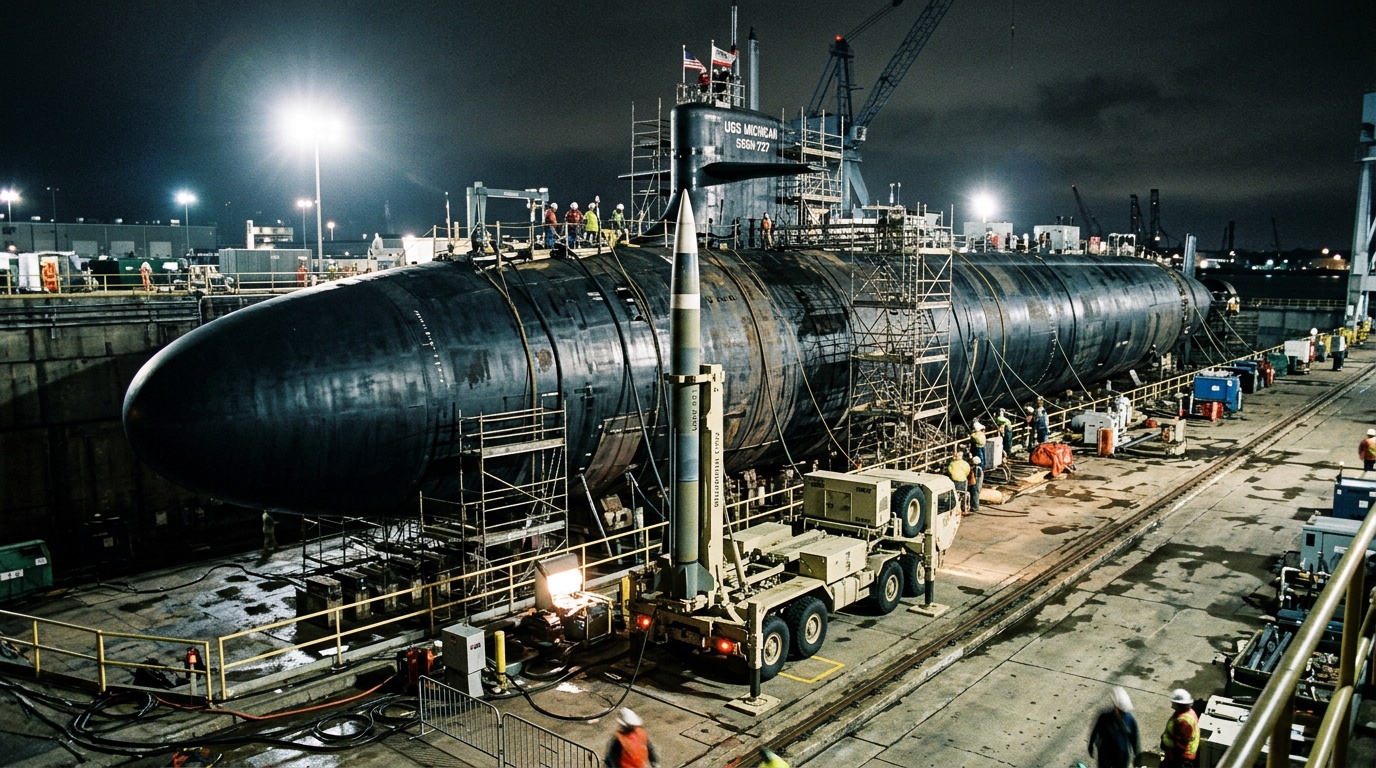
The Pentagon committed more than $135 billion on Wednesday to accelerate production of Patriot missile interceptors and nuclear submarines, as President Donald Trump keeps the pressure on defense contractors to expand factories and prioritize output over shareholder payouts.
Think of it as the government placing a massive bet on the industrial base—and telling companies to spend their cash on plants, not stock buybacks.
Lockheed Expands Patriot Missile Production Capacity
The Army converted an April agreement with Lockheed Martin Corp (LMT) into a seven-year contract worth up to $58.6 billion for PAC-3 Missile Segment Enhancement interceptors. The plan runs through fiscal 2032 and supports Lockheed’s goal of lifting annual output to 2,000 missiles and tripling capacity by 2030.
This deal didn't happen in a vacuum. Trump has been leaning on contractors to quadruple production of critical weapons. According to Reuters, the administration wants companies to reinvest in plants rather than emphasize dividends and buybacks. Congress still needs to appropriate the money before the preliminary agreement reaches its full value, but the direction is clear.
Demand for these interceptors has surged as the United States uses them in Iran and supplies air defenses to Ukraine. The Center for Strategic and International Studies estimates the U.S. holds fewer than 1,000 Patriot interceptors—a surprisingly low number given the geopolitical climate. Lockheed has also unveiled a lower-cost Patriot missile priced at less than half the roughly $4 million PAC-3 MSE, which could open up more export opportunities.
Navy Awards Landmark Nuclear Submarine Contracts
Separately, the Navy awarded General Dynamics Corp. (GD)’s Electric Boat and HII’s Newport News Shipbuilding $76.6 billion for nine Virginia-class attack submarines and five Columbia-class ballistic-missile boats, with work expected through July 2038.
The Navy called the awards a "once-in-a-generation recapitalization." Vice Adm. Robert Gaucher said continuous production would deliver "the world’s most lethal, survivable and resilient combat platform" while stabilizing the shipbuilding base. That's a fancy way of saying: keep the yards busy for the next decade, and everyone wins.
MarketDash reached out to the Pentagon for additional details on both deals but did not hear back immediately.
Defense ETFs Gain On Spending Boom
The commitments reinforce a Pentagon restocking cycle that's already showing up in earnings. Lockheed and RTX Corp. (RTX) raised their 2026 forecasts as missile demand lifted sales and backlogs.
For investors who don't want to pick individual stocks, defense ETFs offer a way to ride the wave. The iShares U.S. Aerospace & Defense ETF (ITA), which holds RTX, General Dynamics, and Lockheed, returned 9.21% at net asset value since the beginning of the year. The Invesco Aerospace & Defense ETF (PPA), also holding all three, gained 8.23%.
The equal-weighted SPDR S&P Aerospace & Defense ETF (XAR), whose largest holdings include RTX and General Dynamics, led with a return of 6.11% year-to-date. Those gains reflect enthusiasm around Trump’s proposed $1.5 trillion defense budget, though the contracts still depend on congressional funding. So keep an eye on Capitol Hill—these numbers are big, but they're not locked in yet.