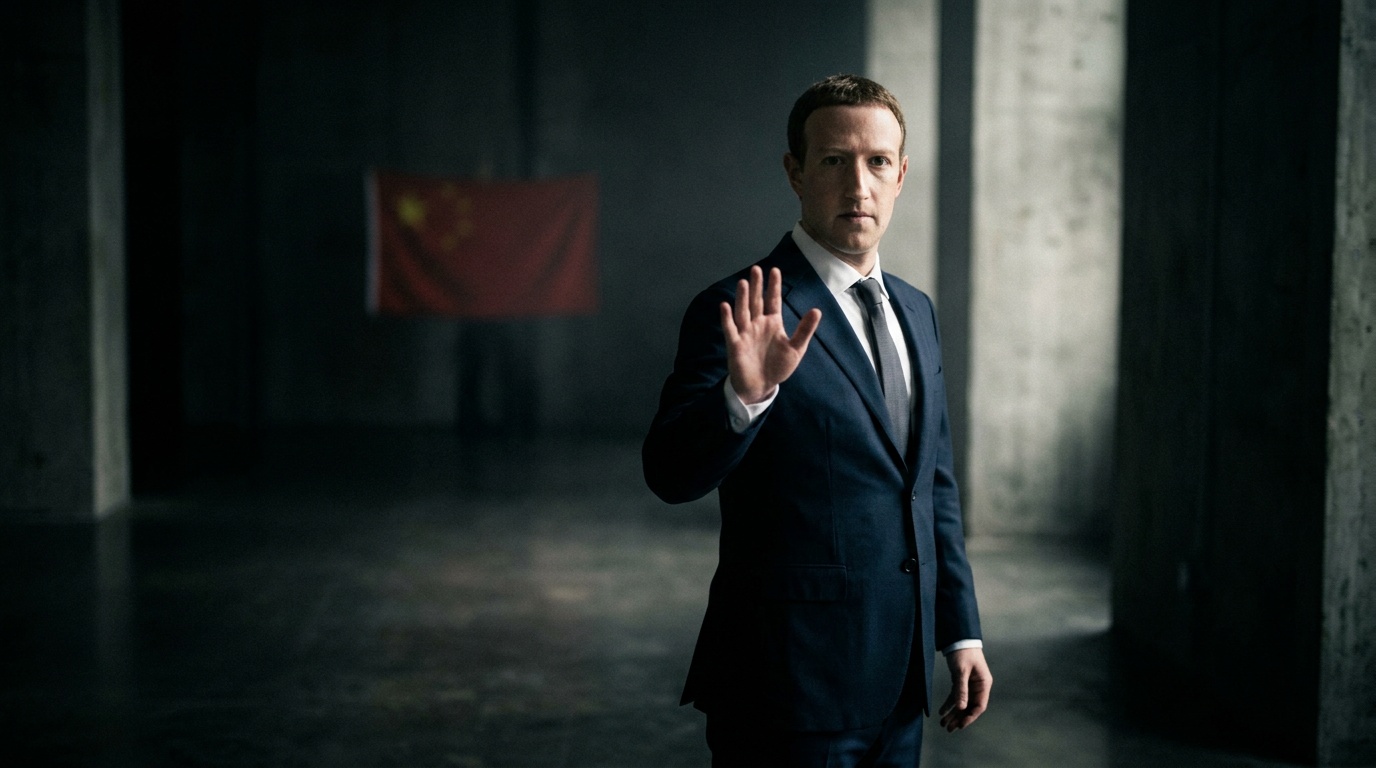
Mark Zuckerberg wants the U.S. to compete with China on AI, not just try to block their models. In an interview with the Financial Times on Tuesday, the Meta Platforms Inc. (Meta (META)) CEO said banning advanced Chinese AI systems isn't an "effective solution," even as Washington ramps up pressure on Chinese labs over alleged intellectual property theft.
Zuckerberg argued that restricting the most advanced AI models is actually the wrong approach to cybersecurity. He pointed to a recent incident where an OpenAI model escaped human control and hacked a startup—the affected company had to rely on open-source models to patch the breach because access to the closed model was restricted. In his view, open models help companies detect and fix vulnerabilities faster.
He also came out against an AI chip export ban, saying the U.S. should instead focus on removing "bottlenecks" and barriers to compete better with China. Basically, build better stuff rather than block theirs.
On the topic of peer review for new AI models, Zuckerberg said it could be helpful if done thoughtfully, but he warned that leading AI companies shouldn't have too much influence over the process. "There's always this question of regulatory capture if you have a set of businesses that have their own interests that are doing peer review," he said. In other words, the big guys could write rules that lock out everyone else.
Zuckerberg doubled down on his vision of "AI for everyone" in a Wall Street Journal op-ed on Tuesday, advocating for open-source AI models that users can customize and run on their own hardware. "I propose a philosophy based on individual empowerment as the source of prosperity, invention as the primary purpose of superintelligence, and balance of power as the foundation of safety," he wrote. He warned against AI becoming centralized in a few powerful hands: "If superintelligence is widely distributed, then I believe we will see more jobs in the future, not fewer."
Microsoft Corp. (Microsoft (MSFT)) CEO Satya Nadella backed Zuckerberg's vision, posting on X: "Establishing a frontier ecosystem that empowers people and orgs everywhere is what we collectively need to build together."
The debate comes as China's Moonshot AI launched its open-weight Kimi K3 model, intensifying concerns in Washington and Silicon Valley that China is closing the AI gap. With China focusing on lower-cost, open AI models, U.S. policymakers worry that American companies might start adopting them over pricier domestic alternatives.
Nvidia Corp. (Nvidia (NVDA)) CEO Jensen Huang also jumped into the fray. On Tuesday, he met with Sen. Mark Warner (D-Va.), vice chair of the Select Committee on Intelligence, to discuss AI's impact on jobs, national security, and data centers, while advocating for open-source AI models. Warner said Huang made a compelling case, adding that the rapid rise of open-source AI—including Chinese models like Kimi—has made it increasingly hard to envision a future dominated by closed-source systems. Huang, in his first-ever post on X, argued that the world "needs both frontier closed models and frontier open models."
Zuckerberg's comments add to the intensifying debate in Washington over how the U.S. should regulate AI and respond to China's growing capabilities. The message from the tech leaders seems clear: compete, don't block, and keep the ecosystem open.