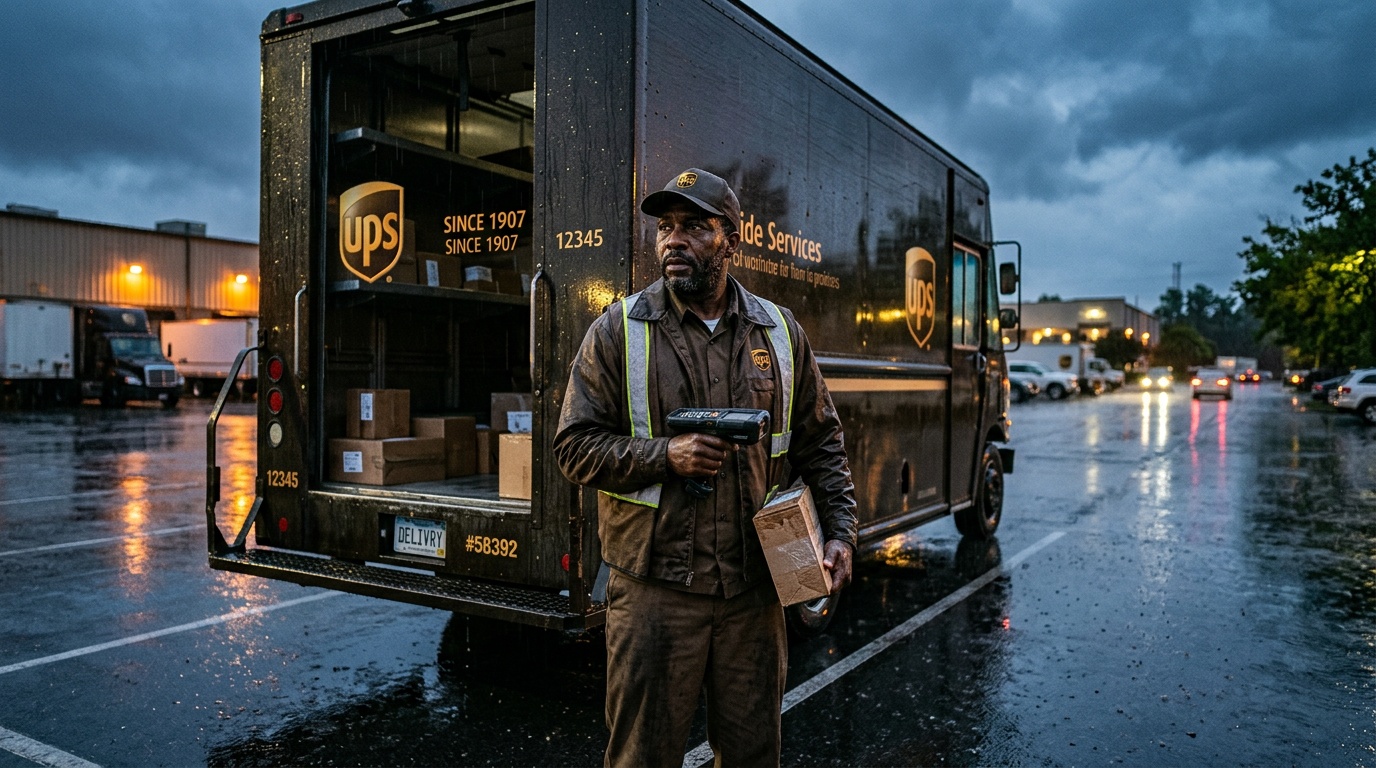
United Parcel Service (UPS) just gave investors a lot to chew on. The shipping giant reported second-quarter 2026 earnings that beat Wall Street's expectations, completed a long-awaited reduction in its Amazon business, and raised its full-year outlook. And yet, the stock dropped more than 5% in premarket trading on Tuesday. Classic.
Let's start with the numbers. Adjusted diluted EPS came in at $1.76, topping the $1.66 consensus estimate. Consolidated revenue rose about 7.6% year over year to $22.8 billion, beating the $21.81 billion estimate. That's the kind of headline that usually sends a stock higher. But markets are complicated, and UPS has been navigating some serious structural changes.
CEO Carol Tomé credited employees for completing what the company calls the "Amazon glide-down" — an 18-month effort to reduce its reliance on lower-margin Amazon packages and reconfigure its network. "I want to thank all UPSers for their extraordinary work over the past 18 months as we successfully completed our Amazon glide down and related network reconfiguration initiatives as designed," Tomé said in the earnings release.
During the earnings call, Tomé noted that tariffs had affected shipping volumes in certain markets, particularly shipments from Canada to the United States. That's a reminder that even when you fix one problem, the world throws another at you.
Earnings and Margins
On a GAAP basis, things looked less rosy. GAAP diluted EPS fell to $0.71 from $1.51 a year ago, and net income dropped to $604 million from $1.28 billion. But that's largely because of transformation charges: $891 million in after-tax costs, or $1.05 per share, mostly tied to employee separation costs from the Driver Choice Program. Adjusted net income actually rose to $1.50 billion from $1.31 billion.
Adjusted operating profit climbed to $2.10 billion from $1.88 billion, and adjusted operating margin expanded to 9.2% from 8.8%. So the underlying business is improving, even if the accounting looks messy.
Segment Performance
Breaking it down by segment: U.S. Domestic revenue rose 6% to $14.93 billion, driven by a 9.3% increase in revenue per piece. That's the magic of focusing on higher-quality packages. Adjusted operating profit in the segment jumped 21% to $1.19 billion, with margin improving to 8%. But average daily volume fell to 16 million packages from 16.55 million, and adjusted cost per piece rose 8% to $13.09. So they're making more money on fewer, pricier shipments.
International revenue increased 12.5% to $5.04 billion, though operating profit slipped to $623 million. Supply Chain Solutions revenue rose 7.8% to $2.86 billion, with operating profit up to $291 million.
Cash Flow and Transformation
First-half operating cash flow reached $3.08 billion, and free cash flow totaled $1.57 billion. The transformation initiatives generated about $1.2 billion in benefits in the first half, with roughly $3 billion expected for the full year. That's real money.
UPS also confirmed that it eliminated about 2 million lower-quality Amazon packages per day as part of the glide-down. That's a big shift in strategy — walking away from volume that wasn't profitable enough.
2026 Outlook
Looking ahead, UPS raised its full-year adjusted EPS guidance to $7.22, above the $7.11 analyst estimate. Revenue guidance was lifted to $91.2 billion from $89.7 billion, also above the $90.29 billion consensus. The company targets adjusted operating profit of $8.65 billion.
Capital expenditures remain at about $3 billion, with dividend payments of roughly $5.4 billion and an expected tax rate of 23%.
UPS Price Action
Despite all the good news, UPS shares were down 5.73% at $106.47 in premarket trading on Tuesday. Maybe the market wanted even more, or maybe it's worried about tariffs and the broader economy. Either way, UPS has done what it set out to do: cut ties with Amazon's lower-quality volume and build a leaner, more profitable network. Now it just needs to convince investors that the story is real.