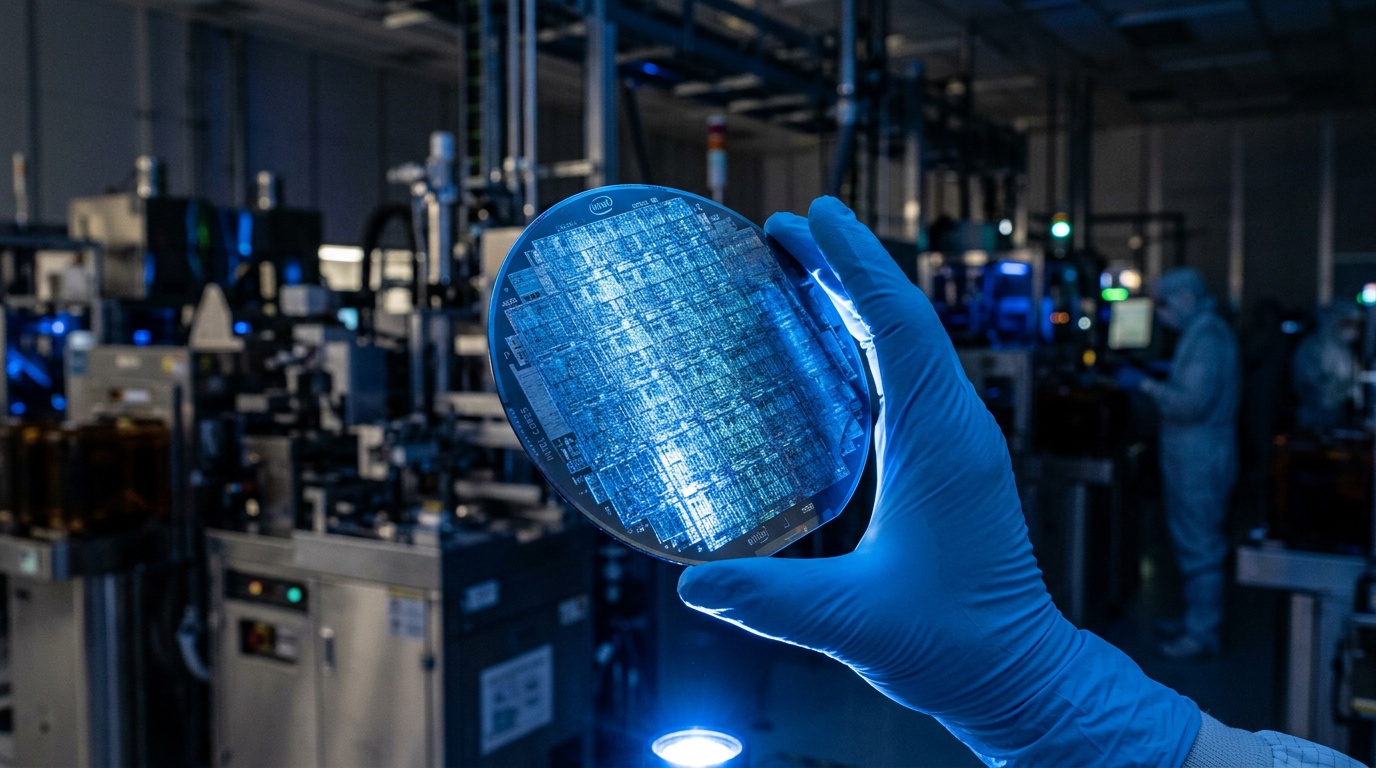
Intel Corp. Intel (INTC) shares jumped in premarket trading Friday after the chipmaker delivered a second-quarter earnings beat that was hard to ignore. Revenue climbed 25% year over year to $16.13 billion, crushing the $14.42 billion estimate. Adjusted earnings per share of 42 cents doubled what analysts were expecting. And the company's third-quarter revenue guidance of $15.8 billion to $16.8 billion came in well ahead of the $15.01 billion consensus, with adjusted EPS of 38 cents topping the 24-cent estimate.
Wall Street largely viewed the quarter as more evidence that Intel's turnaround is gaining real momentum. Analysts pointed to stronger-than-expected results, improving foundry execution, and robust AI-driven server demand as signs the recovery narrative is holding up. But they also cautioned that Intel still has plenty to prove: consistent execution, more external foundry customers, and the ability to turn heavy AI investments into sustainable, profitable growth while competing with Advanced Micro Devices (AMD), NVIDIA (NVDA), and Taiwan Semiconductor (TSM).
Intel Foundry Execution Remains the Key Catalyst
SemiAnalysis' Doug O'Laughlin told CNBC on Friday that Intel's upside ultimately depends on whether it can execute its foundry strategy after years of missteps. He said Intel should announce more external customers over time, including potential interest from Apple (AAPL), Microsoft (MSFT), and Amazon (AMZN), but first needs to prove it can deliver for the customers it has already won.
Benchmark's Cody Acree also told CNBC on Friday that Intel needs firmer foundry customer announcements to drive the stock higher. He said the company is making progress on yields and development, which could help attract more interest.
Benefits From AI-Driven Server CPU Demand
Acree said Intel's second-quarter results showed broad strength across foundry, PC, and server businesses. Server CPU demand remains strong as hyperscalers continue spending on AI infrastructure. He noted that AI workloads are shifting toward inference and agentic AI, which require CPUs to orchestrate and manage activity alongside GPUs. While AMD has gained share from Intel, Acree said the expanding server CPU market could benefit both companies as Intel's products become more competitive.
Intel Valuation Hinges on Turnaround Execution
Deepwater Asset Management's Gene Munster told CNBC on Friday that Intel's post-earnings rally gives investors more upside potential, helped by stronger September-quarter guidance and commentary around 14A, which he sees as a 2028 catalyst. Munster said Intel remains much smaller than NVIDIA in data center and AI, and NVIDIA's GPU business still holds a stronger position in the AI infrastructure buildout. Still, he said Intel's smaller base gives it more room for upside than larger AI leaders.
O'Laughlin said Intel can look expensive on current sales and cash-flow metrics, but investors are paying for the possibility of margin recovery if the company executes in foundry.
Turnaround Still Needs Proof
O'Laughlin emphasized that Intel's U.S. manufacturing footprint gives it scarcity value because the company spans process design through fabrication domestically. He said Intel should not give up its Ohio cleanroom, especially as AI chip demand accelerates. Partnerships with memory suppliers such as SK hynix (SKHY) matter because leading-edge AI accelerators require both logic chips and memory packaging.
He also noted that Intel's restructuring reflects an effort to move past organizational bloat, pointing out that AMD and Taiwan Semiconductor had previously employed fewer people combined despite stronger performance.
Acree said Intel's valuation looks stretched versus its history, but he sees that as secondary while the company remains early in its turnaround and investors wait for proof from foundry, PCs, servers, and AI infrastructure.
Intel Price Action
Intel shares were up 5.55% at $105.79 during premarket trading on Friday, according to market data.