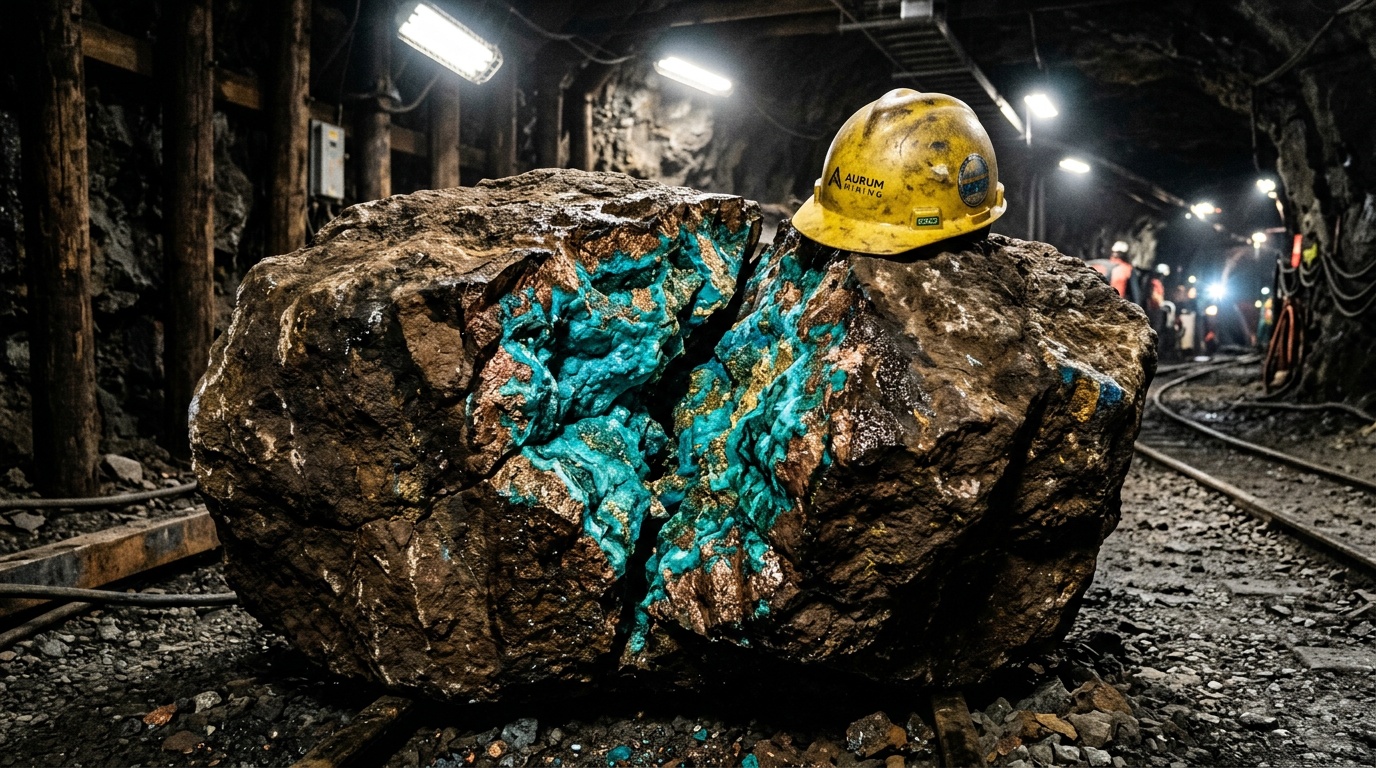
If you've been watching copper prices lately, you know they've been on a tear. And that's great news for Freeport-McMoRan (FCX), which reported second-quarter results on Thursday that blew past Wall Street's expectations. The mining giant earned an adjusted 74 cents per share, crushing the 59-cent consensus, on revenue of $7.03 billion — also ahead of the $6.76 billion analysts were looking for.
The story here is pretty straightforward: higher prices for copper and gold more than made up for lower production volumes, especially from Freeport's massive Grasberg mine in Indonesia, which is still ramping back up after a mud rush incident last September.
The Price Tailwind
Freeport realized an average copper price of $6.17 per pound in the quarter, up sharply from $4.54 a year ago. Gold prices jumped to $4,520 per ounce from $3,291, and molybdenum — a lesser-known but important metal — climbed to $28.75 per pound from $21.10. Those price gains were enough to offset a significant drop in sales volumes: copper sales fell to 710 million pounds from 1.02 billion pounds a year earlier, while gold sales dropped to 123,000 ounces from much higher levels.
Net income attributable to common stock rose to $984 million, or 68 cents per share, from $772 million, or 53 cents per share, a year earlier. On an adjusted basis, net income was $1.1 billion, or 74 cents per share, excluding charges tied to restoration costs from the Grasberg mud rush.
The Grasberg Recovery
The Grasberg Block Cave underground mine is the key to Freeport's future production, and it's coming back online gradually. The company said the ramp-up is on schedule, with production rates expected to average about 65% in the second half of 2026, reach roughly 80% by mid-2027, and approach full capacity by the end of 2027.
President and CEO Kathleen Quirk noted that the company delivered "strong operational execution" with steady progress at Grasberg and solid performance across its Americas operations. That's a good sign, because the ramp-up has been costly: average unit net cash costs for copper rose to $1.97 per pound from $1.13 a year earlier, mainly due to lower volumes at Grasberg. Still, that was better than the company's April estimate of $2.24 per pound.
Cash Flow, Buybacks, and Big Projects
Freeport generated $2.0 billion in operating cash flow during the quarter, after working capital changes. Capital expenditures were $1.1 billion, including $700 million for major mining projects. The company also bought back 1.7 million shares for $110 million, and ended June with $4.1 billion in cash and $9.4 billion in total debt.
Looking ahead, Freeport reaffirmed its 2026 sales guidance: about 3.1 billion pounds of copper, 650,000 ounces of gold, and 93 million pounds of molybdenum. For the third quarter, it expects to sell roughly 750 million pounds of copper, 160,000 ounces of gold, and 22 million pounds of molybdenum. Full-year unit net cash costs are still expected to be around $1.90 per pound of copper.
The company is also advancing several long-term growth projects, including leaching initiatives in the U.S., a potential expansion at the Bagdad mine in Arizona, and a large-scale expansion at El Abra in Chile. Capital expenditures for 2026 are expected to be about $4.3 billion, with $3.0 billion going to major mining projects.
Market Reaction
Despite the strong earnings beat, Freeport shares were down 2.28% at $63.51 at the time of publication on Thursday. That might seem odd, but markets often focus on the forward outlook, and the gradual Grasberg ramp-up means production won't fully recover until 2027. Still, with copper prices riding high and demand from electrification and AI data centers growing, Freeport is in a good spot.