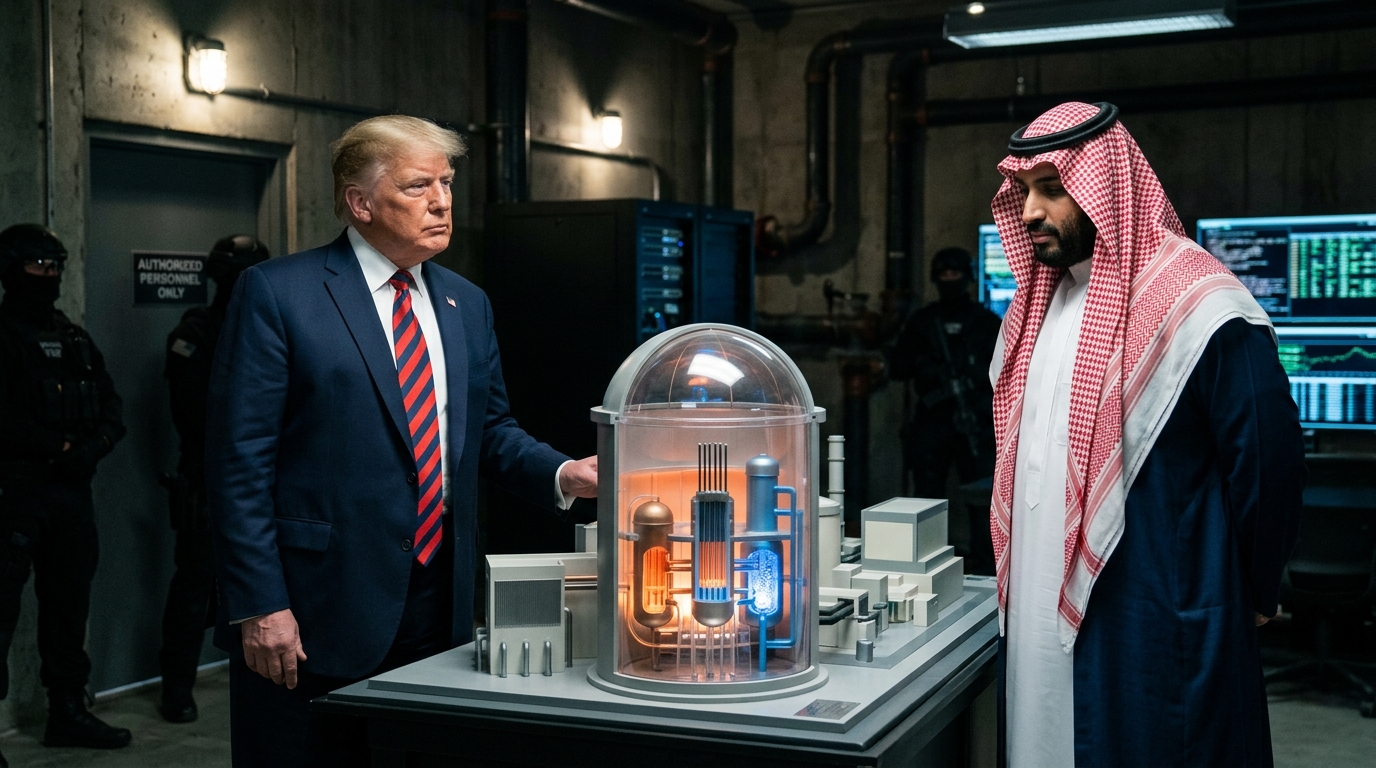
President Donald Trump has reportedly given the green light to a groundbreaking nuclear deal with Saudi Arabia—one that could give the kingdom the ability to enrich uranium for its civilian nuclear program. And it's a big one: estimated to be worth tens of billions of dollars and set to last 30 years.
According to the Wall Street Journal, the deal includes a key provision: a joint U.S.-Saudi study to determine whether Saudi Arabia needs a domestic uranium enrichment facility. If the study says yes, American companies would build one under a so-called "black box" arrangement, meaning the sensitive enrichment technology stays under U.S. control and isn't transferred to the Saudis. The Trump administration argues this gives the U.S. more oversight, ensuring the enriched uranium isn't diverted for military use and that spent fuel can't be reprocessed into weapons-grade material.
But here's where it gets tricky: the deal reportedly does not include the International Atomic Energy Agency's (IAEA) "Additional Protocol," which allows for more intrusive inspections and monitoring. Saudi Arabia is an IAEA member, but without that extra layer of verification, critics say the door is open for potential misuse.
The White House didn't immediately respond to requests for comment.
Wright Details Saudi Nuclear Pact
Trump approved the agreement late last week, and it's expected to be signed Wednesday by Energy Secretary Chris Wright and Saudi Energy Minister Prince Abdulaziz bin Salman. The two had discussed the framework during Wright's first official visit to the kingdom in April 2025. Wright told the Journal that the agreements maintain "the highest nuclear safety and nonproliferation standards" while using U.S.-designed technology and expertise.
But the deal isn't a done deal yet—it's subject to congressional review, and that's where things could get interesting. Lawmakers have long been wary of allowing Saudi Arabia to enrich uranium, fearing it could spark a nuclear arms race in the Middle East. In 2018, a bipartisan group of lawmakers introduced legislation to block U.S. nuclear cooperation with Saudi Arabia unless Congress explicitly approved it. One of the senators backing that stricter requirement? Then-Florida Republican Marco Rubio—who is now Secretary of State.
Critics Oppose the Deal
The timing of this deal is, shall we say, awkward. The U.S. is currently at war with Iran over its nuclear program, and Iran and Saudi Arabia are regional rivals. So handing enrichment capabilities to Riyadh while fighting Tehran over the same thing raises eyebrows.
Robert Einhorn, a former senior State Department official, told the Journal that the agreement could revive the U.S. nuclear industry, deepen U.S.-Saudi ties, and keep Russia and China out of Riyadh's nuclear program. But he warned that without strict safeguards—including limits on enrichment—it could heighten proliferation risks in the Middle East and beyond.
Andrea Stricker, deputy director of FDD's Nonproliferation Program, was more blunt. She called the deal "bad" and urged Congress to reject it. In a tweet, she wrote: "A bad U.S. nuclear deal with Saudi Arabia is coming for congressional review—inexplicably, carried over from the Biden administration. Congress should block it. If it does not, one hopes the policy will be reversed by a subsequent administration before too much damage is done."
Stricker warned the deal could weaken nuclear safeguards, undermine the "gold standard" agreement the U.S. has with the United Arab Emirates, set a poor precedent for other countries, and encourage the spread of enrichment and reprocessing—despite recent efforts to curb Iran's nuclear capabilities.
Conservative news analyst Mark Levin also weighed in, opposing any nuclear deals with Saudi Arabia by invoking the 25th anniversary of the 9/11 attacks. "25 years ago this 9/11 Saudi Arabia was behind the murder of thousands of Americans. No nuke deals with Saudi Arabia," he tweeted.
So the deal is headed to Congress, where it's sure to face scrutiny. Whether it survives—and whether Rubio's past stance comes back to haunt him—remains to be seen.