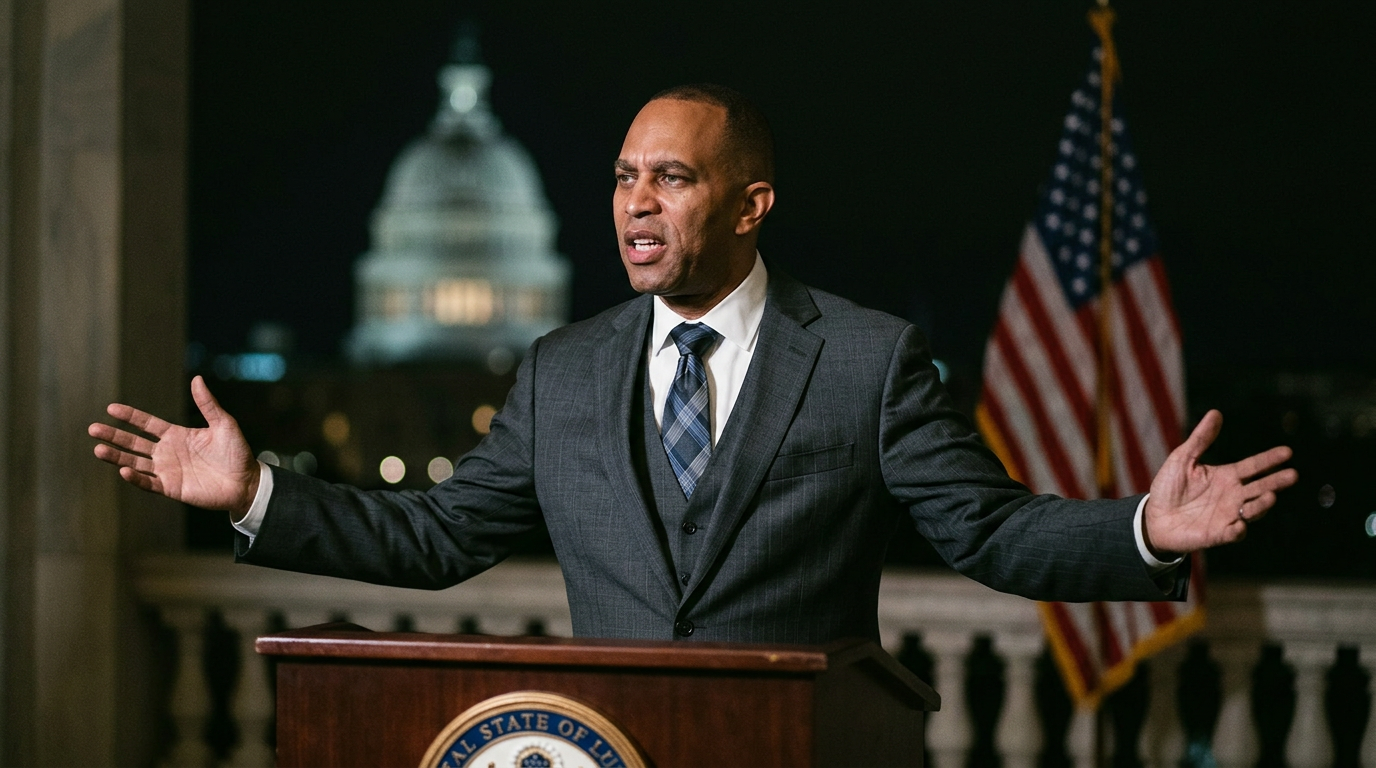
House Minority Leader Hakeem Jeffries didn't hold back on Sunday, taking aim at President Donald Trump over the ongoing war with Iran. In a blistering post on X, Jeffries said the conflict has cost ordinary Americans over $100 billion and sent gas prices soaring.
Jeffries called the situation "out of control" and described the war as a "reckless war of choice" that has wasted more than $100 billion in taxpayer money. He also took a swipe at the Trump administration's name for the operation—"Operation Epic Fury"—rebranding it as "Operation Epic Failure," which he said "has been a disaster."
The criticism comes as gas prices are once again on the rise. GasBuddy analyst Patrick De Haan noted on X that the national average is about to break "an 8-week streak of declines." Prices are up about 11 cents from a week ago, marking "the first weekly rise since May." According to the American Automobile Association (AAA), the national average for a gallon of gas now sits at $3.876. California and Hawaii are feeling the pain the most, with prices at $5.389 and $5.471 per gallon, respectively. Indiana drivers have it relatively easy, with the lowest average at $3.247 per gallon.
Oil prices are also climbing. Brent crude was trading at $79.08 per barrel at the time of writing, up over 4%, while West Texas Intermediate (WTI) crude rose 4% to $74.30 per barrel. De Haan warned that "gasoline and diesel prices likely to continue drifting higher, although not yet at the pace we saw in March/April."
The rising energy costs are tied to escalating tensions between the U.S. and Iran. Over the weekend, the U.S. Central Command announced it had struck several Iranian assets, including missile defense systems and radar technology. This followed Iran's declaration that it would close the Strait of Hormuz after a vessel deviated from its designated route. CENTCOM said the strikes were conducted on Trump's orders to hold the Iranian government accountable. Iran's Supreme Leader, Ayatollah Mojtaba Khamenei, has vowed retaliation.
For investors, the situation is a reminder of how geopolitical conflicts can ripple through energy markets. With oil and gas prices on the rise, the costs of the conflict are becoming increasingly visible at the pump—and in political rhetoric.