PepsiCo (PepsiCo (PEP)) reported second-quarter results Thursday that topped revenue expectations but fell just short on adjusted earnings, sending the stock lower in premarket trading. The numbers tell a story of a company navigating a tricky environment: consumers are feeling the pinch from inflation, and even a giant like PepsiCo isn't immune.
While revenue exceeded Wall Street estimates, investors appeared disappointed by a slight adjusted EPS miss, weaker-than-expected North American organic sales, and the company's decision to maintain, rather than raise, its full-year guidance. Sentiment may also have been pressured by recent price forecast cuts from JPMorgan, Barclays, BNP Paribas, and UBS.
PepsiCo Q2 Revenue And Profit Growth
Net revenue rose 6.4% year over year to $24.18 billion, beating the $23.96 billion analyst estimate. Core EPS increased 4% to $2.20, missing the $2.21 estimate, while GAAP EPS rose 137% to $2.18. That big GAAP jump? It's mostly because last year's results included impairment charges tied to the Rockstar and Be & Cheery brands. Without those one-time hits, the picture is more modest.
Revenue growth reflected 2.4% organic growth and a 2.2-percentage-point benefit from foreign exchange. Acquisitions and divestitures added a net 1.8 percentage points to revenue growth. Global organic volume increased 3% for convenient foods and 2% for beverages.
Operating profit increased 125% to $4.02 billion, and operating margin expanded by 875 basis points to 16.6%. But core operating profit—stripping out the noise—rose 4% to $4.07 billion, while core operating margin decreased by 40 basis points to 16.8%.
North America Softness
The real story this quarter is what's happening in North America. PepsiCo Foods North America's net revenue declined 2%, mainly due to lower effective net pricing. The company says it gained volume and market share through innovation and affordability initiatives, but that didn't fully offset the pricing pressure.
PepsiCo Beverages North America's net revenue increased 7%, supported by acquisitions and 1% organic revenue growth. But organic volume declined by 4%, including a 0.5 percentage-point decrease related to the case-pack water business and a transition to a third-party partner.
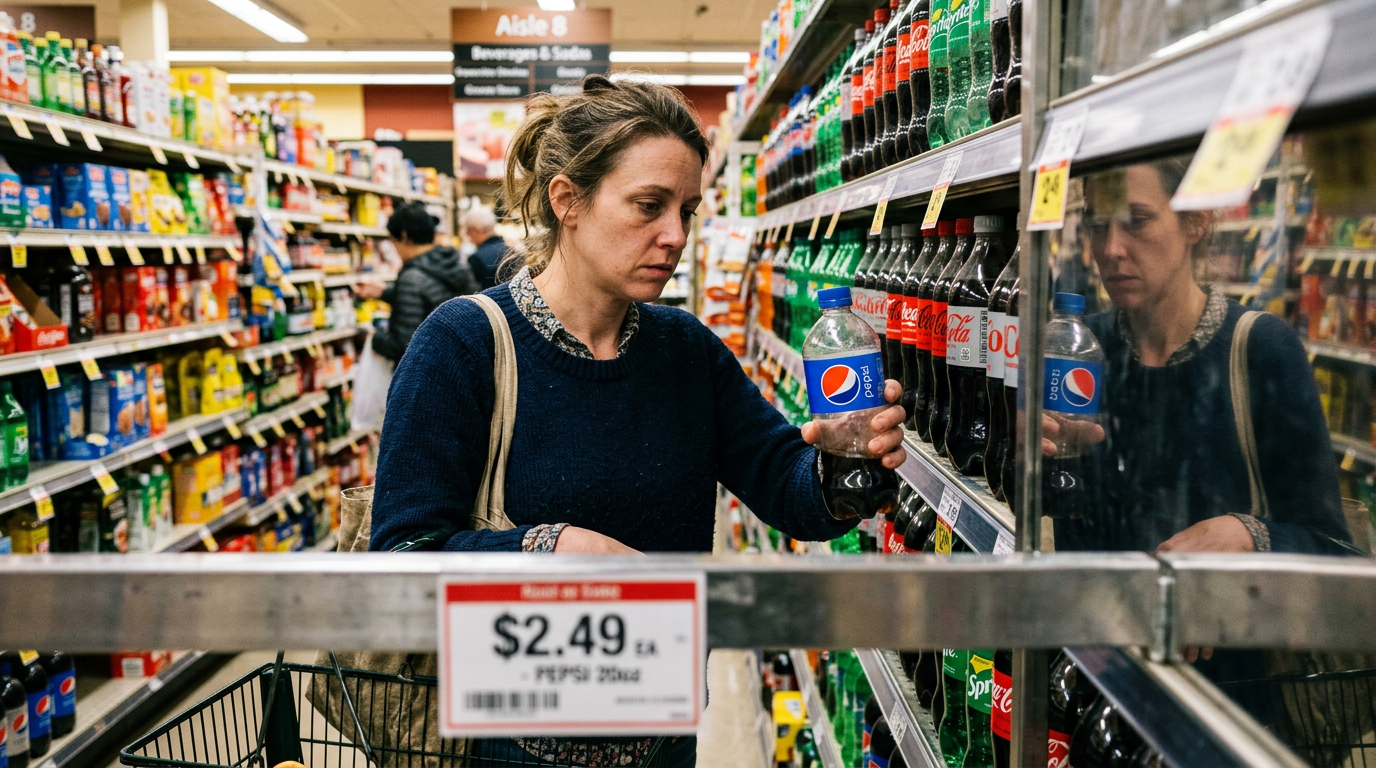
Overall, North America's organic revenue declined 0.5%, falling short of expectations as U.S. food and beverage performance slowed. The company attributed this to tighter consumer budgets amid rising inflation. Shoppers are watching their wallets, and that means less spending on snacks and sodas.
PepsiCo said U.S. food and beverage demand moderated during the quarter as rising inflationary pressures weighed on shoppers, prompting expectations for a more gradual recovery in the region through the rest of 2026.
International Business Momentum
While North America struggles, the rest of the world is picking up the slack. International organic revenue grew 7%, marking the 21st consecutive quarter of at least mid-single-digit growth. That's a remarkable streak.
International Beverages Franchise revenue rose 11%, EMEA increased 10%, Latin America Foods grew 15%, and Asia Pacific Foods rose 12%. These numbers show that PepsiCo's global footprint is a key strength, especially when its home market softens.
Year to date, net revenue increased 7.3% to $43.62 billion. GAAP EPS rose 72% to $3.88, and core EPS increased 6% to $3.81. Operating cash flow reached $2.37 billion, up from $996 million a year ago. Cash and cash equivalents were $10.25 billion, with short-term debt at $10.60 billion and long-term debt at $42.61 billion.
PepsiCo Guidance And Cost Outlook
Looking ahead, PepsiCo anticipates higher input cost inflation in the second half of 2026. To offset that, the company expects record productivity savings and tariff refund claims from last year to help manage costs and fund planned investments.
PepsiCo reaffirmed its fiscal 2026 guidance, projecting organic revenue growth of 2% to 4% and core constant currency EPS growth of 4% to 6%. The company also maintained adjusted EPS guidance of $8.55 to $8.71, compared to the $8.64 estimate, and sales guidance of $97.68 billion to $99.56 billion, versus the $98.88 billion estimate.
The company expects fiscal 2026 net revenue growth of 4% to 6% and core EPS growth of approximately 5% to 7%. Core and core constant currency EPS growth will be concentrated in the fourth quarter, while North American performance is expected to improve gradually throughout the year.
In other words, PepsiCo is playing the long game. It's not panicking about the current soft patch, but it's also not raising expectations. For investors, the message is clear: patience is required.
PEP Stock Price Activity: PepsiCo shares were down 2.44% at $139.03 in the premarket session on Thursday, according to market data.
Photo via Shutterstock