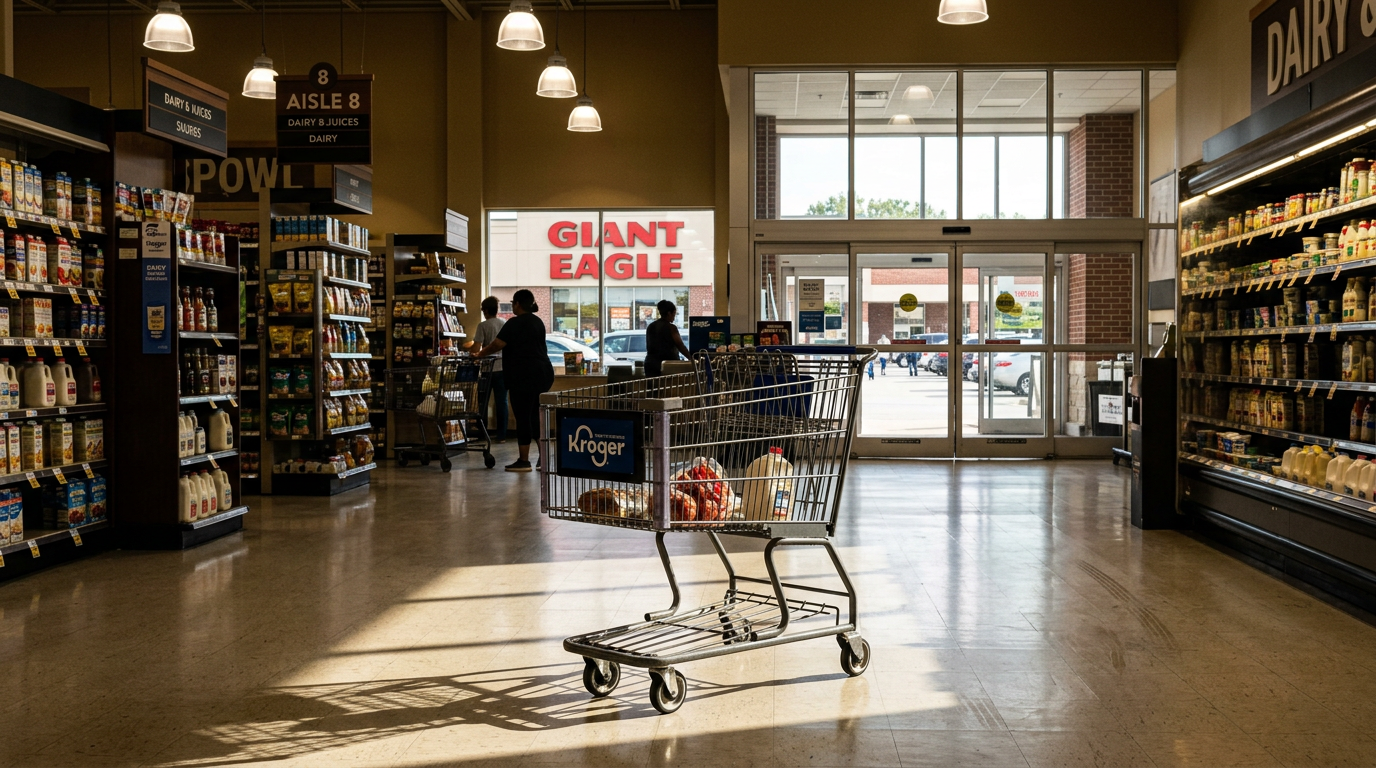
Kroger (KR) is making a big bet on regional grocery. On Wednesday, the company announced it has agreed to acquire privately held Giant Eagle for $1.65 billion. The price tag includes $1.25 billion in cash and the assumption of about $400 million in liabilities.
Shares of Kroger were down 1.13% at $54.90 at the time of publication, hitting a new 52-week low. Not exactly a market celebration, but the deal itself is a strategic move worth understanding.
Giant Eagle operates 197 supermarkets and 11 standalone pharmacies across northern Ohio, western Pennsylvania, West Virginia, Maryland and Indiana. Those stores generate roughly $9 billion in annual sales. For Kroger, this is a chance to deepen its footprint in adjacent markets and strengthen its grocery, pharmacy and digital capabilities.
Kroger expects the deal to be accretive to adjusted earnings per share in the second full year after closing, once you strip out one-time transaction and integration costs. The company plans to fund the acquisition with cash while keeping its target net debt-to-adjusted EBITDA ratio between 2.3x and 2.5x. It also intends to continue paying its dividend (subject to board approval) and to keep its previously announced $2 billion share repurchase program alive.
Regulators will get a say, of course. The companies expect to make limited store divestitures to secure approval, and the transaction is expected to close in 2027. Kroger reported $2.873 billion in cash and cash equivalents as of May 23, 2026, so it has the firepower to make this work.
For investors, the near-term pain might be worth the long-term gain. Kroger is expanding its reach in a competitive industry, and if the integration goes smoothly, this deal could pay off. For shoppers in the Midwest and Mid-Atlantic, it means more Kroger-owned stores — and possibly more loyalty perks and digital tools — coming to a neighborhood near you.