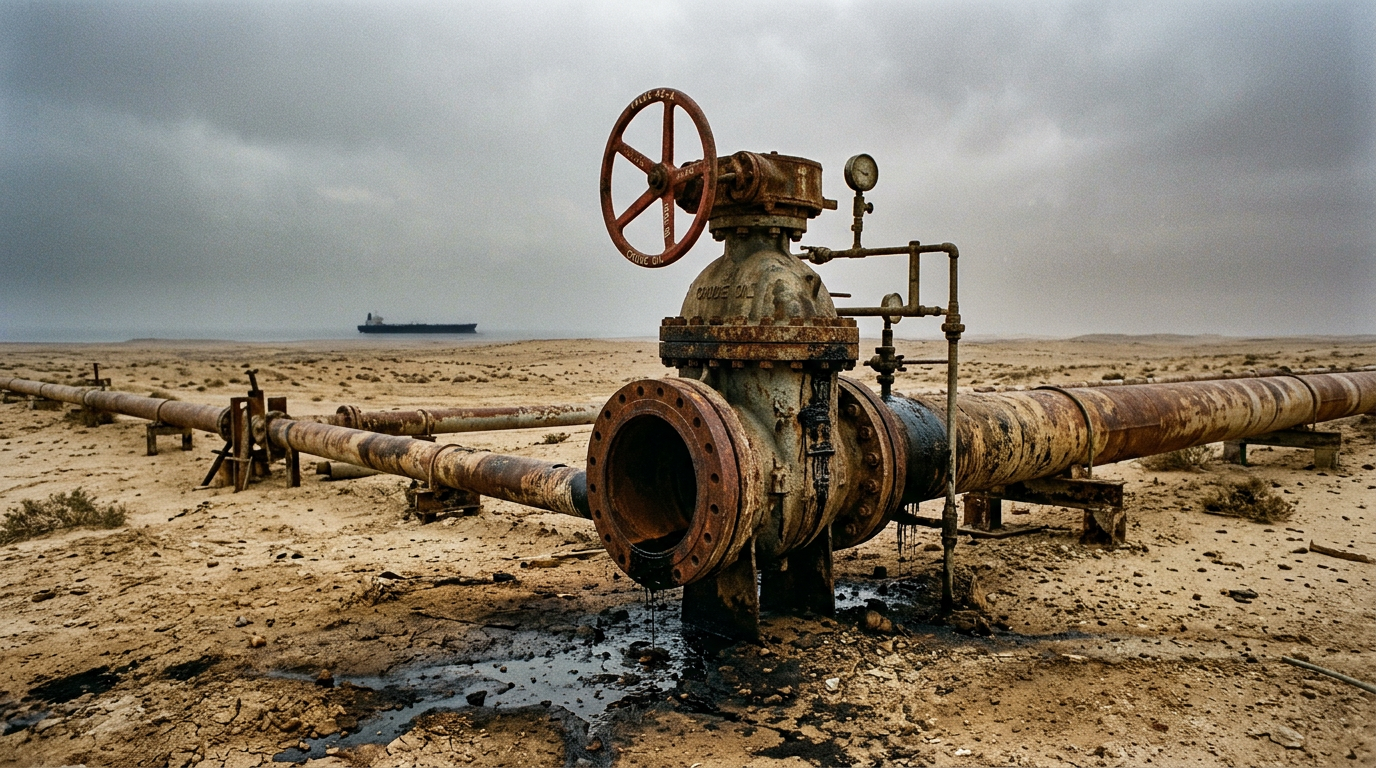
Crude oil tumbled to a critical technical floor on Thursday as traders priced in the reopening of the Strait of Hormuz, a stunning reversal for a market that spent more than 100 days bracing for a shortage.
West Texas Intermediate crude — tracked by the United States Oil Fund (USO) — fell 3.3% to around $73.5 a barrel. It slid to its 200-day moving average near $73.54 — the first test of that long-term trend line since the Iran war erupted.
WTI now sits just 10% above pre-war levels, erasing most of the conflict's risk premium.
The catalyst: a U.S.-Iran memorandum of understanding to lift the blockade and reopen the Strait of Hormuz, with a signing ceremony reportedly set for Friday in Geneva.
Wall Street's biggest commodity desks now agree the oil shock that began when the Strait of Hormuz closed is ending. They cannot agree on what comes after it.
The Biggest Shock On Record Now In Reverse
The scale of what is unwinding is hard to overstate.
BofA commodity analyst Francisco Blanch estimates production losses averaged between 11 million and 14 million barrels a day for months, with more than 1.3 billion barrels of supply lost over 100-plus days.
The bank wrote that the episode is the largest oil supply disruption on record, exceeding both the 1979 Iranian Revolution and the 1991 Gulf War.
Yet, Blanch warns that the enthusiasm over a full resumption of Middle East flows overlooks the reality that clearing mines and restoring normal volumes will take "months, not days."
BofA cut its 2026 Brent forecast to $82 from $93, implying a $70–$80 range for the second half, and sees Brent averaging $70 in 2027 as a roughly 1 million b/d surplus emerges.
Blanch also flagged another risk: a partial reopening could keep Brent near $103, a fragile ceasefire $120, and a return to war $150.
Goldman Sachs analyst Yulia Zhestkova Grigsby's team struck a similar tone on Thursday, indicating Persian Gulf exports could normalize to pre-war levels by end-July, with production recovering by October.
Reaching that mark requires a 12.7 million b/d jump in Hormuz flows, bringing them to around 70% of pre-war volumes. Goldman sees supply risks as "two-sided, but skewed to the downside on net."
The longer-term picture is decisively bearish. The IEA's first 2027 balance projects a global surplus of 5 million barrels per day on 7.9 million b/d of supply growth — well above Goldman's own 3.2 million b/d estimate.
For now, the 200-day moving average marks the battle line.
A decisive break below would confirm the market has shifted from shortage psychology to glut, leaving energy equities in the Energy Select Sector SPDR Fund (XLE) exposed to further downside.