SpaceX-Tesla merger speculation has moved from Wall Street chatter to a structured investment thesis. On May 20, 2026, SpaceX filed its S-1 publicly with the U.S. Securities and Exchange Commission and confirmed plans to list on the Nasdaq under the ticker SPCX. The IPO is reportedly targeting a June 12, 2026 debut. That filing gave the SpaceX-Tesla merger thesis a concrete starting line.
The Financial Architecture of a 2027 Merger
A large-scale 2027 merger would be significantly more difficult without a public valuation for SpaceX to establish transparent share-based exchange ratios. This is why Wall Street analysts, including Wedbush's Dan Ives, now place the probability of a combination as high as 80% to 90%. His reasoning is straightforward. SpaceX's IPO establishes the financial architecture for a deal. Once SpaceX is publicly valued, the exchange ratios and share-based mechanics of a combination become executable. “I think that's the step process they'll go through,” Ives said, “and then ultimately a merger with Tesla. I think 80%, 90% type of chance.” Ives also maintains an Outperform rating on Tesla (TSLA) with a $600 price target.
Not everyone shares that read. Ross Gerber, CEO of Gerber Kawasaki Wealth Management, has argued that the transaction would function less like a merger of equals and more like an acquisition of Tesla by SpaceX. Gerber has also raised conflict-of-interest concerns given Musk's simultaneous leadership of both companies. The contrast matters for investors because the structure of any deal would determine whether Tesla shareholders gain or dilute.
Terafab Is Already Building the Bridge
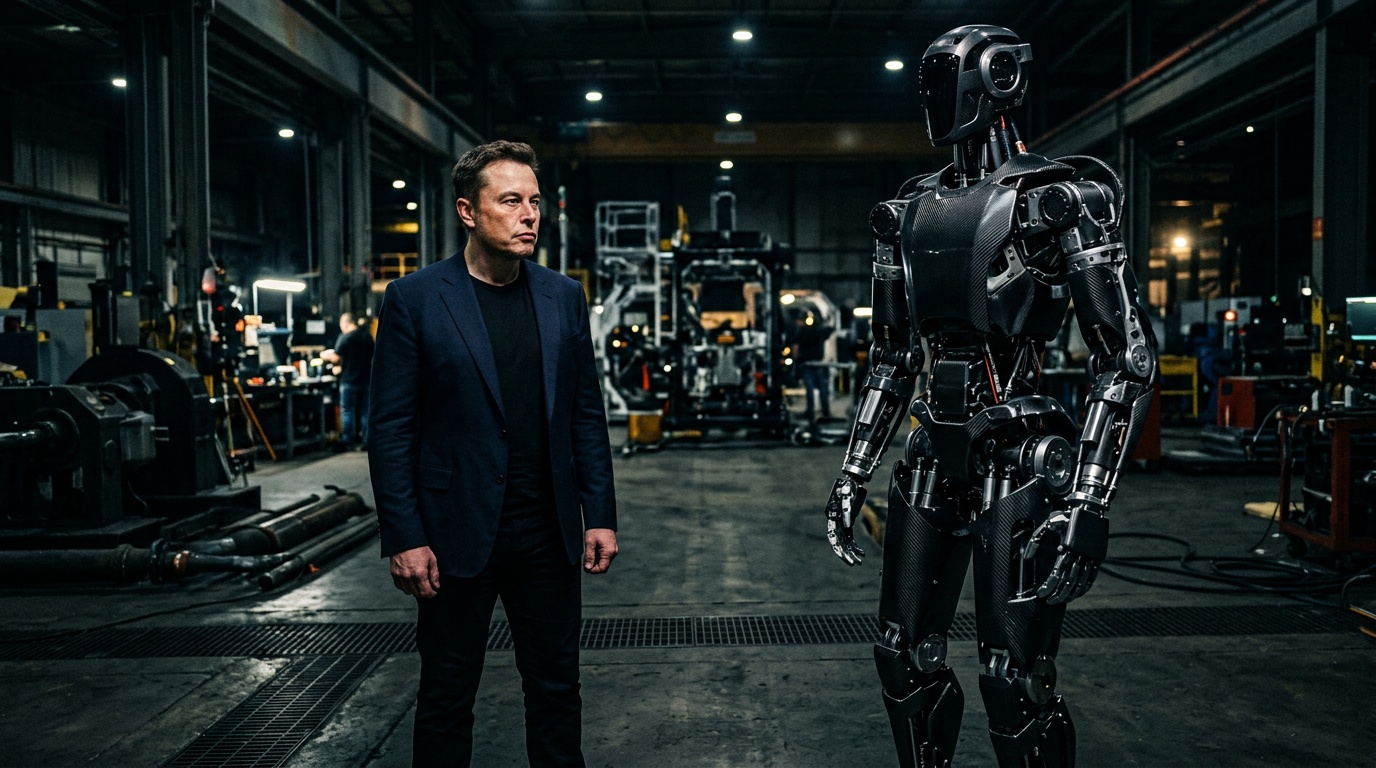
The most concrete sign of convergence is not a filing or a forecast, but a facility. In March 2026, Tesla, SpaceX, and xAI announced Terafab, a joint $25 billion chip manufacturing complex near Giga Texas in Austin. The project produces two chip families. The AI5 and AI6 processors will power Tesla's vehicles and Optimus humanoid robots. The D3 chips are space-hardened processors designed for SpaceX's orbital AI satellites. Intel joined as a manufacturing partner in April 2026. Eighty percent of Terafab's total compute output is directed toward space-based applications. Only 20% serves ground-level use cases. That ratio tells investors something important. SpaceX is not a passenger in this venture. It is the primary customer.
The ownership stakes reinforce this view. In March 2026, the FTC cleared Tesla to convert its previously announced $2 billion investment in xAI into a small stake in SpaceX. That conversion followed SpaceX's February 2026 acquisition of xAI. Tesla is now a SpaceX shareholder ahead of the IPO. That is not a coincidence. It is a financial thread that connects both balance sheets.
Two Tickers or One?
Here is the question retail investors need to answer before the SPCX IPO: will TSLA and SPCX eventually trade as a single stock? The answer depends on a sequence of events that has not yet played out. Specifically, both companies would need independent valuations, shareholder votes, and regulatory clearance from the FTC and DOJ. Those are not small hurdles. In fact, antitrust scrutiny of a deal this size, involving a sitting government official who leads both companies, would be unprecedented. In the near term, TSLA and SPCX will be separate, tradeable equities.
TSLA gives investors exposure to electric vehicles, robotics, and autonomous driving. SPCX would offer direct access to rockets, Starlink satellite revenue, and orbital AI infrastructure. The two are complementary, not redundant. That is precisely what makes a future single-ticker scenario plausible. However, plausible is not imminent. Until a merger is formally announced and approved, investors are looking at two distinct opportunities trading under two distinct symbols. The smarter near-term question is not which ticker survives. It is which one offers better entry value ahead of a potential combination.
What Happens to Musk's Other Companies?
Musk's corporate empire does not stop at Tesla and SpaceX. However, investors should be careful about assuming full consolidation. X, the social media platform formerly known as Twitter, is already folded into SpaceX through the xAI acquisition. Grok, xAI's chatbot, and Starlink all now sit inside the same entity that is filing to go public. Neuralink, Musk's brain-computer interface company, and The Boring Company, his tunnel-drilling venture, remain independent. As of May 2026, no credible reporting from Bloomberg, Reuters, or the Wall Street Journal indicates active merger discussions involving either of those two companies.
The Strategic Logic and the Risk
Musk has used this playbook before. Tesla acquired SolarCity in 2016 under comparable conflict-of-interest criticism. xAI absorbed X in 2025. The pattern is consolidation of overlapping infrastructure under a single capital structure. A combined SpaceX and Tesla entity would command autonomous vehicles, humanoid robotics, orbital compute, and satellite broadband. Ives has described the potential robotics contribution alone as adding $1 to $2 trillion in incremental market capitalization. Still, that outcome is a 2027 scenario at the earliest. For now, the SpaceX-Tesla merger thesis is the most compelling analytical frame for understanding both stocks together. The SPCX IPO may ultimately become the foundational step if Musk chooses to consolidate more of his industrial and AI infrastructure under one capital structure.