Advanced Micro Devices Inc (AMD) is making a huge bet on Taiwan. The company announced Thursday that it plans to invest more than $10 billion across the Taiwan ecosystem, doubling down on partnerships and advanced packaging for next-generation AI infrastructure. The stock dipped about 1% in premarket trading, but the move is less about the news and more about the market digesting the scale of the commitment.
AMD's investment is tied to the booming demand for rack-scale AI systems—those giant server setups that power everything from chatbots to data analytics. The company is focusing on chiplet architectures, high-bandwidth memory integration, 3D hybrid bonding, and system design. In plain English: AMD is building the Lego blocks for AI supercomputers, and it needs Taiwan's manufacturing muscle to do it.
The centerpiece of this push is a deeper partnership with Taiwan Semiconductor Manufacturing Company Ltd (TSM). AMD's next-generation EPYC server processor, code-named "Venice," has entered production using TSMC's advanced 2nm manufacturing technology. AMD says "Venice" is the first high-performance computing chip in the industry to hit production on that node. That's a big deal—2nm chips are faster and more power-efficient, which is exactly what AI workloads need.
But AMD isn't putting all its eggs in one basket. While "Venice" is being made in Taiwan, the company also plans to expand production to TSMC's Arizona facility in the future. That's part of a broader effort to build a geographically diversified manufacturing network. As AMD puts it, this broader production footprint will help support customers deploying AI infrastructure on a larger scale globally.
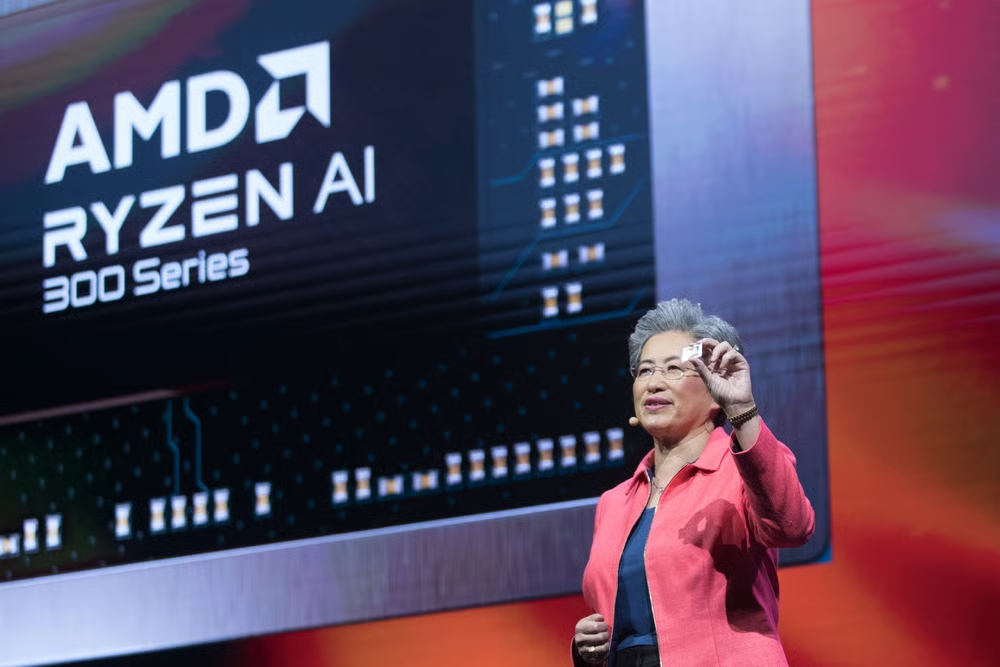
CEO Lisa Su said AMD is working closely with TSMC to bring new AI computing products to market faster as customers scale AI and cloud infrastructure. She's not wrong—demand for EPYC processors is rising across cloud, enterprise, high-performance computing, and AI deployments. And with the rise of more advanced AI agents, CPUs are becoming more important for managing data movement, networking, storage, and security in data centers. It's not just about GPUs anymore.
TSMC Chairman and CEO C.C. Wei chimed in, saying the collaboration combines TSMC's manufacturing technology with AMD's chip design expertise to support the next generation of AI and high-performance computing. AMD also plans to use TSMC's 2nm technology for its future "Verano" EPYC processors, which will focus on improving computing performance and energy efficiency for AI and cloud workloads.
The market's reaction was muted—AMD shares were down 0.96% at $443.30 in premarket trading, approaching its 52-week high of $469.21. U.S. index ETFs were modestly higher: the Nasdaq (QQQ) up 0.07% and the S&P 500 (SPY) up 0.11%. That suggests AMD's dip is more about investors weighing the size, timing, and execution risk of a big manufacturing-and-partnership push, rather than a broader market selloff.
Looking ahead, the next major catalyst for AMD is its earnings report, estimated for August 4, 2026. Analysts expect EPS of $1.55, up from $0.48 a year ago, and revenue of $11.28 billion, up from $7.68 billion. That's a massive jump. But the stock's P/E of 149.2x indicates a premium valuation relative to peers, so investors are already pricing in a lot of growth.
Analyst consensus is a Buy, with an average price target of $446.76. Recent moves include Evercore ISI Group raising its target to $579.00 on May 19, Citigroup raising to $460.00 on May 18, and Daiwa Capital upgrading to Outperform with a $500.00 target on May 13. So the Street is generally optimistic, even if the stock is a bit pricey.
Bottom line: AMD is making a huge bet on Taiwan and TSMC to dominate the AI chip market. The $10 billion investment and the 2nm "Venice" processor are big steps, but execution is key. If AMD can deliver on its roadmap, the payoff could be enormous. If not, well, that's why the stock is trading at 149x earnings.