The worst oil supply shock in history was supposed to break the American consumer.
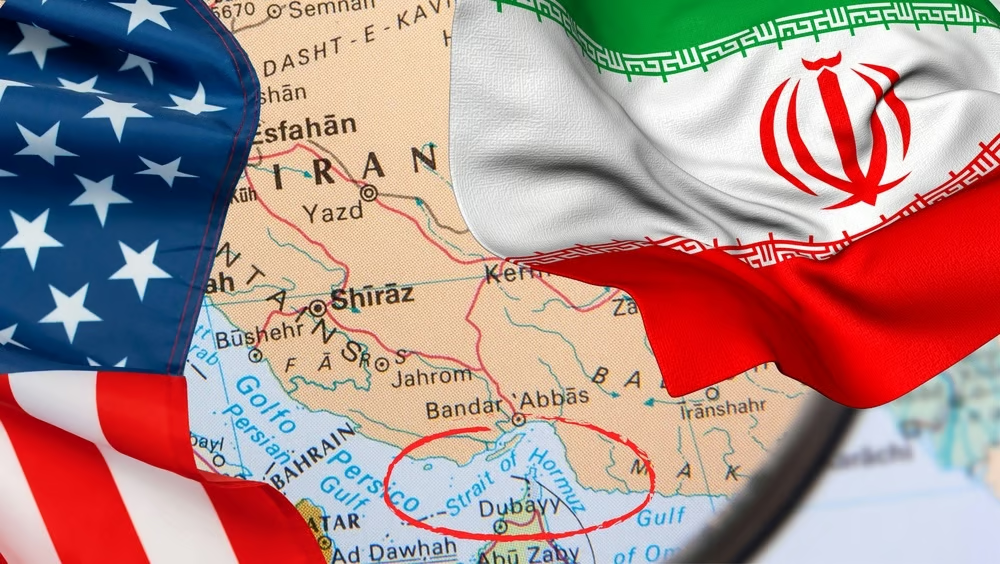
Gasoline at the pump hit $4.46 a gallon Monday, according to AAA, up from $2.96 the day before war broke out in late February. West Texas Intermediate crude is trading near $107. The Strait of Hormuz remains effectively shut, with daily transit calls collapsed from a pre-crisis norm above 130 to single digits.
Yet the S&P 500 – as tracked by the SPDR S&P 500 ETF Trust (SPY) – closed last week at a record, and the benchmark index just delivered its strongest monthly gain since November 2020.
Markets aren't ignoring the energy shock. They are pricing a cushion that arrived with extraordinary timing.
The $200 Billion Offset Hiding In Plain Sight
The cushion has a name: the One Big Beautiful Bill Act, the tax package signed by President Donald Trump on July 4, 2025.
The package made the 2017 Tax Cuts and Jobs Act rate structure permanent, layered on new deductions for tipped income, overtime, auto loan interest, a $6,000 senior bonus, and lifted the standard deduction to $31,500 for joint filers.
It was sold as a tax cut. It is now functioning as a stimulus check.
The mechanics matter. The OBBBA reduced individual income tax liability for 2025 by an estimated $129 billion, but the IRS never adjusted withholding tables after the law passed. Workers kept overpaying through the year. They are now collecting that overpayment all at once — in refund season, exactly as gasoline bills spiked.
The numbers are blunt. The IRS reported the average refund running 11% higher than 2025, with the most recent weekly figure at roughly $3,521 per household and total refunds tracking above $265 billion through mid-April. That is a meaningful jump in disposable cash, concentrated in late March and April — the same weeks pump prices crossed $4.
“We expect household stimulus to reach roughly $200 billion in 2026, helping to more than cushion an estimated $80-$100 billion increase in gasoline and other fuel spending derived from higher oil prices,” Angelo Kourkafas, senior global strategist at Edward Jones, wrote in a recent note.
The implication is uncomfortable for the bear case: even with WTI at $107 and gasoline at multi-year highs, the federal government is handing households more than twice the dollar amount of the energy hit.
Why This Doesn't Look Like 2008 or 2022
Past oil shocks broke the consumer because they arrived without an offset. In 2008, gasoline reached 5% of household income with no fiscal counter. In 2022, the post-Covid surge had stimulus already largely spent. This time is different because the timing is mechanical rather than discretionary — the OBBBA refund flow is hitting now, whether Washington wanted it to or not.
According to Bank of America data, the median lower-income household spent 4.2% of income on gasoline in March, up from 3.9% a year earlier and above 2019 levels. Around 10% of lower-income households are now spending over 10% of their income on gas. But, crucially, the share remains well below the 2022 peak.
David Michael Tinsley, a senior economist at the Bank of America Institute, identified the mechanism that keeps the squeeze contained. “The ‘good news’ is that elevated deposit buffers provide households – even lower-income ones – with a cushion,” he wrote. “Tax refund season is so far seeing a similar-sized increase in deposits to last year,” he added, and the bigger risk arises only if higher gasoline and oil prices leak into other necessities such as grocery and utility prices — though so far there is little evidence for this.
Households earning under $50,000 entered this shock with median checking and savings balances roughly 70% higher in nominal terms than in 2019, per Bank of America internal data, and over 40% higher in real terms. The buffer is real, even at the bottom of the income distribution.
Where The Equity Bid Is Coming From
Translating the consumer story into the equity move requires one more step. Earnings are doing the heavy lifting where the OBBBA leaves off.
The S&P 500 climbed roughly 10.5% in April, its strongest month since November 2020. The Invesco QQQ Trust (QQQ), tracking the Nasdaq-100, rose nearly 16% — its best month since 2002. The iShares Russell 2000 ETF (IWM) gained over 12% as small caps joined a rally that had previously been confined to mega-cap tech. The benchmark closed Friday at 7,230.12.
Two forces drove the rebound. First, AI capex is now expected to deliver roughly 40% of S&P 500 earnings-per-share growth this year, per Goldman Sachs. Hyperscaler spending is on track for $670–770 billion in 2026, untouched by the energy shock. Alphabet alone added approximately $1.2 trillion in market capitalization in April. Second, the energy sector — the obvious beneficiary of $107 crude — is not the marginal price-setter for the index. The Energy Select Sector SPDR Fund (XLE) actually lagged the broader market in April, an unusual outcome that reveals how thoroughly investors have decided this shock will not metastasize.
Earnings season is reinforcing the trade. After 64% of companies reporting first-quarter results, the earnings growth for the S&P 500 is tracking at 27.1% year-over-year, the strongest acceleration since the fourth quarter of 2021.
The Cracks That Could Still Open
Resilience is not invulnerability. The Bank of America data shows lower-income households are running closer to the edge than the headline numbers suggest. Their credit card utilization sits at the highest above 2019 levels of any income cohort. The share making only minimum payments has risen materially. After-tax wage growth for lower-income workers ran just 1.0% year-over-year in March, against 5.6% for the top tercile — a “K-shaped” split that the gasoline shock is widening.
Buy now, pay later usage is rising fastest among lower-income consumers, but BofA finds these users already carry significantly higher card utilization. The relief valve is partially closed.
The bigger risk Tinsley flagged sits one step ahead: pass-through. If sustained higher fuel costs leak into grocery and utility prices — categories that consume far more of household budgets than gasoline does — the cushion arithmetic breaks down quickly. Small businesses in agriculture, wholesaling and transportation are already absorbing higher fuel costs that could conceivably be passed through if oil stays elevated. So far, the data does not show this transmission. That is the line investors should watch next.