Here’s a thought to make your morning coffee a little less comforting: that smart doorbell you installed last month, or the connected fridge humming in your kitchen, might already be sending data back to China. At least, that’s the unsettling warning from a new security report published Wednesday.
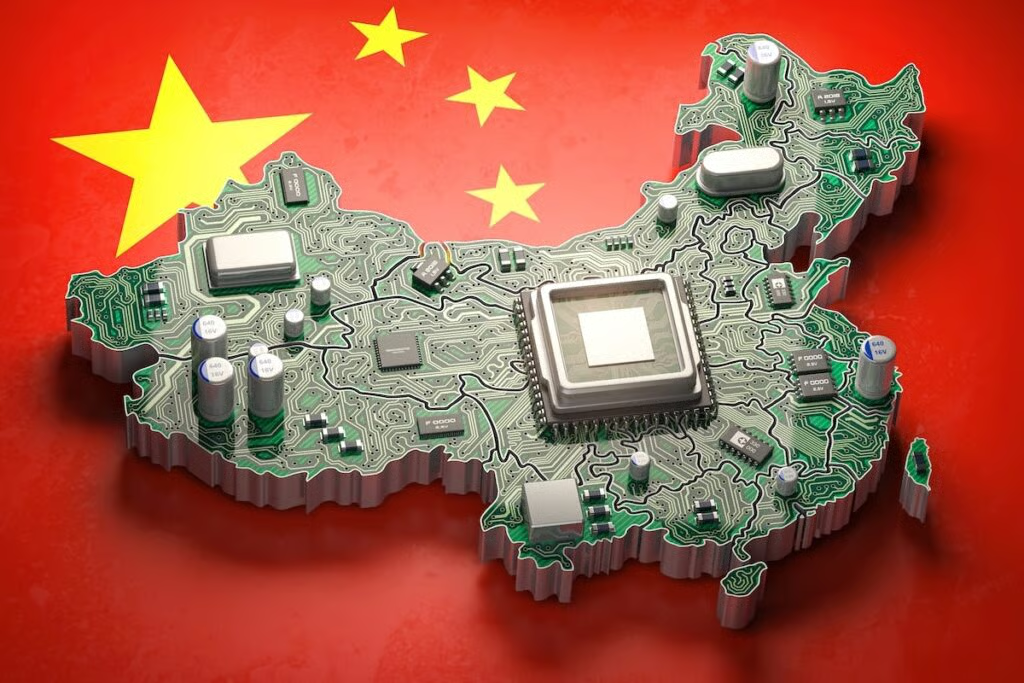
The report, from the Foundation for Defense of Democracies (FDD), zeroes in on Chinese-made cellular modules—those little chips that let your gadgets connect to mobile networks. They’re everywhere: in thermostats, appliances, industrial systems, you name it. And according to the findings, they could be opening a backdoor for data collection and remote access.
"When a doorbell, refrigerator, or thermostat in the United States is connected to the internet, it may already be sending data to the Chinese government," the report states. It’s the kind of line that makes you want to unplug everything and go back to a dumb house.
The Usual Suspects Control the Market
The problem isn’t just theoretical. Two Chinese firms, Quectel and Fibocom, control nearly half of the global cellular module market. These components receive software updates remotely, which means they could, in theory, be used to "shut down their host devices" or inject malicious code. Imagine your smart lock deciding not to open, or an industrial sensor feeding bad data—all because of a firmware update pushed from afar.
The concerns extend far beyond your living room. The report points to congressional investigations and Defense Department worries about cellular modules embedded in port equipment and logistics systems. In extreme scenarios, it warns, "Beijing could hold Washington hostage by threatening to cause massive economic disruption." That’s not just a glitchy doorbell; that’s a potential lever on critical infrastructure.
Jack Burnham, a senior research analyst cited in the report, explained one specific worry to The Hill: modules embedded in Wi-Fi systems "could have access to the information that's passing through that modem." He added that Chinese authorities could potentially access such data. So, it’s not just about the device itself spying; it’s about the module acting as a tap on your entire network.
States Are Already Taking Action
This isn’t the first time alarms have sounded. Earlier, Texas Governor Greg Abbott banned Chinese-linked technology on state devices, citing security risks and concerns over foreign access to sensitive data. The ban included firms like Alibaba Group Holdings (BABA), Shein, Temu, and TP-Link, covering sectors from AI to telecom.
Meanwhile, China is pushing ahead with ambitious tech plans of its own, including developing space-based AI computing systems using solar-powered satellites. The goal is a large-scale orbital data infrastructure, with eyes on asteroid mining and in-orbit resource processing. It’s a reminder that the competition for technological dominance—and the security risks that come with it—is playing out on multiple fronts, from your smart home to outer space.